
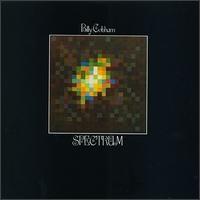
Spectrum
By Billy Cobham
The Story
Billy Cobham made Spectrum at a pivotal moment in 1973, just as his explosive work with the Mahavishnu Orchestra had established him as one of the defining drummers of jazz-rock fusion. Rather than simply extending that band’s intensity under his own name, he used his debut solo album to reshape the sound around groove, clarity, and interaction. Recorded at Electric Lady Studios in New York in May 1973 and released later that year on Atlantic, the album brought together an exceptional cast: Jan Hammer on keyboards, Tommy Bolin on guitar, Lee Sklar on bass for several of the key tracks, and, on other pieces, players including Joe Farrell, Ron Carter, Jimmy Owens, Ray Barretto, and John Tropea. Cobham also produced the album himself, which gave the record a strong sense of personal direction from the start.
One of the most remarkable things about Spectrum is how quickly it was made. Accounts from musicians involved in the sessions describe a live, fast-moving recording process with little or no rehearsal, very few takes, and almost no polishing after the fact. That urgency is part of the album’s identity. Instead of sounding unfinished, it sounds fearless. The performances have the kind of edge that comes from musicians listening and reacting in real time, and that quality helped give the album its lasting reputation. Jan Hammer later described the music as more stripped down than the excesses of Mahavishnu, and that difference matters: Spectrum is still virtuosic, but it is built on funk pulse, open space, and memorable hooks as much as speed and power.
The opening stretch of the record makes that vision clear immediately. “Quadrant 4” is one of the great statements of 1970s fusion, with Cobham driving the music at full force while Hammer and Bolin blur the line between synthesizer and guitar. Across the album, Cobham’s writing balances aggression with structure. Pieces such as “Searching for the Right Door” and “Spectrum,” as well as “Anxiety” and “Taurian Matador,” move between composed passages and combustible improvisation, showing how much he valued momentum and texture, not just technical display. The sessions also produced small but telling moments that stayed on the final record, including Tommy Bolin breaking a high string during “Taurian Matador” and continuing anyway, a detail often cited as proof of how unedited and alive the performances were.
“Stratus” became the album’s most famous piece and, over time, one of the most enduring tracks in fusion. Its deep, repeating bass figure and spacious, hard-driving groove helped define the record’s crossover appeal. The track later reached a wider audience when parts of it were sampled in Massive Attack’s “Safe from Harm,” introducing Spectrum to listeners far removed from the original jazz-rock scene. Yet the piece has lasted for more than its afterlife in sampling culture. It captures the album’s central achievement: highly advanced musicians playing with discipline, funk weight, and a sense of forward motion that makes the complexity feel natural.
The album also shows Cobham’s range as a bandleader. “To the Women in My Life” is a brief solo piano interlude by Hammer, notable because Cobham does not play on it at all, and it leads into “Le Lis,” which opens the palette of the record with a lighter, more melodic feel. That choice says a lot about Spectrum. Even though Cobham was already famous for thunderous drumming, his first solo statement was not designed as a nonstop drum showcase. It was arranged as a full album experience, with contrast, pacing, and room for other musicians to shape the mood.
Spectrum was also a commercial breakthrough. It topped Billboard’s jazz chart and crossed over to the Billboard 200, a sign that Cobham had made a fusion record with unusual reach. Part of that reach came from the personnel itself: Hammer brought electronic fire and melodic imagination, while Bolin and Sklar injected a rock-informed looseness that kept the music from becoming overly academic. That blend is a major reason the album has remained so influential. It is a landmark fusion record, but it also feels bigger than the genre label. It is a meeting point of jazz improvisation, rock energy, funk groove, and studio-era experimentation, captured with unusual freshness.
More than fifty years later, Spectrum still stands as the definitive opening chapter of Billy Cobham’s solo career. It preserved the intensity of the era’s fusion boom while proving that power alone was not enough; the grooves had to breathe, the players had to interact, and the record had to move like a living thing. That balance is what turned Spectrum from a strong debut into a lasting benchmark.