
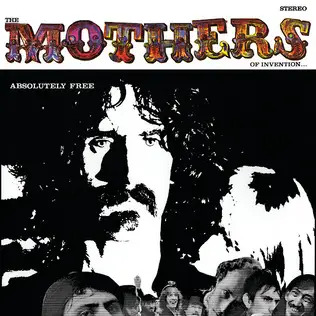
Absolutely Free
By Frank Zappa
The Story
Released on May 26, 1967, Absolutely Free was the second album by Frank Zappa and the Mothers of Invention and the first to show even more clearly how Zappa thought in terms of album structure rather than isolated songs. Issued by Verve and produced by Tom Wilson, it followed Freak Out! but moved further toward tightly organized suites, abrupt transitions, and a deliberately theatrical flow. Instead of presenting a conventional set of tracks, Zappa arranged the record as two side-long programs, linking songs and instrumental passages into a broader satirical design.
The album opens with Plastic People, a sharp attack on conformity that immediately reconnects with one of Zappa's central themes: the pressure to fit into ready-made social roles. From there, the record slips into The Duke of Prunes and its connected passages, where jazz-tinged instrumentals, orchestral gestures, and sudden rhythmic changes show how comfortable Zappa already was moving between rock and more formally arranged music. Call Any Vegetable brings humor and absurdity back to the foreground, yet even that comic surface fits the larger method. On Absolutely Free, parody is rarely just a joke; it is part of a wider critique of American habits, language, and performance.
The second side broadens that critique. Big Leg Emma and Why Don'tcha Do Me Right? play with rhythm and blues forms, while America Drinks turns a barroom setting into a kind of musical caricature, using atmosphere, spoken fragments, and stylized behavior as part of the composition. These scenes build toward Brown Shoes Don't Make It, the album's best-known and most ambitious piece. The song moves rapidly through multiple sections, voices, and styles, shifting between suburban satire, political mockery, and darker social commentary. Its restless structure captures the album's larger identity: fragmented on the surface, but carefully assembled underneath.
Absolutely Free confirmed that Zappa was not treating the rock LP as a container for singles and filler. He was using it as a compositional form where doo-wop references, experimental writing, satire, and social observation could all coexist. If Freak Out! announced the method, Absolutely Free refined it. The result is an album that deepened Zappa's reputation as a musical satirist and formal experimenter, and one that helped define the Mothers of Invention as far more than a typical 1960s rock band.