
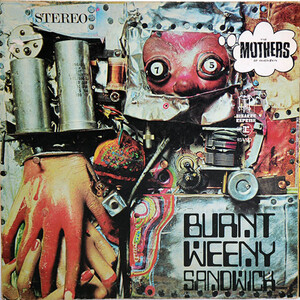
Burnt Weeny Sandwich
By Frank Zappa
The Story
Released in February 1970, Burnt Weeny Sandwich was compiled by Frank Zappa from recordings made by the Mothers of Invention in 1967 and 1968, following the breakup of the original lineup. Rather than presenting new sessions, the album assembled previously recorded material into a carefully structured sequence that reflected Zappa’s interest in editing and conceptual continuity. The result blends short instrumental pieces, extended composition, and doo-wop-inspired vocal tracks, framed as a unified listening experience.
The album opens with WPLJ, a doo-wop cover that contrasts with the largely instrumental focus that follows. Zappa uses this stylistic shift intentionally, placing familiar vocal material at the edges of the album while the center emphasizes composed instrumentals. Igor’s Boogie, Phase One leads into Overture to a Holiday in Berlin and related passages, which introduce recurring musical themes. These short segments function as connective material, creating a suite-like structure that develops across the album’s first half.
The central portion of the album moves into more extended instrumental writing. Theme from Burnt Weeny Sandwich and Holiday in Berlin, Full-Blown expand earlier motifs, while Aybe Sea provides a brief transitional piece built around a concise melodic idea. These compositions highlight Zappa’s interest in blending rock instrumentation with chamber-style arrangement and jazz-influenced phrasing. The sequencing allows small fragments to reappear in different forms, reinforcing the album’s cyclical design.
Little House I Used to Live In occupies much of the second half and serves as the album’s longest and most elaborate composition. The piece moves through multiple sections, including composed passages and improvisational segments, and incorporates shifts in tempo and instrumentation. Its structure reflects Zappa’s method of assembling large-scale works from smaller ideas recorded across different sessions. The track also emphasizes ensemble interplay, with musicians moving between tightly arranged sections and freer performance.
The album closes with Valarie, another doo-wop-influenced vocal track, mirroring the opening and framing the instrumental core. This placement creates a symmetrical structure, with vocal harmony pieces surrounding a center built from instrumental composition and thematic development. By sequencing older recordings into a cohesive form, Zappa shaped Burnt Weeny Sandwich into a unified album rather than a simple collection of leftover material.
Burnt Weeny Sandwich highlights Zappa’s compositional approach at the end of the original Mothers of Invention era. It blends archival recordings, recurring motifs, and stylistic contrast into a single continuous experience. The album emphasizes instrumental writing, editing, and conceptual continuity, demonstrating how Zappa could transform disparate sessions into a structured and coherent work.