
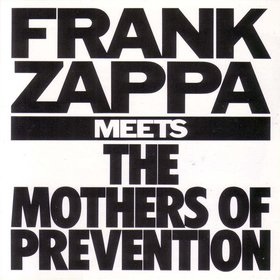
Frank Zappa Meets the Mothers of Prevention
By Frank Zappa
The Story
Released in 1985, Frank Zappa Meets the Mothers of Prevention was shaped by the mid-1980s political debate surrounding censorship, media control, and attempts to regulate popular music. The album’s title referenced the Parents Music Resource Center, whose campaign for warning labels and content restrictions drew strong opposition from Zappa. Rather than responding only through interviews and public testimony, he constructed an album that blended satire, instrumental composition, and spoken-word collage into a direct artistic reaction to those cultural pressures.
The record opens with I Don't Even Care, a compact rock-based track that sets a sarcastic tone. One Man, One Vote follows with layered vocals and rhythmic shifts, reflecting Zappa’s interest in political irony and group chant structures. Little Beige Sambo and Aerobics in Bondage continue the satirical approach, combining humor with tightly arranged backing. These shorter tracks establish the album’s collage-like pacing, where brief songs function as fragments within a broader commentary.
We're Turning Again expands the scope, revisiting themes related to rock culture and generational cycles. The track combines structured arrangement with shifting vocal sections, illustrating Zappa’s continued interest in assembling complex pieces from smaller components. Alien Orifice moves into instrumental territory, highlighting layered keyboards and extended guitar phrasing. This transition emphasizes the balance between satire and musicianship that defines the album.
Yo Cats continues the instrumental focus with jazz-influenced interplay, while What's New in Baltimore? develops slowly around guitar-driven melodic lines. These tracks showcase Zappa’s mid-1980s ensemble sound, combining tight rhythm sections with overdubbed textures. Positioned between more direct satirical songs, they provide contrast and reinforce the album’s alternating structure.
Porn Wars serves as the conceptual centerpiece. Constructed as a spoken-word collage, the piece incorporates edited voices and political rhetoric, transforming public debate into compositional material. Instead of traditional melody, the track unfolds through assembled speech fragments and atmospheric backing, reflecting Zappa’s long-standing interest in musique concrète and audio montage. The album closes with H.R. 2911, a short instrumental that functions as a coda after the extended collage.
Frank Zappa Meets the Mothers of Prevention combines political commentary, studio editing, and instrumental composition into a unified response to censorship. By juxtaposing satire, guitar-centered pieces, and spoken collage, the album captures a moment when Zappa’s music and public activism overlapped directly. The result is a concise but pointed work that uses composition and sequencing to comment on artistic freedom and cultural control.