

The Story
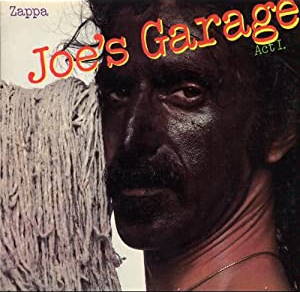
Released in 1979, Joe's Garage was originally issued in two parts: Joe's Garage Act I in September, followed by Joe's Garage Acts II & III in November. Framed as a rock opera narrated by the Central Scrutinizer, the album follows Joe from teenage garage-band innocence into a dystopian world where music is treated as a social threat. That structure is central to the record's identity, because each section moves Joe further from ordinary youth culture toward surveillance, manipulation, prison, and isolation.
Act I opens with The Central Scrutinizer, which establishes the album's authoritarian voice before Joe's Garage introduces Joe as a kid playing music for its own sake. Catholic Girls and Crew Slut widen the story into satire of teenage desire, religion, and the groupie economy around local rock scenes. Wet T-Shirt Nite and Toad-O Line push the narrative into a more exaggerated and theatrical register, showing how gossip, humiliation, and spectacle accelerate Joe's emotional collapse. Why Does It Hurt When I Pee? and Lucille Has Messed My Mind Up complete that first descent, turning sexual misadventure into one more part of the album's cautionary world.
The second and third acts broaden the target from personal embarrassment to systems of control. A Token of My Extreme satirizes fake spiritual authority and pseudo-religious self-improvement through the Church of Appliantology, while Stick It Out and Sy Borg push the story into grotesque absurdity. Dong Work for Yuda and Keep It Greasy place Joe inside institutions that treat people as objects to be processed and degraded. Zappa uses that escalation to connect the album's sexual comedy to larger themes of conformity, power, and social engineering.
Outside Now marks the emotional turning point. Joe has been released into a society where music itself has been outlawed, so he can only imagine guitar solos in his head. He Used to Cut the Grass extends that feeling of dislocation, while Packard Goose turns outward into a critique of censorship, commercial culture, and the corruption of art. Watermelon in Easter Hay then strips the story down to pure feeling, with Joe's inner musical life surviving even after public expression has been forbidden.
A Little Green Rosetta closes the work by breaking the tension with a communal, almost absurdly celebratory finale. That ending matters because Joe's Garage is not only a satire about repression. It is also an argument that music persists in memory, imagination, and collective performance even when institutions try to regulate it out of existence. The original release remains one of Zappa's most coherent large-scale statements, balancing narrative, social critique, and some of the most emotionally resonant music of his career.