
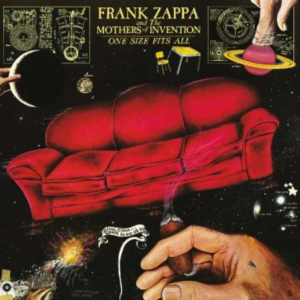
One Size Fits All
By Frank Zappa
The Story
Released in June 1975, One Size Fits All brought together studio recordings and live performances by Frank Zappa’s mid-1970s band, often regarded as one of his most versatile ensembles. The album blends progressive rock structures, jazz-influenced improvisation, and satirical songwriting, combining complex instrumental passages with more concise vocal tracks. Much of the material was recorded in 1974, with additional overdubs and edits shaping the final versions.
The album opens with Inca Roads, one of Zappa’s most elaborate compositions. The track moves through multiple sections, shifting between tightly arranged passages, vocal harmonies, and extended instrumental breaks. The piece includes a guitar solo taken from a live performance, integrated into the studio structure, illustrating Zappa’s practice of combining live improvisation with composed material. This method allows the track to balance precision with spontaneity.
Can't Afford No Shoes and Sofa No. 1 provide contrast, alternating between satirical lyrics and instrumental themes. These shorter pieces help pace the album while maintaining its emphasis on arrangement. Po-Jama People returns to a groove-oriented structure with layered instrumentation and rhythmic interplay, followed by Florentine Pogen, which features rapid changes in tempo and complex ensemble writing.
Evelyn, a Modified Dog introduces a brief, humorous interlude before San Ber'dino shifts into a more accessible rock format built around steady rhythm and melodic vocal lines. Andy continues the album’s mixture of satire and musicianship, incorporating shifting sections and instrumental breaks within a compact structure. The closing track, Sofa No. 2, revisits earlier thematic material, bringing the album to a cohesive conclusion.
One Size Fits All highlights Zappa’s ability to combine technical composition with accessible songwriting. The album alternates between complex arrangements and more direct tracks, while recurring motifs and careful sequencing create unity. By integrating live solos, layered overdubs, and ensemble precision, the record reflects Zappa’s mature mid-1970s style, balancing experimentation with clarity.
The result is a concise but musically dense album that showcases both the technical skill of Zappa’s band and his compositional approach. One Size Fits All stands as a key example of his mid-1970s period, blending progressive rock structure, jazz-influenced improvisation, and satirical lyric writing into a cohesive work.