
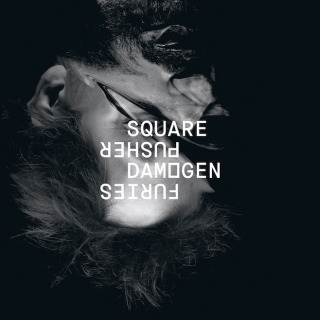
Damogen Furies
By Squarepusher
The Story
Damogen Furies captures Squarepusher at a point where Tom Jenkinson pushed his electronic music back toward speed, pressure, and technical extremity while also rethinking the tools used to create it. Released in 2015 by Warp, the album followed Ufabulum and arrived after years in which Squarepusher had moved between live bass virtuosity, digital abstraction, jazz-fusion influence, and high-density electronic composition. Rather than presenting a simple nostalgic return to the drill and bass sound that first made him famous, Damogen Furies feels like an updated collision between his older hyperactive programming style and a newer, harsher digital language.
One of the most important contexts for the album is Jenkinson's use of his own software and performance systems. Around this period, Squarepusher was especially interested in the relationship between composition, live execution, and technology, and Damogen Furies reflects that obsession. The music often feels unstable in a deliberate way, as if structures are being pushed close to collapse while still remaining under strict control. This gives the album a different character from smoother electronic records: it is built around friction, overload, and the sensation of real-time manipulation.
The opening track 'Stor Eiglass' immediately establishes the album's brightness and aggression. Its melodic fragments, distorted textures, and rapid rhythmic edits create a sense of movement that is both playful and forceful. From there, the album becomes increasingly jagged. 'Baltang Ort' and 'Rayc Fire 2' lean into the fractured rhythmic language long associated with Squarepusher, but the sound design is sharper and more metallic than much of his earlier work. The album does not simply revisit the late-1990s template of breakbeats and bass runs; it subjects that vocabulary to a more modern, abrasive digital treatment.
Several tracks emphasize the physical force of the record. 'Kontenjaz' and 'Exjag Nives' are dense, unstable pieces where rhythm and melody seem to compete for space. 'Baltang Arg' and 'Kwang Bass' push the low-end weight and rhythmic complexity further, showing how Squarepusher could make electronic composition feel almost like an extreme instrumental performance. Even when the music is generated through digital systems, the sense of attack and human decision-making remains central.
The closing track 'D Frozent Aac' brings the album to an intense conclusion, reinforcing the record's focus on energy, distortion, and precision. Across the album, Squarepusher avoids easy hooks or conventional dance-floor structures, choosing instead to explore how far rhythm, bass, and digital texture can be stretched while still remaining musical.
Damogen Furies stands as a strong example of Squarepusher's later-period identity. It connects to the speed and complexity of his earlier work, but it also reflects a mature artist still trying to rebuild his own process rather than repeat old successes. For listeners drawn to the most intense side of his catalog, the album offers a concentrated version of his obsessions: extreme rhythm, custom systems, distorted electronic color, and the constant tension between control and chaos.