
Albert King
Biography
Albert King was one of the great architects of electric blues guitar, a player whose sound could be recognized in a single bent note. He did not play with the quick, conversational elegance of B.B. King or the sharp Texas fire of Freddie King. Albert King sounded heavier, colder, and more massive. His phrases were often short, but they carried enormous weight. He could hold a note, bend it upward, shake it with a slow vibrato, and make silence around it feel as important as the sound itself. For later blues and rock guitarists, that approach became a language.
King's early life has always carried a degree of uncertainty, partly because he shaped his own story in interviews. He was born Albert Nelson in Mississippi in 1923, and he often associated himself with Indianola and with the King name already made famous by B.B. King. Surviving documents and later research have complicated parts of those claims, but the larger outline is clear: he came out of the rural South, grew up in a world of farms, church singing, manual labor, and blues culture, and built his identity through music rather than through formal training. He was one of many musicians whose early biography was not preserved neatly by official institutions, but whose sound later became impossible to ignore.
As a child, King sang gospel and absorbed the music around him. He was left-handed, and that fact became central to his guitar style. Instead of learning in a conventional way, he taught himself on instruments that did not fit him naturally. He became famous for playing a right-handed guitar upside down, often associated with his Gibson Flying V, with the strings sitting in an unusual order compared with a standard left-handed setup. That setup affected the way he bent notes. His bends could sound huge, vocal, and almost physically strained, as if he were pulling the guitar against its will. What might have been a technical disadvantage became one of the most distinctive sounds in blues.
Before he became a major recording artist, King worked ordinary jobs and moved through several cities and scenes. He spent time in Arkansas, later moved north, and played in and around Gary, Indiana, before establishing himself more firmly in St. Louis. These years were not glamorous. Like many blues musicians of his generation, he worked outside music while trying to build a career in clubs and small venues. He drove trucks, worked hard labor, and played where he could. That life fed the authority of his music. King never sounded like a performer inventing hardship for effect. His voice had the grain of someone who had lived inside the workaday world his songs described.
His first recording, 'Bad Luck Blues', appeared in the early 1950s on the Parrot label, but it did not make him a star. King developed slowly compared with some of his peers. He was not a teenage prodigy suddenly discovered by the industry, and he did not have an immediate national breakthrough. His big frame, deep voice, and commanding guitar tone made him a strong live presence, but records came unevenly. The blues business was difficult, especially for artists moving between regional labels, clubs, and changing audience tastes. King had to wait a long time before the right setting finally matched his gifts.
That first real national sign came with 'Don't Throw Your Love on Me So Strong', released in 1961. The song became an R&B chart success and showed the emotional force of King's singing and guitar. His vocal style was sometimes overshadowed by his guitar reputation, but it deserves attention. He did not sing with ornamental sweetness. His voice was smoky, direct, and slightly weary, capable of sounding both commanding and wounded. In his best performances, the guitar answered the voice, not as decoration but as a second singer.
The major transformation of King's career came when he connected with Stax Records in Memphis in the mid-1960s. Stax was not a traditional blues label. It was a soul powerhouse, home to a deep, rhythm-driven sound built by musicians such as Booker T. Jones, Steve Cropper, Donald 'Duck' Dunn, Al Jackson Jr., and the Memphis Horns. For King, this was the perfect environment. The Stax musicians gave him tight grooves, clean arrangements, and a modern rhythmic foundation without burying his guitar. His playing became even more dramatic because the band around him was so disciplined.
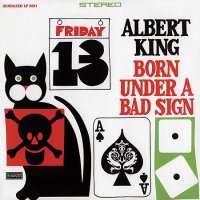
The Stax sessions that produced 'Born Under a Bad Sign' were not originally conceived as a conventional album in the modern rock sense. Much of the record was assembled from singles recorded across several sessions between 1966 and 1967. Yet the album, released in 1967, became King's defining work and one of the essential electric blues records. It joined blues feeling with soul-band precision. The songs were concise, the rhythm section was sharp, the horns added punch and color, and King's guitar cut through everything with a tone that seemed both raw and perfectly placed.
The title track, 'Born Under a Bad Sign', written by Booker T. Jones and William Bell, became King's signature song. Its famous opening line about bad luck and trouble matched King's public sound so naturally that it seemed written for his voice and guitar. The track was built around a strong, unusual groove rather than a standard blues shuffle, and King made every guitar phrase feel monumental. He did not need to fill every bar. He understood how to enter, bend, leave space, and return with force. That restraint became a lesson for generations of guitarists.
The album also included 'Crosscut Saw', 'Laundromat Blues', 'Oh, Pretty Woman', 'The Hunter', and 'Personal Manager', each showing a different side of King's power. 'Crosscut Saw' gave him a churning Latin-tinged groove to cut across. 'Personal Manager' stretched into one of the album's great guitar moments, with King's soloing unfolding slowly and intensely. 'Oh, Pretty Woman' later became especially important to rock and blues-rock guitarists, who absorbed King's phrasing closely. The record did not turn King into a pop superstar, but among musicians it became a sourcebook.
What made King's guitar playing so influential was not speed. In fact, his greatness often came from refusing speed. He used space like a weapon. A phrase might contain only a few notes, but each one was bent, placed, and attacked with authority. His vibrato was wide and vocal. His tone was sharp but thick, often piercing without becoming thin. He favored minor-key tension and dramatic bends that could make a blues progression feel almost cinematic. Guitarists who studied him learned that intensity did not require constant motion. One note, if bent the right way, could say more than a flurry of runs.
King's left-handed technique also gave his phrasing a physical identity. Because of the way his strings were arranged, his bends often moved differently from those of standard right-handed players. He pulled and pushed phrases in ways that made familiar blues patterns feel strange and personal. It was not just a quirk of presentation. It shaped the music. Many guitarists copied his licks, but fewer could reproduce the weight of his touch. Albert King's playing came from the hands as much as from the notes.
After 'Born Under a Bad Sign', King became increasingly important to the rock audience. Late 1960s blues-rock musicians were hungry for electric blues models, and King gave them something powerful to study. Cream covered 'Born Under a Bad Sign'. Jimi Hendrix, Mike Bloomfield, Eric Clapton, and later Stevie Ray Vaughan all drew from King's vocabulary. He became one of the rare blues artists who could play to traditional blues listeners and to young rock fans without changing his essence. His appearances at venues such as the Fillmore helped place him in front of the counterculture audience, where his long bends and heavy tone translated naturally to amplified rock rooms.
The live album 'Live Wire/Blues Power', released in 1968, captured this phase beautifully. Recorded at the Fillmore Auditorium in San Francisco, it showed King stretching songs in front of a rock audience while retaining the authority of a blues bandleader. The title phrase 'blues power' suited him. He did not present the blues as fragile museum music. He presented it as a living force that could fill a hall with the same physical authority as rock. The album is important because it reveals how King's style opened up live: the silences became longer, the bends became more dramatic, and the audience responded to each phrase as if it were a vocal statement.
King's Stax period continued with albums such as 'Years Gone By' and 'King, Does the King's Things', the latter an Elvis Presley tribute that showed Stax's willingness to place him in unusual contexts. Not every experiment was equally central to his legacy, but the period kept him active and visible. The essential point is that Stax modernized Albert King without smoothing him out. The label's musicians gave him soul structure, but the personality remained his own: stern, smoky, economical, and unmistakable.
In the 1970s, King continued to adapt as blues, soul, funk, and rock moved around each other. 'I'll Play the Blues for You', released in 1972, became another major album in his catalog. The title track is one of his great performances, built on a relaxed but deeply emotional groove. By this point, King had become not only a guitarist's guitarist but a singer of mature blues authority. The record's atmosphere was smoother than the sharpest Stax singles of the 1960s, but King still sounded like a man who could command a room with a single phrase.
'I Wanna Get Funky', released in 1974, showed how naturally King could sit inside funk-influenced arrangements. He was never a funk artist in the full sense, but his sense of space and rhythmic placement made him compatible with funk's emphasis on groove. His guitar did not need to compete with busy rhythm parts. It could enter like a blade, then disappear. This period is sometimes treated as secondary to 'Born Under a Bad Sign', but it matters because it shows King refusing to become a nostalgia act. He remained a bluesman, but he was willing to let the surrounding rhythms change.
King's stage presence was a major part of his identity. He was a large man, often physically imposing, and he carried himself with a mixture of command and dry humor. He could be stern with band members and audiences, and stories about his toughness became part of blues lore. Yet the music itself was not simply hard. It could be tender, wounded, seductive, or mournful. The contrast between his imposing presence and the emotional vulnerability of his guitar gave his performances their drama. He sounded like a giant capable of whispering.
Unlike some blues artists whose careers were built around elaborate storytelling, King often worked through mood, groove, and short lyrical statements. His songs usually did not need many verses to establish their world. Bad luck, troubled love, work, desire, loneliness, and masculine pride moved through his catalog in direct language. The complexity came from delivery. A simple phrase could become heavy because of how he sang it, where the guitar answered, and how long he let the next silence hang.
King's relationship to the other famous Kings of the blues is important but should not blur their differences. B.B. King was the most elegant and widely beloved of the three, with a singing guitar style full of lyrical clarity. Freddie King brought a Texas attack, a sharper rhythmic drive, and an important bridge to rock and instrumental blues. Albert King was the most severe and physically imposing. His guitar sounded like iron bending. Together, the three Kings shaped modern electric blues, but Albert's influence on rock guitar may be the most directly audible in the hands of players who chased big bends and dramatic sustain.
Stevie Ray Vaughan's admiration for King became one of the clearest examples of that influence. Vaughan absorbed King's phrasing deeply, especially the huge bends, the minor-key tension, and the ability to build a solo through space rather than constant speed. Their televised session in the 1980s, later released as 'In Session', is a remarkable meeting between master and disciple. King could be teasing, demanding, and amused, while Vaughan played with visible respect. The performance shows blues tradition not as a museum handoff but as a living conversation between generations.
King's later career included recordings for labels such as Tomato and Fantasy, continued touring, and steady recognition from blues audiences and younger musicians. He never became as universally famous as B.B. King, and he did not have the crossover celebrity of some rock artists he influenced. But among guitarists, his status was immense. To understand blues-rock lead guitar without Albert King is almost impossible. His fingerprints are on Clapton, Hendrix, Bloomfield, Vaughan, Gary Moore, Joe Walsh, Mick Taylor, Robert Cray, and countless others who learned that a note could be bent until it sounded like speech.
Part of King's lasting power is that his music did not depend on fashion. The Stax records have a 1960s soul setting, but the guitar remains outside time. The tone is too personal to date neatly. His phrasing is not busy enough to become old-fashioned in the way some virtuosic styles do. It still sounds direct. A listener can come to Albert King through blues history, through classic rock, through guitar study, or through soul music, and the central impact remains the same: the feeling of a note being pulled from the body with great force and great control.
King died in Memphis on December 21, 1992, after suffering a heart attack. He had performed close to the end of his life, and his death closed one of the major chapters of postwar electric blues. By then, his influence was already secure. He had been inducted into the Blues Hall of Fame, and after his death his reputation continued to grow. Later honors, reissues, and the continued study of his recordings confirmed what musicians had known for decades: Albert King was one of the essential voices of the electric guitar.
The essential recordings tell the story clearly. 'Born Under a Bad Sign' is the central studio statement, the place where King's guitar met the Stax sound and created a modern blues landmark. 'Live Wire/Blues Power' captures his ability to stretch and command a rock-era audience. 'Years Gone By' and 'I'll Play the Blues for You' show the mature soul-blues artist deepening his mood and authority. 'I Wanna Get Funky' reveals his ability to work inside changing 1970s grooves. The later live material and the session with Stevie Ray Vaughan show the elder statesman whose lessons were still being absorbed in real time.
Albert King matters because he changed the emotional grammar of guitar playing. He proved that the blues could be modern without losing its core, that a solo could be slow and still devastating, and that tone could carry as much meaning as melody. He did not play many notes when a few would do. He made each phrase count, and he made the space around it count too. His guitar could sound angry, amused, lonely, or regal, but it always sounded like Albert King.
Today, he stands as one of the foundational figures of electric blues and one of the most important guitarists in popular music. His work connects Mississippi and Arkansas roots, St. Louis club experience, Memphis soul, San Francisco rock audiences, and generations of blues-rock players who tried to follow the path of his bends. The legend rests not on mystery or myth, but on sound. One big note, bent past comfort and held until it speaks, is enough to explain why Albert King still matters.