
Captain Beefheart
Biography
Captain Beefheart was the stage name of Don Van Vliet, born Don Glen Vliet in Glendale, California, on January 15, 1941. Long before he became one of rock music's most difficult and rewarding figures, he was known as a gifted child sculptor with an intense feeling for animals, desert landscapes, and strange natural forms. Stories around his childhood have often been tangled with the myths he later encouraged, but the central fact is clear: visual art came first. He modeled animals as a boy, appeared on local television because of that talent, and developed the sharp, creaturely imagination that would later fill his lyrics with fish, birds, insects, electricity, weather, bones, moonlight, and dust. His family moved to the Mojave Desert town of Lancaster, and the desert never left him. In Beefheart's music, America is rarely a smooth highway or a polished studio dream. It is dry ground, roadside machinery, animal motion, overheated blues, and voices that seem to come from somewhere older than rock and roll.
In Lancaster, Van Vliet met Frank Zappa, another teenage outsider with a taste for rhythm and absurdity. Their friendship was never simple, but it was important. They shared a fascination with doo-wop, R&B, low-budget film culture, and the possibility of making music that did not behave politely. Zappa later became closely tied to the Captain Beefheart name and produced Beefheart's most famous record, but their temperaments were very different. Zappa was a satirist, organizer, editor, and disciplined studio architect. Van Vliet was more like a visual artist trying to force a band to play the shapes he saw in his head. He did not read music in the conventional way and often presented himself as untaught by design. That limitation became part of his method: he would sing, whistle, pound on piano, give images, invent names, and depend on musicians around him to translate his ideas into playable parts.
Captain Beefheart and His Magic Band emerged in the mid-1960s, during the same Los Angeles moment that produced psychedelic rock, garage bands, folk-rock, and the more theatrical underground around Zappa's Mothers of Invention. The early Magic Band was still recognizably a blues-rock group. They played tough, amplified R&B and drew on Howlin' Wolf, Bo Diddley, Delta blues, Chicago blues, and raw garage rock. Beefheart's voice was the first thing that made the band impossible to confuse with anyone else. It could bark, moan, scrape, leap, and suddenly sound huge, as if a blues singer had been pulled through a broken loudspeaker and then set loose in a cartoon desert. Their 1966 version of Bo Diddley's 'Diddy Wah Diddy' earned attention and briefly put them in reach of a conventional record-industry path, but that path closed quickly. A&M released early singles and then dropped the band, reportedly uncomfortable with material that sounded too abrasive and strange for a pop market.
The debut album, 'Safe as Milk', arrived in 1967 on Buddah Records and remains one of the great odd debuts of the psychedelic era because it is both approachable and already unstable. It is not yet the fully exploded Beefheart universe of 'Trout Mask Replica', but the signs are everywhere. The songs run on blues riffs, R&B swagger, and sharp hooks, yet they are bent by unusual guitar figures, sudden rhythmic turns, theremin color, surreal lyrics, and Van Vliet's volcanic singing. The young Ry Cooder played guitar and helped give the album some of its cutting slide and arrangement detail. 'Sure 'Nuff 'n Yes I Do' opens by reaching backward to Delta blues before the band kicks into a wiry electric groove. 'Electricity' sounds like the title itself: jagged, buzzing, unstable, and theatrical. The record did not make Beefheart a mainstream star, but it showed that he was not simply a novelty eccentric. He could write compact songs with hooks, but he wanted those hooks to snag on something dangerous.
One of the most repeated early Beefheart stories concerns Ry Cooder's departure from the band before the planned Monterey Pop appearance. Accounts vary, and Beefheart lore should always be handled carefully, but the broad outline is that Cooder became unwilling to continue after a troubling performance incident in which Van Vliet behaved unpredictably onstage. The loss mattered. Cooder's guitar work had helped make 'Safe as Milk' unusually sharp, and without him the band lost a musician capable of making Beefheart's stranger impulses sound almost radio-ready. The missed Monterey opportunity also symbolized a larger pattern: Beefheart repeatedly came close to the center of the 1960s rock story, then veered away from it.
After 'Safe as Milk', the music became more unstable. 'Strictly Personal', released in 1968, was built from material recorded around a difficult and uncertain period for the band. Its heavy phasing and psychedelic production have divided listeners, and Van Vliet later objected to some of the sound treatment. Still, it is a crucial bridge: the blues is still there, but the songs are starting to lurch, stretch, and fracture. The longer material later associated with 'Mirror Man' shows another side of the band, closer to extended hypnotic blues jams. These records can feel transitional, but that is part of their fascination. Beefheart had not yet found the exact machinery for his ideas, but the old blues-rock frame was already cracking.
The machinery arrived with the band that made 'Trout Mask Replica'. By 1968, Beefheart had assembled a group of young musicians who could be pushed into a new language: Bill Harkleroad, known as Zoot Horn Rollo, on guitar; Jeff Cotton, known as Antennae Jimmy Semens, on guitar; Mark Boston, known as Rockette Morton, on bass; and John French, known as Drumbo, on drums and arrangement. Victor Hayden, credited as The Mascara Snake, added bass clarinet and presence. The famous nicknames were not decoration. They were part of Beefheart's attempt to build an alternate world where ordinary band identity disappeared. The group lived and rehearsed in a house in Woodland Hills, often called the Trout House or Magic Band House, working for months on music that was deliberately unnatural to play.
The making of 'Trout Mask Replica' has become one of rock's most unsettling creation stories. Beefheart composed much of the material at a piano, an instrument he did not approach in a trained way, and John French played a central role in translating those fragments into parts the band could learn. The musicians rehearsed obsessively until the music, which can sound chaotic to a first-time listener, could be performed with precision. Former members have described the rehearsal conditions as harsh and controlling. Any serious account of Beefheart has to hold two truths at once: the album is a radical musical achievement, and the process that produced it put real strain on the people who made it. Beefheart's art was not merely eccentric fun. It was bound up with domination, discipline, mythmaking, and a sometimes cruel need to bend the room around his vision.
Released in 1969 on Frank Zappa's Straight label, 'Trout Mask Replica' is the record that made Captain Beefheart a permanent problem for rock history. It is a double album of 28 pieces that combine country blues, free jazz, garage rock, field holler, absurdist poetry, and fractured ensemble writing. The guitars do not simply play chords or riffs; they jab, interlock, slide, and collide like independent wires carrying different currents. The drums often refuse the expected backbeat, instead mapping the music through stops, accents, and off-center patterns. Van Vliet sings, howls, chants, mutters, and declaims as if he is part preacher, part cartoon wolf, part desert auctioneer. Songs such as 'Frownland', 'Ella Guru', 'Moonlight on Vermont', and 'Pachuco Cadaver' seem to obey a logic that rock had not previously admitted into the studio.
What makes 'Trout Mask Replica' important is not that it is difficult. Difficulty alone is cheap. Its force comes from the way it creates a complete grammar. Once the ear adjusts, the album is not random; it is full of repeated shapes, call-and-response figures, sharp internal cues, and strange humor. Beefheart did not abandon the blues. He took the blues apart and rebuilt it as cubist theater. The words are just as important as the notes. His lyrics can be funny, tender, aggressive, ecological, erotic, childish, and apocalyptic within a few lines. He wrote as if American vernacular speech, animal names, advertising slogans, and dream images all belonged to the same cracked folk tradition. The result influenced punk, post-punk, experimental rock, no wave, alternative music, and many artists who did not sound directly like Beefheart but learned from his refusal to smooth out contradiction.
After such a record, the obvious question was whether Beefheart could go further or whether he had already burned down the map. 'Lick My Decals Off, Baby', released in 1970, answered by tightening the language. It is less sprawling than 'Trout Mask Replica' and, in some ways, even more exact. Art Tripp, formerly of the Mothers of Invention, brought marimba and percussion colors that sharpened the band's attack. The guitar lines became longer and more intricately braided. The title phrase has often been understood as Beefheart's instruction to remove labels and categories, and the music enacts that idea. It is blues without blues cliches, jazz without jazz politeness, rock without rock's usual forward march. For many listeners, 'Lick My Decals Off, Baby' is the most concentrated Magic Band album: playful, dry, thorny, and alive with rhythmic intelligence.
The early 1970s brought another shift. 'The Spotlight Kid' and 'Clear Spot', both released in 1972, made Beefheart's music heavier, cleaner, and in places more accessible. 'The Spotlight Kid' slows down and thickens the groove. Its songs are swampy and menacing, with Beefheart leaning into a more spacious blues atmosphere. 'Clear Spot', produced with a brighter, more polished sound, contains some of his most direct and emotionally readable work. 'Her Eyes Are a Blue Million Miles' reveals a tenderness that casual descriptions of Beefheart as merely weird often miss. 'Big Eyed Beans from Venus' keeps the comic menace and heavy riffing intact. These albums are not commercial sellouts. They are evidence that Beefheart's imagination could operate at different temperatures: sometimes frantic and splintered, sometimes thick, sensual, and almost graceful.
The mid-1970s were more troubled. 'Unconditionally Guaranteed' and 'Bluejeans and Moonbeams', both from 1974, are usually treated as the low point of the catalog. They were attempts, in different degrees, to reach a smoother mainstream rock audience. The problem was not that Beefheart made softer music; he had always had a lyrical, melodic side. The problem was that much of the danger drained away. Several key Magic Band members left around this period, and the phrase 'Tragic Band' has often been used by disappointed fans to describe this diluted chapter. Yet even here, the story is not simply failure. These records show the cost of trying to make Beefheart fit an industry shape. He could simplify, but when the simplification removed friction, it also removed much of what made him necessary.
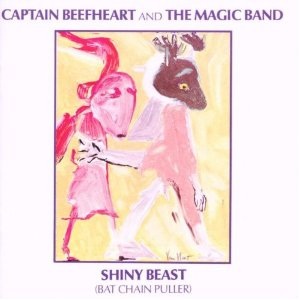
A more convincing return began with the material surrounding 'Bat Chain Puller'. Recorded in 1976, the original album became trapped in legal conflict connected to Frank Zappa and Herb Cohen and was not officially released until decades later. Its title track is said to have taken rhythmic inspiration from the sound of windshield wipers, a perfect Beefheart detail because it turns a mundane mechanical pulse into a lopsided musical engine. Since the album could not appear at the time, Beefheart reworked parts of that world into 'Shiny Beast (Bat Chain Puller)', released in 1978. 'Shiny Beast' is one of the richest later Beefheart albums because it restores the angular invention without simply trying to remake 'Trout Mask Replica'. The band is nimble, the grooves are colorful, and the production lets the oddness breathe. Tracks such as 'Tropical Hot Dog Night' and 'The Floppy Boot Stomp' show his gift for making absurd titles feel like pieces of a coherent folklore.
The late period continued with 'Doc at the Radar Station' in 1980, an album that feels like Beefheart returning with his edges sharpened. Recorded and mixed quickly, it captures a hard, bright, abrasive band sound. The guitars cut in jagged patterns; the rhythms snap; Van Vliet's voice sounds older but not weaker, more like a cracked commander shouting from the middle of an electrical storm. 'Hot Head' opens the album with a compact blast of aggression, while 'Ashtray Heart' turns bitterness into a phrase that feels both ridiculous and wounded. The record also draws on older fragments, including ideas connected to the delayed 'Bat Chain Puller' sessions, but it does not feel archival. It feels rebuilt under pressure. For listeners who find 'Trout Mask Replica' too mythologized, 'Doc at the Radar Station' can be the clearer proof of Beefheart's compositional power: six people moving like a machine designed by a painter who hated straight lines.
His final album, 'Ice Cream for Crow', appeared in 1982. By then Beefheart was already moving toward the visual art career that would occupy the rest of his life. The title track's video, filmed in the Mojave Desert, entered the Museum of Modern Art collection, a fitting bridge between his music and his painting. The album is lean, strange, and final without sounding like a farewell speech. Gary Lucas's guitar work gives parts of it a sharp new edge, and Van Vliet sounds fully himself: funny, gnomic, gruff, and unassimilated. After this, he walked away from recording. Unlike many rock departures, it did not become a cycle of comebacks. Don Van Vliet became, more publicly, a painter.
The painting was not a hobby added after fame. It was a return to the first language of his life. Van Vliet had his first significant exhibitions while still associated with music, and by the mid-1980s he was represented in the serious art world, including through Michael Werner Gallery. His paintings, often raw, gestural, animal-like, and physically direct, share something with the music but should not be reduced to album-cover eccentricity. They show the same attraction to motion, creature forms, pressure, and mark-making. He withdrew from the public music world, lived quietly with his wife Jan, and became increasingly private. Reports in later years connected his seclusion to multiple sclerosis. He died on December 17, 2010, in Arcata, California, at the age of 69.
Captain Beefheart's legacy is unusual because he was influential without being easily imitated. Many artists took permission from him, but few could copy the actual system. Punk and post-punk musicians admired the anti-commercial stance and the abrasive energy. Experimental composers and rock musicians studied the interlocking guitars and asymmetrical rhythms. Alternative artists heard in him a way to be rooted in blues and American vernacular music without becoming nostalgic. Tom Waits, PJ Harvey, the Fall, Pere Ubu, Sonic Youth, and many others have been linked to his influence in different ways. But Beefheart's deeper importance is not a list of followers. It is the example of an artist who treated rock music as raw material rather than a fixed form.
He was also a difficult figure, and the difficulty matters. A romantic version of Beefheart turns him into a harmless mad genius. A harsher version reduces him to a bully with a strange voice. Neither is enough. The records survive because they contain a genuine musical language: disciplined, funny, violent, tender, ecological, grotesque, and precise. The stories around him remain uncomfortable because that language was made through human relationships that were often strained. To listen well is to hear both the invention and the cost.
What made Captain Beefheart unique was not weirdness for its own sake. It was the conviction that the oldest materials in American music - blues moans, field rhythms, street jokes, animal cries, train sounds, desert silence - could be rearranged into forms that sounded completely new. He could make a guitar band behave like a broken machine, a cartoon, a ritual, and a chamber ensemble at the same time. He could turn a nonsense phrase into a hook and a hook into a riddle. His best music still resists becoming background. It interrupts the room. It asks the listener to meet it on unfamiliar ground, where the beat limps, the words molt, the guitars argue, and the voice at the center sounds less like a singer than a weather system passing through human language.