
David Bowie
Biography
David Bowie was born David Robert Jones in Brixton, London, in 1947 and spent much of his childhood in South London, first in Brixton and later in Bromley. His childhood was not the kind of mythic origin story he would later seem to deserve. He was a bright, curious boy in an ordinary English setting, drawn toward American music, style, theater, and the strange power of self-invention. His father, Haywood Jones, worked in promotions for the children's charity Barnardo's, and his mother, Margaret Mary Burns, had worked as a cinema usherette. Bowie absorbed music early, especially rock and roll, rhythm and blues, jazz, and the performance language of singers who seemed to become larger than life the moment they stepped in front of an audience.
One of the defining incidents of his youth came not from music but from a fight. As a teenager, Bowie was punched by his friend George Underwood during an argument over a girl. The injury left one pupil permanently dilated, giving Bowie the mismatched gaze that became part of his visual identity. The story has often been exaggerated into myth, but the fact is already strange enough: a schoolboy accident became part of the face that would later stare out from album covers, films, and concert stages as if it had been designed for mystery.
Before he became Bowie, he was one of many ambitious young musicians moving through the London pop world of the 1960s. He played saxophone, sang in beat groups, tried on styles, and searched restlessly for a name and a role. He adopted the surname Bowie partly to avoid confusion with Davy Jones of the Monkees. His first recordings showed talent but not yet a clear identity. He moved through mod pop, novelty songs, theatrical cabaret touches, and folk-leaning material, absorbing more than he mastered. This period matters because Bowie did not arrive fully formed. He built himself in public, through trial, embarrassment, sharp observation, and a willingness to abandon anything that stopped working.
His first major breakthrough came with 'Space Oddity', released in 1969 and helped by the cultural mood around the Apollo moon landing. The song introduced Major Tom, the drifting astronaut who would haunt Bowie's work in different forms for years. It was not just a clever topical single. It revealed one of Bowie's great gifts: he could turn modern anxiety into pop theater. 'Space Oddity' sounded like science fiction, but its emotional core was isolation, distance, and the frightening beauty of being cut loose from ordinary life.
The albums that followed showed Bowie searching for a language big enough for his ambitions. 'The Man Who Sold the World', released in 1970 in the United States and 1971 in the United Kingdom, brought a heavier sound shaped by guitarist Mick Ronson and producer Tony Visconti. Its music leaned toward hard rock, but its atmosphere was stranger than most heavy music of the time. Songs dealt with fractured identity, madness, power, and dread. Bowie was not yet a star, but the ingredients were gathering: literary references, theatrical distance, gender ambiguity, and a fascination with characters who seemed to be splitting apart.
With 'Hunky Dory' in 1971, Bowie found a warmer and more flexible voice. The album moved between piano-led pop, art-song delicacy, and sharp cultural portraiture. 'Changes' became one of his defining statements not because it explained him simply, but because it made instability sound like a principle. 'Life on Mars?' turned melodrama, cinema, and surreal social observation into one of his most sweeping recordings. The album also showed his habit of writing about other artists and cultural forces as if he were mapping a private pantheon: Bob Dylan, Andy Warhol, and the Velvet Underground all hover around the record. Bowie was still outside the center of pop fame, but 'Hunky Dory' made clear that he had stopped merely imitating influences and had begun arranging them into his own universe.
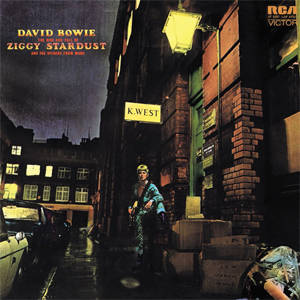
The transformation became unavoidable with 'The Rise and Fall of Ziggy Stardust and the Spiders from Mars' in 1972. Ziggy was not simply a costume, though the red hair, makeup, and alien rock star image became instantly memorable. The album worked because Bowie understood pop stardom as both fantasy and trap. Ziggy was a messenger, a seducer, a doomed performer, and a mirror held up to the audience. With Mick Ronson's guitar giving the music muscle and drama, the Spiders from Mars turned Bowie's ideas into something direct enough for teenagers and strange enough for outsiders. 'Starman' brought him to a wider British audience after his famous television appearance on 'Top of the Pops', where his androgynous presentation felt, to many viewers, like a signal from another world.
The Ziggy period also showed Bowie's unusual discipline. He did not merely write songs; he managed image, staging, gesture, and narrative. He understood that pop could be a complete artwork without becoming stiff or academic. Yet he also knew when to destroy a creation. In 1973, during the final Ziggy Stardust concert at the Hammersmith Odeon, Bowie announced that it was the last show the band would ever do. Many fans heard it as his retirement from performance, though it marked the end of the Ziggy persona rather than the end of Bowie. The gesture was theatrical, risky, and perfectly suited to him. He had made a star out of a mask, then killed the mask before it could imprison him.
Bowie's early 1970s run was astonishingly fast. 'Aladdin Sane' in 1973 took the Ziggy momentum and pushed it toward a harsher, more unstable sound. Written largely while Bowie was traveling in America, it reflected a country he found exciting, violent, glamorous, and fragmented. Pianist Mike Garson's avant-garde playing on the title track gave the record one of its most unsettling signatures, while the lightning-bolt cover became one of the most recognizable images in rock history. 'Diamond Dogs' in 1974 moved into a dystopian cityscape partly inspired by George Orwell's 'Nineteen Eighty-Four', though Bowie could not secure the rights for a direct adaptation. The result was more ragged and feverish than Ziggy, full of urban decay, theatrical menace, and transitional energy.
By the mid-1970s, Bowie turned toward American soul and funk. 'Young Americans', released in 1975, was recorded partly in Philadelphia and brought him into contact with musicians from the American soul tradition. Bowie called the style 'plastic soul', a self-aware phrase that admitted both admiration and artificiality. The album produced his first U.S. number one single, 'Fame', co-written with John Lennon and Carlos Alomar. Its clipped funk groove and bitter view of celebrity marked another change: Bowie was now writing from inside fame rather than dreaming toward it.
This period also carried personal cost. Bowie was living at extreme speed, using drugs heavily, and becoming physically thin and emotionally erratic by many accounts from those around him. The Thin White Duke, associated with 'Station to Station' in 1976, was one of his most chilling creations: elegant, remote, and spiritually empty. The album itself was far richer than the persona. Its title track stretched from ominous art-rock into driving funk; 'Golden Years' and 'TVC15' joined rhythm, strangeness, and pop craft; 'Word on a Wing' revealed a search for belief that felt unusually exposed. Bowie later said he remembered little of making the album, but the music sounds intensely controlled, as if chaos had been forced into architecture.
Seeking escape from Los Angeles and from his own condition, Bowie moved to Europe and entered one of the most creatively important phases of his career. His work with Brian Eno and Tony Visconti produced what became known as the Berlin Trilogy, though only 'Heroes' was recorded entirely in Berlin. 'Low', released in 1977, was a radical break from conventional rock album structure. Its first side contained short, fractured songs with clipped rhythms and emotional compression; its second side moved into instrumental pieces shaped by ambient textures and electronic atmosphere. The record's sound was influenced by German bands such as Kraftwerk and Neu!, but Bowie did not simply borrow from them. He translated the cold pulse of European experimental music into something deeply personal, full of damaged feeling and strange calm.
'Heroes', also released in 1977, carried a more open emotional force. The title track, recorded with Robert Fripp's sustained guitar lines and Visconti's production techniques, became one of Bowie's central songs. Its setting near the Berlin Wall and its image of lovers meeting under pressure turned private defiance into public myth without losing ambiguity. The album balanced rock songs with instrumentals and continued Bowie's fascination with divided cities, divided selves, and music as a way to move through psychological ruin. 'Lodger' in 1979 was more restless and global in texture, playing with travel, displacement, and art-pop angles. It was less immediately revered than 'Low' or 'Heroes', but it showed Bowie refusing to settle even inside his own experimental breakthrough.
Bowie's Berlin-era work also affected music beyond his own catalog. Its use of electronics, fragmented song forms, ambient spaces, and disciplined artificiality helped shape post-punk, new wave, synth-pop, and later alternative music. Just as important was the example it set: a major rock artist could step away from commercial formulas, embrace European avant-garde ideas, and still make music with emotional weight. Bowie made experimentation feel glamorous, but also serious.
In 1980, Bowie released 'Scary Monsters', an album that looked backward and forward at once. 'Ashes to Ashes' returned to Major Tom, no longer as a romantic astronaut but as a damaged figure caught in addiction and memory. The song's video, with its Pierrot imagery and strange procession, became central to the visual language of early music television. Musically, the album was sharp, modern, and tense, bringing together guitar abrasion, electronic polish, and some of Bowie's strongest vocal performances. For many listeners, it marked the last great work of his 1970s artistic streak, though Bowie himself would continue to complicate that kind of neat judgment.
The next transformation made him a global pop star on a scale he had never reached before. 'Let's Dance', released in 1983 and produced by Nile Rodgers, gave Bowie a bright, muscular, danceable sound built for the 1980s mainstream. The title track, 'Modern Love', and 'China Girl' became major hits, and Stevie Ray Vaughan's guitar added bite to the record's sleek surfaces. It was not merely a sellout, as some later critics suggested; it was a smart, expertly produced pop album. But its success created a problem Bowie understood too late. He had reached the mass audience he once seemed to court from a distance, and now that audience expected clarity, hooks, and accessibility.
His mid-to-late 1980s work struggled under that pressure. 'Tonight' and 'Never Let Me Down' contained moments of craft but were widely viewed as less inspired than his earlier work. Bowie later expressed dissatisfaction with parts of that era. Rather than continue as a polished solo pop figure, he made another odd move: he joined a band. Tin Machine, formed with guitarist Reeves Gabrels and the Sales brothers, allowed him to hide from his own brand inside a loud, abrasive group format. The music divided listeners, but the project served a purpose. It forced Bowie away from the machinery of superstar expectation and reconnected him with risk, noise, and collaboration.
The 1990s found Bowie moving with renewed curiosity. 'Black Tie White Noise' in 1993 reflected personal change, including his marriage to Iman, and mixed soul, jazz, electronic textures, and art-pop elegance. 'Outside' in 1995 reunited him with Brian Eno for a dark, concept-heavy record connected to art, crime, and fractured identity. It was dense, strange, and sometimes difficult, but it showed Bowie again treating the album as a world rather than a product. 'Earthling' in 1997 brought drum and bass and industrial energy into his sound. Bowie was not pretending to be a young club artist; he was testing how contemporary electronic music could be bent into his own vocabulary.
Throughout these later decades, Bowie's influence was no longer theoretical. Artists from punk, goth, new wave, alternative rock, electronic music, pop, and glam-derived scenes had already learned from him. His impact was musical, visual, and psychological. He gave permission to treat identity as something performed and reshaped. He made androgyny, theatricality, and alienation part of mainstream pop language. He also showed that change itself could be an artistic method, not just a career strategy.
Bowie was not only a musician. He acted on stage and screen, most notably in Nicolas Roeg's film 'The Man Who Fell to Earth', where his otherworldly presence was used with remarkable precision. He appeared on Broadway in 'The Elephant Man', taking the role without heavy prosthetics and relying on physical control and voice. In film, video, fashion, and performance, he carried the same central idea: the body, the voice, and the image could be arranged like musical material.
In the 2000s, Bowie settled into a quieter public presence after decades of reinvention. Albums such as 'Heathen' and 'Reality' were mature works that looked back without becoming nostalgic. After suffering a heart-related health emergency in 2004, he largely withdrew from touring and public life. For years, the silence created speculation, but Bowie did not spend it explaining himself. Then, on his 66th birthday in 2013, he unexpectedly released 'Where Are We Now?' and announced the album 'The Next Day'. The return was handled with unusual secrecy in an age of constant publicity. It was a reminder that even late in life, Bowie could still control surprise.
His final album, 'Blackstar', released on his 69th birthday in January 2016, became inseparable from his death two days later from liver cancer, which had not been publicly disclosed. The album was recorded with jazz musicians led by saxophonist Donny McCaslin and moved through art rock, jazz, electronic tension, and ritual-like atmosphere. It was not a simple farewell note, and reducing it to that makes it smaller than it is. Still, knowing the circumstances gives songs such as 'Lazarus' and the title track a stark power. Bowie turned mortality into form, not sentiment. Even at the end, he treated the album as a constructed space, full of symbols, masks, humor, dread, and control.
David Bowie's career is often described through reinvention, but that word can become too easy. The deeper truth is that he understood the relationship between sound, image, character, and cultural timing with rare intelligence. He was not always ahead of everyone, and he was not always successful. He borrowed, adapted, misfired, corrected, and moved on. What made him extraordinary was the seriousness with which he treated transformation. From Major Tom to Ziggy Stardust, from the Thin White Duke to the Berlin experiments, from 1980s pop brightness to the final darkness of 'Blackstar', Bowie made change feel like a way of thinking. His legacy is not one style, one decade, or one persona. It is the body of work left by an artist who kept asking what a song, a face, a voice, and a life could become.