
Eminem
Biography
Marshall Bruce Mathers III, known to the world as Eminem, grew out of a Detroit hip-hop scene that did not make success easy for anyone, and especially not for a white rapper trying to prove himself in rooms where novelty could quickly turn into ridicule. Born on October 17, 1972, in St. Joseph, Missouri, he spent much of his childhood moving between Missouri and Michigan before Detroit became the city that shaped him. His upbringing was unstable, his school years were difficult, and rap became less a career plan than a language he could use with unusual precision. By his teenage years he was studying rhyme patterns, battling locally, and forcing his way into a culture where skill mattered but acceptance still had to be earned one verse at a time.
Eminem's early development was built in battle circles, small clubs, and makeshift recording situations rather than in the machinery of the music business. He performed with Detroit groups including New Jacks and Soul Intent, and he became closely connected to the Bass Brothers, Mark and Jeff Bass, who helped give his earliest recordings a professional shape. His 1996 independent debut, 'Infinite', showed a technically sharp young rapper still searching for a voice. The album did little commercially and was criticized in some local circles for sounding too close to other East Coast-influenced rappers of the period. That failure mattered. Instead of simply polishing the same approach, Eminem pushed his writing toward something harsher, funnier, more unstable, and more personal.
The answer was Slim Shady, an alter ego that allowed him to turn frustration, poverty, humiliation, shock humor, and pop-culture disgust into a character who sounded half cartoon villain and half wounded outsider. The 1997 'Slim Shady EP' was the real turning point. Its rhymes were nastier, more elastic, and more memorable than 'Infinite', and the voice was finally unmistakable. That same year, Eminem traveled to Los Angeles for the Rap Olympics and finished second. The loss still helped change his life: a copy of his music reached Interscope chief Jimmy Iovine, who played it for Dr. Dre. Dre had already changed rap as a member of N.W.A and as the architect of much of West Coast hip-hop's 1990s sound; his decision to work with Eminem gave the Detroit rapper credibility that no marketing campaign could have supplied on its own.
The first sessions between Eminem and Dr. Dre have become part of modern rap history because they revealed how fast their chemistry worked. Eminem has recalled being nervous around Dre, but the process quickly became productive. Dre would build or play beats, and Eminem seemed to attack them quickly with rhyme ideas. Accounts of those early sessions say 'My Name Is' came together with unusual speed during their first stretch of work together, along with other material from the same burst of sessions. What mattered was not just Dre's co-sign. Dre gave Eminem's most abrasive ideas a bright, rubbery, radio-ready frame, while Eminem brought a density of rhyme, comic timing, and character acting that made the beats feel theatrical.
Released in 1999, 'The Slim Shady LP' made Eminem famous almost overnight, but it was not a simple pop breakthrough. The album sounded like prank calls, horror films, therapy notes, and battle rap all shoved into the same body. 'My Name Is' introduced him as a mischievous television-age troublemaker, but deeper cuts showed a more complicated writer: a rapper who could be juvenile, technically dazzling, cruel, self-mocking, and wounded within the same verse. The production, handled by Dr. Dre, the Bass Brothers, Eminem, and others, balanced eerie loops with bouncy hooks, letting the songs move between comedy and menace without losing momentum. It won Grammy Awards and sold massively, but it also made Eminem a public controversy. Parent groups, critics, and commentators argued over his language and violent fantasies, while fans heard a rapper turning alienation into a new kind of mainstream spectacle.
Eminem's next album, 'The Marshall Mathers LP', arrived in 2000 with the pressure of sudden fame built into its bones. It was bigger, darker, sharper, and more self-aware than its predecessor. The album's title was important: this was not only Slim Shady acting out, but Marshall Mathers responding to celebrity, lawsuits, family chaos, moral panic, and the strange experience of being condemned by the same culture that was buying millions of his records. 'The Real Slim Shady' mocked pop culture with a hook that seemed designed to invade every radio station at once, while 'Stan' revealed a different gift: long-form storytelling. Built around a sample of Dido's 'Thank You', 'Stan' follows an obsessed fan through letters and mounting desperation, and it became one of Eminem's defining works because it used his fame as subject matter rather than decoration.
The album also showed the contradictions that have followed Eminem throughout his career. His technical control was extraordinary: internal rhymes, shifting voices, tightly arranged syllables, sudden punch lines, and narrative details came at a speed few mainstream listeners had heard so clearly. At the same time, parts of the record were attacked for misogyny, homophobia, and violent language. Eminem often defended the work as character, satire, anger, or fantasy, but the backlash was real and became inseparable from his rise. One of the most important public moments of that period came at the 2001 Grammy Awards, when he performed 'Stan' with Elton John. The pairing did not erase the criticism, but it complicated the story: one of pop's most famous openly gay artists stood beside one of music's most accused provocateurs, and the performance became a symbolic moment in Eminem's fight with public perception.
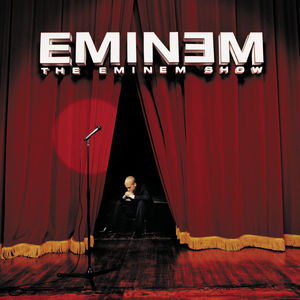
In 2002, Eminem moved from embattled superstar to something even larger with 'The Eminem Show' and the film '8 Mile'. 'The Eminem Show' shifted the balance again. It kept the humor and aggression, but the production was heavier, more rock-influenced, and more openly autobiographical. Eminem took a larger production role, and songs such as 'Cleanin' Out My Closet', 'White America', 'Sing for the Moment', and 'Without Me' showed how broad his range had become. He could write about family bitterness, political hypocrisy, fan culture, censorship, and absurd celebrity theater while still bending rhymes into complicated shapes. The album made clear that he was no longer merely Dre's discovery; he was becoming the central author of his own sound.
'8 Mile' deepened that image without being a direct autobiography. Eminem played Jimmy Smith Jr., known as B-Rabbit, a Detroit factory worker and battle rapper trying to escape the limits of his environment. The film drew from real elements of Eminem's world: Detroit, battle rap, class pressure, and the feeling of being trapped between talent and circumstance. Its closing battle scene, where the character disarms his opponent by admitting his own humiliations first, captured something essential about Eminem's art. He often wins by exposing himself before anyone else can. 'Lose Yourself', written for the film, became one of his most important songs: urgent, disciplined, and motivational without losing the grit of his early work. It won the Academy Award for Best Original Song, a rare crossover moment for hip-hop at that level of Hollywood recognition.
The mid-2000s were more uneven. 'Encore', released in 2004, contained major singles and moments of sharp writing, but it also showed signs of exhaustion, excess, and creative strain. Some tracks leaned heavily into shock humor without the same focus that made the earlier albums feel dangerous and purposeful. Around the same period, Eminem was also running Shady Records, helping bring 50 Cent to a massive breakthrough with 'Get Rich or Die Tryin'', and maintaining ties to D12, whose success carried a strong Detroit identity into the mainstream. But behind the commercial machine, his health and drug use were worsening. After the death of his close friend and D12 member Proof in 2006, Eminem retreated further from public life. Proof's death was a major emotional and creative blow, not just because of their friendship, but because Proof had been one of the people who understood Eminem before fame turned him into a global argument.
Eminem returned in 2009 with 'Relapse', an album that divided listeners but remains one of his strangest major releases. Built largely with Dr. Dre, it leaned into horror-movie imagery, serial-killer voices, accents, and dense rhyme schemes. For some fans, the accents and grotesque concepts overwhelmed the writing; for others, the album's technical construction and Dre's production made it a fascinating document of an artist rebuilding himself through exaggeration. 'Relapse' was not a comfortable comeback, and that is part of what makes it revealing. Eminem did not return as a healed elder statesman. He returned through distortion, using rap almost like a compulsive exercise in rhythm and character.
'Recovery' in 2010 was a more direct reset. Eminem moved away from many of the accents and horrorcore devices of 'Relapse' and wrote more plainly about addiction, sobriety, regret, and the cost of the previous decade. The sound was bigger and more arena-sized, with producers and hooks that pushed him toward pop-rap without softening the intensity of his delivery. 'Not Afraid' presented recovery as defiance rather than confession, while 'Love the Way You Lie', featuring Rihanna, became a huge hit by turning a volatile relationship narrative into a dramatic pop duet. The album reintroduced Eminem to a younger audience and showed that he could survive the collapse of his original controversy cycle. He was no longer just the nightmare of parents in 1999; he was now a veteran wrestling with what his own mythology had done to him.
His 2013 album 'The Marshall Mathers LP 2' deliberately reopened the past. Rather than simply copying the 2000 album, it treated Eminem's earlier self as something to argue with. 'Rap God' became a showcase for speed, breath control, and syllabic architecture, while 'Bad Guy' revisited the world of 'Stan' from a new angle. The album's best moments were not only nostalgic; they were almost forensic, as if Eminem were studying the wreckage and triumph of his own career. This period also highlighted one of his defining traits: an obsession with technique. Even when critics questioned his taste, hooks, or subject matter, his command of rhyme remained central. He often sounded like someone trying to solve a puzzle at high speed, stacking internal rhymes until the verse became both argument and athletic display.
The late 2010s brought another complicated phase. 'Revival' in 2017 aimed for political and personal seriousness, including criticism of Donald Trump and reflections on fame, family, and age, but it was widely met with mixed or negative reviews. Eminem responded in the most Eminem way possible: by rapping back. 'Kamikaze', released as a surprise in 2018, was shorter, angrier, and more combative, aimed at critics, younger rappers, and anyone he believed had misunderstood or dismissed him. It did not solve every criticism of his later work, but it restored a sense of urgency. The album showed how deeply Eminem still cared about being measured as an MC, not merely honored as a veteran.
'Music to Be Murdered By', released in 2020 and expanded later that year, continued his late-career pattern of surprise releases, technical workouts, and darkly comic framing. Its title nodded to Alfred Hitchcock, and the album moved between fast-rapping set pieces, relationship songs, murder-mystery atmosphere, and moments of social commentary. By this stage, Eminem's place in hip-hop had become unusually layered. He was both a canonized figure and a permanent battler, an artist with nothing left to prove commercially who still sounded irritated by the idea that anyone might think he had slipped. That tension could be exhausting, but it was also part of what kept his music alive. He never fully settled into ceremonial legacy mode.
In 2022, Eminem was inducted into the Rock and Roll Hall of Fame, with Dr. Dre introducing him. The induction formalized something that had been obvious for years: his career had moved beyond rap controversy and into broader popular music history. Still, the honor did not make him less connected to Detroit or to hip-hop's competitive roots. His performance history, including major festival appearances and high-profile events, continued to emphasize the same traits that built his reputation: clipped breath control, dense rhyme delivery, and a stage presence more focused than flamboyant. Unlike artists who reinvent themselves visually every era, Eminem's core image remained stubbornly consistent: hoodie, cap, guarded expression, and the sense of someone still treating the microphone like a fight.
His 2024 album 'The Death of Slim Shady (Coup de Grace)' turned the old alter ego into the subject of a full late-career concept. The rollout played with the idea of Slim Shady as a character whose life and death could be investigated, mourned, mocked, or finally buried. 'Houdini' deliberately echoed the comic-book energy of 'Without Me', bringing back familiar faces and visual jokes while staging a collision between the younger Shady persona and the older Eminem. The album's premise underlined a question that had followed him for decades: what happens to a character built from youthful rage, shock, and insult when the artist behind it is older, sober, famous, and historically decorated? Whether heard as farewell, satire, or self-interrogation, the project showed that Eminem still understood his own career as a drama between masks.
Eminem's creative process has always depended on the friction between control and chaos. The chaos is obvious: the alter egos, feuds, controversies, grotesque jokes, and sudden emotional turns. The control is what makes the work last. He is one of rap's most obsessive technicians, famous for bending pronunciation, packing multisyllabic rhymes into conversational lines, and using different vocal characters to separate narrator, victim, villain, celebrity, and critic. At his best, he writes songs like scenes. 'Stan' works because the letters feel increasingly claustrophobic. 'Lose Yourself' works because every bar tightens around one decisive moment. 'The Way I Am' works because the beat's heavy stomp mirrors the pressure of being watched, judged, and consumed.
His impact is difficult to separate from the arguments around him. Eminem opened doors for some listeners who had not previously paid close attention to hip-hop, but he did so as a guest in a Black art form that had already produced decades of innovation before his arrival. The more accurate measure of his importance is not that he made rap legitimate, because rap did not need him for that. It is that he became one of the most commercially dominant and technically studied rappers in the world while forcing mainstream audiences to confront a version of hip-hop that was abrasive, verbally dense, emotionally volatile, and often uncomfortable. He also changed what a pop superstar could sound like: not smooth, not reassuring, but frantic, defensive, brilliant, and combative.
Today Eminem stands as one of modern music's most paradoxical figures: a private man who became famous by exposing raw nerves in public; a meticulous craftsman whose most famous character thrived on recklessness; a rapper repeatedly criticized for cruelty who also wrote some of the most influential songs about obsession, poverty, addiction, and self-disgust in mainstream music. His best records are not polite monuments. They are messy, argumentative, and alive with conflict. That is why his biography cannot be reduced to sales, awards, or scandals. Eminem matters because he turned language itself into combat, comedy, confession, and armor, and because the battle between Marshall Mathers and Slim Shady became one of the defining stories of hip-hop's global era.