
Jeff Beck
Biography
Jeff Beck was never the easiest guitar hero to package. He did not become a singer-guitarist like Eric Clapton, build a stadium empire like Jimmy Page, or attach himself permanently to one famous band. His career moved in sharp turns: blues-rock, proto-heavy rock, jazz fusion, funk, electronica, orchestral ballads, rockabilly tributes, and late-period collaborations that could place him beside singers, metal veterans, actors, or full string arrangements. What held it together was not a genre but a touch. Beck treated the electric guitar less like a machine for riffs than like a living voice, bending notes until they seemed to speak, cry, laugh, or snarl without needing lyrics.
Geoffrey Arnold Beck was born on June 24, 1944, in Wallington, Surrey, England. He grew up in the postwar years, when American records reached British teenagers like signals from another world. Rock and roll, rhythm and blues, and rockabilly mattered deeply to him, especially the sharp, quicksilver playing of guitarists such as Cliff Gallup, Les Paul, and later blues players like Buddy Guy. Before he had a proper instrument, Beck tried to make one himself, using improvised materials including cigar boxes and a fence-post neck. It was a small childhood detail, but it says a lot about him: he was not just interested in playing guitar, he was fascinated by how sound could be physically made.
As a young man he attended Wimbledon School of Art and worked ordinary jobs, including as a painter and decorator and car paint sprayer. That manual side of him never disappeared. Beck became famous for guitars, but he was also deeply absorbed by hot rods and mechanical work, often spending serious time around cars and engines. Unlike many rock stars who cultivated mystery through distance, Beck often seemed most himself when talking about tone, tools, wires, pickups, engines, and the exact feel of a machine responding under his hands.
His route into major rock history came through The Yardbirds. In 1965, Eric Clapton left the band after their move toward more commercial pop with 'For Your Love'. Jimmy Page, already a friend of Beck and a respected session guitarist, recommended Beck as the replacement. Beck joined a band that was already important, but his arrival changed its voltage. The Yardbirds under Beck became stranger, louder, and more experimental. On records such as 'Heart Full of Soul', 'Evil Hearted You', 'Shapes of Things', and 'Over Under Sideways Down', his guitar sounded like it was pushing against the walls of pop music. He used sustain, distortion, feedback, Eastern-flavored lines, and sudden bursts of noise in ways that made the guitar feel unstable and alive.
The Yardbirds period was brief, but it was one of the most important short chapters in 1960s rock guitar. Beck's playing on 'Shapes of Things' in particular helped point toward psychedelic rock and heavier forms of British guitar music. The solo did not simply decorate the song; it seemed to tear a hole through it. In an era when many guitar parts still stayed close to blues vocabulary, Beck was already treating the studio as a place for sound design. He could play with blues feeling, but he was not a purist. He liked distortion, accidents, volume, and the expressive possibilities of things going slightly wrong.
One of the clearest images of Beck's Yardbirds era appears in Michelangelo Antonioni's 1966 film 'Blow-Up'. The band performed 'Stroll On', a reworked version of 'Train Kept A-Rollin'', with both Beck and Jimmy Page in the lineup. In the scene, Beck becomes irritated by a crackling amplifier and smashes his guitar in staged fury. The moment was scripted, but it captured something real about his image at the time: volatile, wired, impatient with ordinary performance. Beck later disliked being reduced to that kind of showmanship, yet the scene preserved a rare document of the Page-Beck Yardbirds, two future giants sharing one unstable stage.
Beck's temperament and the pressures of touring made his time in The Yardbirds difficult. He left, or was effectively dismissed, in 1966 during an American tour after missed appearances and internal tension. That exit kept him from the more linear path that led Jimmy Page from The Yardbirds into Led Zeppelin. But Beck's career was never linear. Around this period, he recorded one of the great transitional rock instrumentals of the 1960s, 'Beck's Bolero'. The session included Jimmy Page, John Paul Jones, Nicky Hopkins, and Keith Moon. Built partly around a dramatic, rising arrangement inspired by Ravel's 'Bolero', the track moved from orchestral tension into crushing guitar power. It later appeared on Beck's debut album 'Truth' and has often been heard as one of the recordings that helped foreshadow hard rock and heavy metal.
The Jeff Beck Group made his post-Yardbirds identity clearer. The first major lineup featured Rod Stewart on vocals, Ronnie Wood on bass, Micky Waller on drums, and Nicky Hopkins contributing piano. Their 1968 album 'Truth' was a landmark of heavy blues-rock. It did not have the unified mythology of Led Zeppelin's first album, which arrived a few months later, but it occupied similar territory: loud blues, dramatic vocals, thick guitar tone, and a sense that British rock was becoming heavier and more physical. Beck's version of 'You Shook Me', the explosive 'Let Me Love You', and the eerie, massive 'I Ain't Superstitious' showed how far he could stretch blues material without losing its bite.
'Truth' mattered because it placed Beck in a band setting where the guitar could dominate without turning the music into empty display. Rod Stewart's raspy voice gave the songs a human center, while Beck's guitar pushed around it, answering, interrupting, and sometimes almost arguing with the vocal. Ronnie Wood, still known then as a bassist rather than as a Rolling Stone, helped give the group a rough, flexible bottom end. The record sounded less polished than much later hard rock, but that was part of its force. It felt like a band finding a new language while the tape was rolling.
The follow-up, 'Beck-Ola', released in 1969, was louder and more unruly. Its famous sleeve note dismissed most pop music as rubbish, a line that matched the album's impatience. The record included heavy versions of Elvis Presley-associated songs such as 'All Shook Up' and 'Jailhouse Rock', alongside original material like 'Spanish Boots' and 'Plynth'. If 'Truth' helped define heavy blues-rock, 'Beck-Ola' showed the limits of that first Jeff Beck Group. The chemistry was powerful, but the personalities were hard to contain. Stewart and Wood soon moved on toward Faces, and Beck again found himself outside the obvious career path.
A serious car crash in 1969 interrupted his momentum. Beck had been planning to work with bassist Tim Bogert and drummer Carmine Appice of Vanilla Fudge, but the accident left him unable to continue those plans at the time. Bogert and Appice formed Cactus while Beck recovered. The delay mattered: had the trio formed immediately, Beck's career might have developed as a heavy power-trio story in direct competition with the biggest hard rock bands of the early 1970s. Instead, he returned in stages, first with a second Jeff Beck Group that moved into soul, funk, and rhythm-and-blues textures.
The early 1970s Jeff Beck Group, with musicians including Bob Tench, Cozy Powell, Max Middleton, and Clive Chaman, produced 'Rough and Ready' and 'Jeff Beck Group'. These records are sometimes overshadowed by the Rod Stewart era and the later fusion albums, but they show Beck searching for a more elastic groove. Max Middleton's keyboards were especially important, bringing harmonic color that would later become central to Beck's instrumental work. Beck was moving away from the blues-rock frontman model and toward something more fluid, where the guitar could float over funk rhythms and jazz-influenced chords.
He eventually did join Tim Bogert and Carmine Appice for 'Beck, Bogert & Appice', released in 1973. The trio had power, and their version of Stevie Wonder's 'Superstition' became one of the record's best-known tracks. The connection with Wonder was not incidental. Beck played on Wonder's 'Talking Book' sessions, including 'Lookin' for Another Pure Love', and the history around 'Superstition' has long linked the song to their musical exchange. Wonder's own version became a defining hit before Beck's recording appeared. The Beck, Bogert & Appice album had impressive force, yet the group did not become the long-term vehicle that might have been expected. Once again, Beck moved on.
The decisive reinvention came with 'Blow by Blow' in 1975. Produced by George Martin, best known for his work with The Beatles, the album transformed Beck from a volatile blues-rock guitarist into a major instrumental artist. The choice was bold. Rock guitarists had made instrumentals before, but Beck made an entire album where the guitar functioned like a lead singer. 'Cause We've Ended as Lovers', written by Stevie Wonder, became one of his signature performances. Beck played it with remarkable restraint, using space, vibrato, and delicate bends rather than speed. Every note seemed shaped by hand.
'Blow by Blow' was not jazz in a strict traditional sense, and it was not ordinary rock either. It sat in the 1970s fusion moment, but Beck's voice made it different from the more academic or virtuosic corners of the genre. Tracks such as 'You Know What I Mean' and 'Freeway Jam' balanced groove, melody, and tone. George Martin's production gave the album clarity without sanding away Beck's edge. The result reached a wider audience than an instrumental guitar-fusion record might have been expected to reach, and it gave Beck a new path: he no longer needed a singer, and he no longer needed to behave like a conventional bandleader.
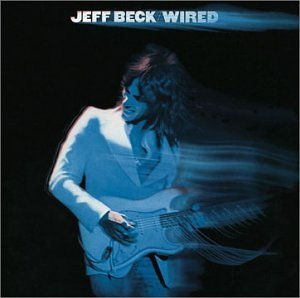
'Wired', released in 1976, pushed further into fusion. With players including Jan Hammer and Narada Michael Walden, the album was sharper, faster, and more technically charged than 'Blow by Blow'. 'Led Boots' opened with a muscular funk-rock drive, while 'Goodbye Pork Pie Hat', Charles Mingus's tribute to Lester Young, showed Beck's ability to enter jazz material without sounding like a guest from another world. He did not imitate horn phrasing in a polite way; he translated it into electric guitar speech. His bends, volume swells, and control of attack allowed him to make a note bloom or collapse almost vocally.
The Beck-Hammer connection also changed his live sound. Jan Hammer's synthesizer could match Beck in pitch bends and expressive slides, creating a dialogue between guitar and keyboard that was futuristic for its time. On stage, Beck was not simply soloing over backing tracks; he was conversing with another electronic voice. This helped separate him from the guitar-hero stereotype. He was not only interested in being faster or louder. He was interested in making the guitar less predictable.
The late 1970s and 1980s were less commercially straightforward for Beck, but they deepened his reputation among musicians. 'There & Back' in 1980 continued his instrumental direction, while 'Flash' in 1985 brought him into a glossier production environment. 'Flash' included vocal tracks and outside production, and Beck was not always naturally associated with slick pop-rock polish. Still, the track 'Escape' won him his first Grammy Award. It was a reminder that even when the surrounding style changed, his playing could cut through the production surface.
One of the most admired albums of his later middle period was 'Jeff Beck's Guitar Shop', released in 1989 with Terry Bozzio on drums and Tony Hymas on keyboards. The title sounded almost casual, but the album was a serious statement. Rather than chasing 1980s pop trends, Beck made a compact, muscular instrumental record full of mechanical funk, odd textures, and sharp humor. The trio format left plenty of room for his guitar to act like a character: growling, muttering, singing, and sparking against Bozzio's explosive drumming. The album won a Grammy for Best Rock Instrumental Performance and helped reestablish Beck as a restless instrumental innovator rather than a 1960s survivor.
By the 1990s and 2000s, Beck entered another unexpected phase. He embraced electronic textures on 'Who Else!' in 1999 and 'You Had It Coming' in 2001. Many guitarists of his generation treated electronic music as a threat or a passing fashion, but Beck heard new surfaces to cut into. With collaborators including Jennifer Batten, he placed his guitar against programmed beats, industrial edges, and modern production. 'Dirty Mind' from 'You Had It Coming' won a Grammy, and the period showed that Beck's experimental instinct had not frozen in the 1970s.
His technique in these decades became increasingly distinctive. Beck often played a Fender Stratocaster with extraordinary control of the whammy bar, volume knob, harmonics, and finger attack. He frequently played without a pick, using his fingers to pull, snap, and soften the strings. This gave him a level of nuance that could be missed by listeners expecting only riffs. A Beck note could begin as a whisper, rise like a human voice, then twist slightly out of tune before resolving. He made pitch instability expressive. Where many rock guitarists used the tremolo arm for dramatic dives, Beck used it almost like breath.
This is one reason singers loved him. Beck's guitar could occupy the emotional space of a vocalist without competing in the usual way. On 'Emotion & Commotion', released in 2010, he placed the guitar beside orchestral arrangements and guest singers, interpreting pieces such as 'Nessun Dorma' and 'Over the Rainbow'. It could have become sentimental, but Beck's best performances avoided syrup. He approached melodies as if they needed to be discovered note by note. 'Nessun Dorma' won a Grammy for Best Pop Instrumental Performance, while 'Hammerhead' won Best Rock Instrumental Performance.
Beck's public personality was a mixture of shyness, dry humor, perfectionism, and stubborn independence. He could seem allergic to the career machinery that made other artists larger. He did not always capitalize on commercial openings, and he sometimes abandoned lineups just when they seemed ready to grow. Yet that same refusal to settle is central to why his discography remained alive. He did not want to spend decades repeating 'Truth', 'Blow by Blow', or any other successful formula. He preferred the risk of sounding out of place to the comfort of sounding finished.
His collaborations underline how widely he was respected. Across his career he worked or recorded with artists including Rod Stewart, Stevie Wonder, Jan Hammer, Tina Turner, Mick Jagger, Buddy Guy, Imelda May, Herbie Hancock, Ozzy Osbourne, and Johnny Depp. Not all collaborations were equally central to his legacy, but they show how adaptable his playing was. He could fit into blues, funk, pop, hard rock, orchestral settings, or electronic music without losing his identity. The sound was always recognizably Beck: vocal, sharp-edged, slightly dangerous, and intensely controlled.
Beck was inducted into the Rock and Roll Hall of Fame twice: first as a member of The Yardbirds in 1992 and later as a solo artist in 2009. Awards only partly explain his importance. His deeper influence lies in how he expanded the emotional grammar of electric guitar. He showed that distortion did not have to mean blunt force, that virtuosity did not have to mean speed, and that instrumental rock could be expressive without becoming empty exhibition. Guitarists listened to him not only for licks, but for touch.
His later years kept that curiosity intact. 'Loud Hailer', released in 2016, included politically charged material and collaborations with vocalist Rosie Bones and guitarist Carmen Vandenberg, putting Beck into a modern, confrontational setting. In 2022 he released '18' with Johnny Depp, an album of covers and originals that received attention partly because of Depp's celebrity, but Beck's playing remained the musical center. He also appeared on Ozzy Osbourne's 'Patient Number 9', contributing to 'A Thousand Shades' and the title track. Even near the end of his life, he was not simply revisiting the past.
Jeff Beck died on January 10, 2023, after suddenly contracting bacterial meningitis. He was 78. The response from other musicians made clear how unusual his standing was. He had not been the most commercially dominant guitarist of his generation, but among players he occupied a rare place. He was admired by peers who understood how difficult it was to do what he did: to make a guitar sound spontaneous and precise at the same time, emotional without melodrama, technically astonishing without seeming like a contest.
His legacy is not a single band, a single hit, or one fixed era. It is the long arc of a musician who kept changing the question of what electric guitar could be. From the Yardbirds' feedback-splashed singles to the heavy blues of 'Truth', from the lyrical fusion of 'Blow by Blow' to the modern textures of 'Who Else!' and the orchestral sensitivity of 'Emotion & Commotion', Beck repeatedly escaped the role assigned to him. He was a guitar hero who distrusted the obvious poses of guitar heroism. That tension made him difficult, fascinating, and irreplaceable.