
Kanye West
Biography
Kanye West, legally known as Ye since 2021, is one of the most consequential and divisive figures in modern popular music: a producer who changed the sound of mainstream hip-hop, a rapper who turned self-doubt and ego into commercial fuel, a fashion entrepreneur whose sneakers reshaped streetwear, and a public figure whose later career has been deeply damaged by repeated antisemitic remarks and volatile public behavior. His story is not a simple rise-and-fall narrative, because the music itself keeps complicating the picture. At his best, West treated the studio like a laboratory where gospel choirs, soul samples, drum machines, orchestras, industrial noise, Auto-Tune, house music, and trap could all be forced into new shapes. At his worst, he made his own fame feel unstable, turning brilliance, provocation, grievance, and self-sabotage into one tangled public spectacle.
West was born in Atlanta, Georgia, on June 8, 1977, and was raised mainly in Chicago after his parents divorced. His father, Ray West, had worked as a photojournalist, and his mother, Donda West, became an English professor and later chaired the English department at Chicago State University. Donda was central to Kanye's early life and public mythology: educated, protective, and deeply involved in his development, she encouraged his creativity while also giving him a sense that language, argument, and self-definition mattered. West studied art and briefly attended college, including Chicago State, before leaving to pursue music. The decision later became part of the architecture of his debut album, but it was not just branding. The tension between formal education and self-invention, between respectability and rebellion, would run through much of his work.
Before he was a famous rapper, West was a hungry Chicago producer trying to make records that sounded different from the dominant radio style of the late 1990s and early 2000s. His signature early approach was built around pitched-up soul samples, crisp drums, and emotional hooks that turned old records into bright, urgent hip-hop backdrops. He produced for local artists and gradually moved into bigger circles, but the breakthrough came through Roc-A-Fella Records. His production work on Jay-Z's 'The Blueprint' in 2001 helped define the album's warm, sample-driven sound and made West one of the most sought-after producers in rap. Tracks such as 'Izzo' and 'Takeover' showed how he could make a beat feel both nostalgic and immediate: old soul records were not treated as museum pieces, but as living voices pushed into a new emotional register.
The problem was that the industry wanted Kanye West the producer more than Kanye West the rapper. He did not fit the dominant image of early-2000s rap stardom. He was not a street-hardened gangster figure, and he was not interested in pretending to be one. He rapped about insecurity, family, faith, consumerism, ambition, and class anxiety, often with a tone that could shift from funny to wounded in a few bars. The key event in his origin story was a serious car crash in October 2002, after which his jaw was wired shut. Instead of letting that stop him, he recorded 'Through the Wire' while still recovering, rapping through the physical limitation over a Chaka Khan sample. The song became both a single and a manifesto: West would not wait for permission to be taken seriously as an artist.
'The College Dropout', released in 2004, was the rare debut that arrived with a fully formed world. It challenged the idea that mainstream rap had to choose between street credibility and conscious reflection. The album used skits about education and status, gospel touches, soul samples, and a warm, crowded production style to create a portrait of a young Black artist trying to survive capitalism without losing his spirit. 'Jesus Walks' was especially important because it brought overt religious language into rap radio without sounding like a sermon. 'All Falls Down' examined insecurity and materialism with unusual directness, while 'Spaceship' turned low-wage work into a dreamer's lament. The album was funny, self-aware, proud, and vulnerable, and it made West seem less like a rapper entering the mainstream than a producer-author building his own lane inside it.
He followed quickly with 'Late Registration' in 2005, an album that expanded the palette rather than simply repeating the debut. Working with producer and composer Jon Brion, West brought in richer orchestration, layered arrangements, and a more cinematic sense of movement. The record still had the soul-sample heart of his early style, but it stretched into strings, horns, and grander structures. 'Gold Digger' became one of his biggest early hits, but the album's depth lies in its contrasts: 'Drive Slow' moves with humid patience, 'Roses' turns a family hospital visit into a meditation on care and class, and 'Diamonds from Sierra Leone' connects luxury imagery to the blood diamond trade. West was already becoming famous for interruption, spectacle, and self-advertisement, but the records showed a craftsman with an obsessive ear for how emotional information could be carried by texture.
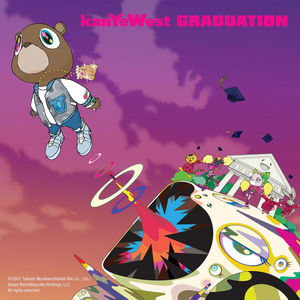
'Graduation' in 2007 pushed him further away from the sample-heavy intimacy of his first two albums and toward arena-sized electronic rap. Inspired in part by stadium rock, house music, and European electronic sounds, the album made his ambitions louder and more streamlined. 'Stronger', built around Daft Punk's 'Harder, Better, Faster, Stronger', turned a club pulse into a rap anthem, while 'Good Life' and 'Flashing Lights' polished his contradictions into gleaming pop surfaces. The album's commercial battle with 50 Cent's 'Curtis' became a symbolic moment in hip-hop: West outsold 50 Cent in first-week sales, helping mark a shift away from gangsta rap's dominance and toward a more emotionally varied, fashion-conscious, genre-fluid rap mainstream.
Then came the personal rupture that reshaped his music. In November 2007, Donda West died, a loss that deeply affected him. His engagement to Alexis Phifer also ended around that period. Instead of making another triumphant rap album, West made '808s & Heartbreak' in 2008, a cold, wounded record built around Auto-Tune vocals, sparse drum-machine programming, and open emotional exposure. At the time, some listeners found it jarring: West was singing more than rapping, and the music often felt skeletal. In retrospect, the album became one of his most influential works. Its use of Auto-Tune as an emotional instrument, not just a pop effect, helped open a path for artists such as Drake, Kid Cudi, Future, and many others who blurred rap, melody, sadness, and atmosphere. Songs like 'Love Lockdown' and 'Heartless' made alienation sound mechanical and intimate at the same time.
West's public image became more volatile in 2009 after he interrupted Taylor Swift's acceptance speech at the MTV Video Music Awards, an incident that caused a major backlash and became one of the defining celebrity controversies of the decade. Afterward, he retreated for a period and worked intensely on what became 'My Beautiful Dark Twisted Fantasy', released in 2010. The album is often treated as his grand comeback, but it is more interesting as an act of maximalist self-examination. Recorded partly in Hawaii with a large rotating cast of musicians, producers, and guests, it fused progressive rap, soul, orchestral flourishes, rock textures, and pop hooks into a dense, expensive-sounding statement about fame, appetite, shame, and power. 'Power' sounded like a monument to ego under siege. 'Runaway' turned apology into performance art, stretching a simple piano figure into a long, uneasy meditation on failure and narcissism. 'All of the Lights' gathered voices and brass into something almost architectural. The album did not make West look humble; it made his flaws part of the composition.
The early 2010s showed West moving between collaboration, luxury, and confrontation. 'Watch the Throne', his 2011 album with Jay-Z, was a lavish meeting of two artists thinking about wealth, Black success, history, and excess from inside the highest rooms of the music business. It produced major singles such as 'Otis' and 'N****s in Paris', but its most interesting quality was the way it balanced celebration with unease. West also used his GOOD Music label as a platform for other artists, and the 2012 compilation 'Cruel Summer' captured his growing interest in collective spectacle, even when the results were uneven.
'Yeezus', released in 2013, was West's most abrasive left turn. Where 'My Beautiful Dark Twisted Fantasy' was ornate, 'Yeezus' was stripped, harsh, and confrontational. The production drew on industrial music, acid house, drill, dancehall, and minimalist electronic textures. Rick Rubin was brought in late in the process and helped reduce the material, cutting away excess until the album felt jagged and exposed. 'New Slaves' attacked racism, consumer control, and luxury branding from within the contradictions of West's own life. 'Black Skinhead' used pounding drums and breathless aggression, while 'Bound 2' closed the record by suddenly returning to soul-sample warmth, almost like a glimpse of the old Kanye through a cracked screen. The album divided listeners, but it reinforced one of his defining traits: he often changed direction at the moment when repeating himself would have been easiest.
West's fashion ambitions were not a side project. For years he had wanted to be taken seriously beyond music, and he often spoke publicly about the barriers he faced entering the fashion world. His Yeezy partnership with Adidas, launched in the mid-2010s, became a major commercial success. The Yeezy Boost sneakers helped define the silhouette and color palette of 2010s streetwear: muted tones, sculptural soles, scarcity-driven drops, and a blend of athletic design with luxury minimalism. The fashion work fed back into the music. In 2016, he premiered 'The Life of Pablo' during the Yeezy Season 3 event at Madison Square Garden, turning an album launch into a fashion show, listening party, and public happening.
'The Life of Pablo' was chaotic even by West's standards, but its chaos was part of its identity. It moved between gospel uplift, fragmented rap, jokes, confession, and digital-age instability. 'Ultralight Beam' opened the album like a church service, with Chance the Rapper delivering one of the record's defining guest moments. 'Father Stretch My Hands Pt. 1' became a strange collision of sacred feeling and crude humor. West continued altering the album after release, describing it as a changing work rather than a fixed object. That approach was frustrating for some listeners, but it also anticipated a streaming-era idea of albums as updateable files. The supporting tour was eventually canceled in late 2016, and West was hospitalized, adding to the sense that his public and creative life had become increasingly unstable.
In 2018, West returned with a burst of Wyoming-recorded projects, including his solo album 'ye' and 'Kids See Ghosts', his collaboration with Kid Cudi. 'ye' was brief and uneven, but it openly addressed mental health and impulsivity in a way that felt raw, sometimes uncomfortably so. 'Kids See Ghosts' was more focused and widely admired, pairing Cudi's haunted melodic style with West's production instincts. The album used psychedelic textures, gospel fragments, and distorted rock energy to create a compact record about survival, fear, and release. Around the same period, West became increasingly associated with political controversy, including his public support for Donald Trump and a 2018 Oval Office meeting that drew enormous attention.
'Jesus Is King', released in 2019, marked another sharp turn: a gospel rap album centered on West's renewed Christian focus. It was connected to his Sunday Service performances, where gospel choirs reworked his songs and other popular music in a worship setting. The album itself was shorter and more restrained than his most celebrated work, but it showed how seriously he was thinking about faith as sound, not just subject matter. Choirs, organs, and devotional language replaced much of the profane, unstable energy that had defined earlier records. Whether listeners found it moving or incomplete, it was another example of West using an album to announce a change in identity.
'Donda', released in 2021 and named after his mother, was both a memorial gesture and a massive public event. Its rollout included stadium listening sessions, shifting track lists, masked appearances, and a sense that the album was being assembled in public. Musically, it was sprawling: gospel, trap, drill, organ-heavy minimalism, and meditations on grief, family, faith, punishment, and redemption. The album's strongest moments, including 'Come to Life', suggested that West could still turn personal crisis into music with emotional force. But the record also reflected the scale problem of his later work: huge ideas, huge casts, uneven editing, and a release process that sometimes overshadowed the songs.
The years after 'Donda' brought the most serious public consequences of West's career. In 2022, he made repeated antisemitic remarks and appeared in public wearing a shirt with the phrase 'White Lives Matter' during a Yeezy presentation. Social platforms restricted some of his accounts, companies and agencies distanced themselves from him, and Adidas ended its Yeezy partnership, stopping production of Yeezy-branded products and payments to Ye and his companies. The collapse of that partnership was not just a business setback; it marked a rupture in one of the most profitable artist-brand relationships in modern fashion. West issued apologies at different points, but later remarks and releases continued to provoke condemnation. By the mid-2020s, his reputation was inseparable from the harm and backlash caused by those statements.
Even in that damaged context, West continued releasing music. In 2024, he and Ty Dolla $ign released 'Vultures 1', a collaborative album distributed outside the major-label structure. It debuted at number one on the Billboard 200, showing that West still had a large audience despite industry fallout and public controversy. The album mixed trap, R&B, club textures, and the loose, sometimes unfinished feeling of his later work. Ty Dolla $ign's melodic flexibility gave the project a smoother center than many late-period West releases, while guest appearances and viral moments kept it in circulation. 'Vultures 2' followed later in 2024. In March 2026, West released 'Bully', continuing a late-career phase defined by independence, controversy, and a much more unstable relationship with mainstream institutions.
What makes West musically important is not simply that he had hits, won awards, or influenced fashion. It is that he repeatedly changed the emotional grammar of mainstream rap. 'The College Dropout' made room for the insecure middle-class striver who could be funny, spiritual, materialistic, and self-critical at once. 'Graduation' helped push hip-hop toward electronic pop scale. '808s & Heartbreak' altered the future of melodic rap and emotional Auto-Tune. 'My Beautiful Dark Twisted Fantasy' showed how maximalist production could turn celebrity disgrace into grand, self-lacerating theater. 'Yeezus' brought abrasive minimalism into the center of a major rap career. Even albums that arrived messily often contained production choices, vocal treatments, or release strategies that other artists later absorbed.
His creative process has often seemed obsessive, collaborative, and unstable. West is known for gathering large groups of musicians, producers, writers, engineers, and guests, then shaping fragments into songs through revision, sampling, subtraction, and sudden rearrangement. He has often behaved less like a traditional solo auteur than a director of rooms: choosing sounds, provoking performances, editing structures, and imposing a strong aesthetic frame even when many hands are involved. That method helped create some of the richest music of his generation, but it also contributed to the unevenness of later projects, where the line between open-ended experimentation and lack of discipline became harder to separate.
West's legacy is therefore difficult and unresolved. As an artist, he helped redesign hip-hop's sound, subject matter, fashion vocabulary, and relationship to pop culture. As a celebrity, he became a model for the modern artist as brand, designer, provocateur, and media event. As a public figure, he has caused real harm through antisemitic statements and other inflammatory actions that cannot be separated from how his later life is understood. The result is a career that resists clean celebration. Kanye West's best music remains deeply embedded in the sound of the 21st century, but the story around it has grown darker, stranger, and more troubling. To write about him honestly is to hold both truths at once: the producer-rapper who expanded what popular music could sound like, and the man whose public choices damaged the world he built around that music.