
Lamb Of God
Biography
Lamb of God came out of Richmond, Virginia with the sound of a band that did not seem built for compromise. Before they became one of the defining American metal bands of the 2000s, they were Burn the Priest, a rougher and more chaotic group formed in 1994 by musicians connected to Virginia Commonwealth University. Bassist John Campbell, drummer Chris Adler, and guitarist Mark Morton were part of the early core, with the lineup changing quickly as Morton temporarily left and guitarist Abe Spear entered the picture. Randy Blythe joined as vocalist in the mid-1990s, bringing a presence that was not simply about volume. His voice had the rasp and force of hardcore, but also the phrasing of someone who understood rhythm, tension, and confrontation. When Morton returned and Chris Adler's younger brother Willie Adler eventually joined on guitar, the essential Lamb of God shape was in place: Campbell's heavy, grounded bass, Chris Adler's precise and unusually musical drumming, Morton's blues-rooted leads and jagged riffing, Willie Adler's violent right-hand attack, and Blythe's body-as-weapon vocal delivery.
The Burn the Priest years matter because they explain why Lamb of God never sounded like a band assembled by a label to fit a metal trend. They came from a local scene of small venues, demos, split releases, and hard touring rather than from the machinery of mainstream rock. Their 1999 album 'Burn the Priest' was produced by Steve Austin of Today Is the Day, and it captured the band in a raw, nervous state: part hardcore, part death metal, part thrash, and still messy enough to feel dangerous. The name change to Lamb of God was not a softening of the music. It was a way to move forward with a changed lineup and avoid being reduced to assumptions about the old name. What followed was a rare case of a band becoming more focused without losing its hostility.
'New American Gospel', released in 2000, was the first real statement under the Lamb of God name. The album already contained many of the ingredients that would define them: low, locked-in grooves, sudden tempo shifts, clipped guitar patterns, and Blythe's barked vocals cutting through the instruments like a second rhythm section. It did not have the clarity or scale of the records that followed, but it established the band's identity at a time when American metal was still reacting to the commercial dominance of nu metal. Lamb of God were not nostalgic thrash revivalists, and they were not writing radio-friendly hooks. Their sound was built around physical impact, but the playing was disciplined. Chris Adler's drumming became one of the band's secret weapons, full of off-kilter cymbal patterns, sharp double-kick work, and fills that made the songs feel unstable without losing the groove.
The breakthrough began in earnest with 'As the Palaces Burn' in 2003. Produced by Devin Townsend with the band, it was a major leap in songwriting and intensity. The production was harsh and compressed, but that roughness became part of the album's character. Songs such as 'Ruin', '11th Hour', and 'Vigil' sounded like they were collapsing and rebuilding themselves in real time. The riffs were tighter, the arrangements more dramatic, and Blythe had begun to turn rage into something more pointed than aggression for its own sake. The album arrived at a moment when metal was splitting into scenes and sub-scenes, but Lamb of God cut across them. Hardcore audiences could understand the blunt force. Thrash fans could hear the riff craft. Technical players could hear how carefully the chaos was arranged.
What made 'As the Palaces Burn' important was not only its heaviness. It gave Lamb of God a sense of scale. The songs had a political and apocalyptic atmosphere, but they were also grounded in the exhausted feeling of early-2000s America, with its war imagery, media overload, and distrust of authority. The title itself felt like a warning rather than a pose. Years later the album was remixed and remastered for a 10th anniversary edition, a sign of how much its original sound had become both beloved and debated. The revised version revealed details that had been buried, but the original's suffocating quality remains part of its history: it sounded like a band fighting its way out of a basement and into a much larger world.
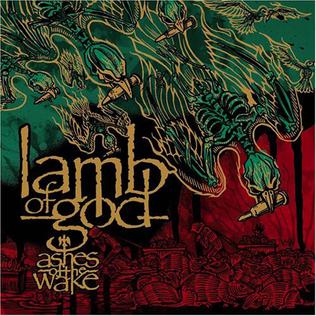
That larger world arrived with 'Ashes of the Wake' in 2004, the band's first major-label release and still one of the clearest examples of what Lamb of God could do at full strength. Recorded with producer Machine, the album sharpened the band's attack without polishing away the violence. 'Laid to Rest' became a signature song because it translated Lamb of God's complexity into something instantly recognizable: a riff that lunges forward, a chorus built more on impact than melody, and a vocal performance that feels both furious and controlled. 'Now You've Got Something to Die For' and 'Omerta' carried the same sense of martial momentum, while the instrumental title track used spoken material connected to the Iraq War, making the album's political anger unmistakable.
'Ashes of the Wake' worked because it was specific to its moment without becoming trapped in it. The Iraq War gave the album a target, but the music was not just protest set to riffs. The guitars moved between groove-metal weight and thrash velocity; the drums refused to sit still; the lyrics aimed at power, obedience, bloodshed, and the way public language can turn violence into abstraction. The album debuted strongly on the Billboard 200 and helped push Lamb of God into the front rank of the New Wave of American Heavy Metal, but it did so without sanding down their identity. They were now visible to a much larger audience, yet the music still sounded like it had been built in opposition to comfort.
Touring turned Lamb of God from an important metal band into a serious live force. Their performances were physical, confrontational, and extremely tight, with Blythe throwing himself around the stage while the musicians behind him played with almost mechanical precision. The 2005 live release 'Killadelphia' showed both sides of the band: the disciplined machine onstage and the combustible personalities offstage. It also made clear that Lamb of God were not a faceless heavy act. They had humor, tension, exhaustion, and a working-band toughness that came from years of grinding through venues before mainstream metal media fully caught up to them.
'Sacrament', released in 2006, was another turning point. Again working with Machine, the band made a darker, more personal record. If 'Ashes of the Wake' looked outward at war and political violence, 'Sacrament' turned inward toward addiction, depression, burnout, damaged relationships, and the psychic cost of life on the road. It was also more streamlined. The riffs were still severe, but the songs had a cleaner architecture, and tracks such as 'Redneck', 'Walk with Me in Hell', and 'Descending' helped the band reach a broader metal audience. 'Redneck' in particular became one of their most recognizable songs, partly because its swagger and contempt were easier to grasp on first listen than the denser material on earlier records.
The making and touring of 'Sacrament' revealed the cost of Lamb of God's momentum. The documentary material later included in 'Walk with Me in Hell' showed a band under pressure: endless travel, physical strain, internal friction, and the demands of becoming a global metal act. Blythe, who had long been associated with chaotic performance energy, later became open about sobriety and the need to survive the life he was living. That shift is important to understanding the band's later years. Lamb of God did not become gentler, but the rage became more disciplined, more adult, and less dependent on self-destruction.
'Wrath' in 2009 and 'Resolution' in 2012 showed the band trying to expand without abandoning its center. 'Wrath' had a leaner, less glossy sound than 'Sacrament' and included songs that kept the band in Grammy conversations, while 'Resolution' pushed into longer forms and moodier textures, ending with the ambitious 'King Me'. These records did not reinvent Lamb of God, but they proved that the band could keep refining its language: groove as punishment, thrash as propulsion, hardcore as attitude, and Southern heaviness as atmosphere. Mark Morton and Willie Adler remained a particularly important guitar pairing because they were not duplicates. Morton often brought a bluesier, more fluid sensibility, while Willie Adler's riffs had a serrated, percussive quality. Together they gave the band a recognizable fingerprint.
The most serious crisis in Lamb of God's history came from outside the usual story of records and tours. In 2012, Randy Blythe was arrested in the Czech Republic in connection with the death of a fan, Daniel Nosek, who had been injured after going onto the stage at a 2010 concert in Prague and later died. Blythe was charged, spent time in custody, returned to face trial, and was acquitted in 2013. The case was a devastating and unusual event in metal history, not only because of its legal stakes but because it forced a band known for physical live intensity to confront the real-world consequences of concert chaos, security failures, and the fragile boundary between performer and audience. The 2014 documentary 'As the Palaces Burn' shifted from its original concept into a record of that period, making the episode inseparable from the band's public story.
After that, 'VII: Sturm und Drang' in 2015 carried a different weight. The album was not simply a comeback, but a document of survival and reflection. '512', whose title referred to the number of the cell where Blythe had been held, addressed imprisonment without turning it into cheap drama. Musically, the album kept Lamb of God's core force but allowed more atmosphere and melodic shading than some listeners expected. The guest appearances, including Chino Moreno on 'Embers' and Greg Puciato on 'Torches', did not distract from the band's identity; they showed how far Lamb of God's influence had spread across heavy music. By this point, they were not just participants in a scene. They had become a reference point for younger metal bands trying to combine technical precision with pit-level impact.
The departure of Chris Adler changed the band's internal chemistry in a way fans could not ignore. Adler had been central from the beginning, and his drumming was one of the most identifiable elements in the band's sound. Art Cruz, who officially became the drummer in 2019 after first performing with the band live, entered a difficult position: he had to respect an established rhythmic language while proving he was not merely a substitute. The 2020 self-titled album 'Lamb of God' was the first full-length with Cruz, and it sounded like a band reasserting itself. Songs such as 'Memento Mori' and 'Checkmate' were direct, heavy, and contemporary, carrying the anger of the political and social climate without pretending to be a return to 2004.
'Omens', released in 2022, continued that late-career renewal. Produced by Josh Wilbur, who had worked with the band for years, it was recorded with an emphasis on live energy, giving the album a less sterile feel than many modern metal productions. The record did not radically redesign Lamb of God, but it showed the band leaning into immediacy. Art Cruz sounded more settled, the guitars retained their familiar bite, and Blythe's voice carried the authority of someone who had lived through the extremes that earlier Lamb of God songs sometimes seemed to court. 'Omens' debuted high on rock and hard rock charts, confirming that the band remained commercially strong decades into its career.
The 2018 Burn the Priest covers album 'Legion: XX' also deserves a place in the story because it showed the band's roots without overexplaining them. By reviving the old name for a set of punk, hardcore, and noise-rock covers, Lamb of God acknowledged the music that had shaped them before they became a modern metal institution. The point was not nostalgia. It was a reminder that underneath the precision and festival-stage power, they had begun as a band connected to underground aggression, weirdness, and do-it-yourself energy.
By the time 'Into Oblivion' arrived in 2026, Lamb of God had been active for more than three decades counting the Burn the Priest years. Few bands that began in small, hostile rooms survive long enough to become institutions, and fewer still do it while keeping their core sound recognizable. The album, again produced by Josh Wilbur, continued the band's late-career focus on live force, social unease, and controlled aggression. Their later music reflects age without sounding resigned: the riffs remain violent, but the perspective is broader. Blythe's public identity has also changed. Once known mainly as a ferocious frontman, he has become an author, photographer, spoken-word performer, and a more reflective figure, while still able to command a metal stage with frightening intensity.
Lamb of God's importance lies in the way they helped define what American metal could be after the 1990s. They took the groove of Pantera, the speed and attack of thrash, the blunt force of hardcore, and the technical demands of extreme metal, then built a language that was unmistakably theirs. They were never the most theatrical band, the most radio-friendly band, or the most mysterious band. Their power came from concentration: riffs that feel engineered for impact, drums that turn violence into architecture, and vocals that make anger sound like a physical discipline.
Their legacy is not only in album sales, festival slots, Grammy nominations, or the number of bands that followed their template. It is in the fact that Lamb of God made uncompromising metal feel central again at a time when heavy music could easily have split into nostalgia on one side and commercial compromise on the other. They proved that a band could be brutal, technically serious, politically aware, personally scarred, and still reach a mass audience. From 'As the Palaces Burn' to 'Ashes of the Wake', from 'Sacrament' to 'VII: Sturm und Drang', and through the Art Cruz era, their best work carries the same message: metal can be precise without becoming sterile, angry without becoming empty, and disciplined without losing danger.