
Led Zeppelin
Biography
Led Zeppelin began less like a carefully planned band than like a collision of four unusually strong musical personalities at exactly the right moment. Jimmy Page was already one of the most experienced guitarists in Britain before the group existed. As a London session player in the 1960s, he had learned how records were built from the inside: microphone placement, overdubs, tape atmosphere, arrangement, and the discipline of working quickly. He then joined the Yardbirds, first on bass and later as lead guitarist, inheriting a group that had already been a training ground for Eric Clapton and Jeff Beck. By 1968 the Yardbirds were collapsing, but Page still had Scandinavian tour dates to fulfill. Instead of treating the obligation as an ending, he used it as the beginning of something heavier, stranger, and more ambitious.
The first version of the new group was briefly billed as the New Yardbirds. Page wanted a band that could move beyond the standard blues-rock format, and the personnel came together with unusual speed. John Paul Jones, another highly skilled session musician, had heard that Page was forming a new group and contacted him about the bass position. Jones brought far more than bass: he was an arranger, keyboard player, and musician with a deep understanding of orchestration and studio craft. Robert Plant, a young singer from the Midlands, was recommended after Page saw him perform. Plant had a voice that could leap from blues phrasing to banshee-like high notes, but he also brought a fascination with folk, mythology, and older musical traditions. Plant then suggested drummer John Bonham, his friend from the Birmingham-area scene and a player whose force was not simply volume, but weight, timing, and authority. Bonham was not easy to secure, because he was already working and had offers elsewhere, but once he joined, the chemistry was immediate.
One of the most repeated early stories about Led Zeppelin is also one of the most revealing. The four musicians first rehearsed in a small room on Gerrard Street in London and played a version of 'Train Kept A-Rollin'', a Yardbirds number with roots in earlier rock and roll. What mattered was not the song itself but the shock of the sound. Page later described the first rehearsal as an instant recognition that the group had something powerful. That moment helps explain why Led Zeppelin sounded so complete on their debut album. They did not spend years searching for an identity in public. They arrived with one: blues roots, folk shadows, hard rock impact, and a producer-guitarist in Page who understood how to make space feel enormous on tape.
Their self-titled debut, recorded in 1968 and released in early 1969, was made quickly, with Page financing the sessions before the band secured its Atlantic Records deal. That independence mattered. It meant the group entered the record business with unusual leverage and a finished sound. 'Led Zeppelin' was built from blues forms, but it did not simply imitate Chicago or Delta blues. On 'Good Times Bad Times', Bonham's bass drum patterns announced a drummer who could make rhythm sound both athletic and immovable. 'Dazed and Confused', adapted from a song by Jake Holmes and transformed through Page's Yardbirds-era experiments, became a long, dramatic vehicle for tension and release. 'Babe I'm Gonna Leave You' showed another side: acoustic guitar, quiet-loud dynamics, and Plant singing as if the song were being pulled out of him in real time. Page's production style was already central. He liked depth, contrast, and the feeling of a band occupying a physical space rather than being flattened by the studio.
The band's rise was unusually fast, especially in the United States. Peter Grant, their formidable manager, pushed for strong fees, album-oriented promotion, and control over how the group was presented. Led Zeppelin were not built as a singles act, even though individual songs became radio staples. Their reputation grew through touring, where the songs stretched, mutated, and became more dangerous than their studio versions. Page could be precise or chaotic depending on the night; Plant turned blues moans into a new kind of rock-frontman vocabulary; Jones held the architecture together; Bonham made the music swing even when it sounded like machinery. They were loud, but their best performances were not only about loudness. They were about scale.
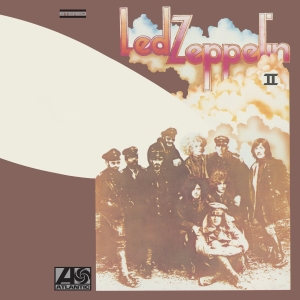
'Led Zeppelin II', released in 1969, captured the band while they were almost constantly on the road. Parts of it were recorded between shows in different studios, and that restless origin is part of its character. It is less spacious than the debut and more aggressive, with Page using riffs as weapons and the rhythm section driving hard behind him. 'Whole Lotta Love' became one of the defining hard-rock recordings of its era, not only because of its riff but because of its middle section, where echo, panning, theremin-like sounds, and studio manipulation turn the track into a brief psychedelic rupture. 'Heartbreaker' placed Page's guitar in the foreground with a solo that sounded raw and exposed, while 'Ramble On' mixed acoustic textures with Tolkien-inspired imagery, showing that Zeppelin's heaviness was already tied to fantasy, travel, and escape. The album's success made them one of the major rock bands of the moment, but it also intensified criticism over their use of blues material and songwriting credits, an issue that would follow them for decades.
Instead of making a simple sequel to 'Led Zeppelin II', the group retreated to Bron-Yr-Aur, a remote cottage in Wales, where Page and Plant worked on acoustic material. The result, 'Led Zeppelin III', surprised listeners who expected only amplification and force. The album still opened with the galloping attack of 'Immigrant Song', but much of it leaned into folk, country-blues, and pastoral atmosphere. 'Gallows Pole' reworked a traditional song with banjo and mandolin textures that build into a stomp. 'Tangerine' carried traces of Page's Yardbirds past and showed the band's ability to be gentle without becoming soft. At the time, some critics and fans misunderstood the shift, but the album is crucial because it widened the band's map. Led Zeppelin were not just inventing a heavier rock language; they were arguing that heaviness could coexist with old songs, mountain air, and acoustic mystery.
Their fourth album, released in 1971 without a printed band name on the cover, became the record that fixed Led Zeppelin most deeply in popular memory. The decision to use symbols instead of conventional identification was partly a response to critical hostility and partly an assertion of mystique. The music justified the confidence. 'Black Dog' was built around a twisting riff and call-and-response vocal structure that feels deliberately off balance. 'Rock and Roll' paid tribute to early rock while sounding much larger than its sources. 'The Battle of Evermore' brought Sandy Denny into a folk-drama setting, making the band's mythic interests explicit without turning them into mere decoration. And then there was 'Stairway to Heaven', a song that moved from acoustic delicacy to electric climax so gradually that it became almost a model for rock escalation. Its fame later made it easy to mock, but the construction is still remarkable: the track grows through arrangement rather than simple repetition, with Page's guitar solo serving as a bridge between spiritual hush and full-band release.
The same period showed how carefully Led Zeppelin balanced secrecy and spectacle. They rarely behaved like a band that wanted to explain itself. Album covers were cryptic, interviews could be evasive, and the live shows became events rather than simple concerts. Page, especially, cultivated an aura around sound, symbols, and the occult, including his well-known interest in Aleister Crowley. Plant, by contrast, projected warmth, sensuality, and an almost golden openness onstage, though his lyrics often wandered through myth, landscape, and loss. Jones was the quiet professional, essential but less visibly theatrical. Bonham was the engine, capable of terrifying power but also subtle groove, particularly in the way he placed beats slightly behind or ahead of expectation. Their personalities did not blend into one image; they created tension inside the band.
'Houses of the Holy', released in 1973, proved that Zeppelin were still restless. It was cleaner, brighter, and more playful than the fourth album, with the band pushing into funk, reggae influence, and layered studio color. 'The Song Remains the Same' rushed forward like a travel fantasy, while 'The Rain Song' used unusual tuning and orchestral colors from Jones's Mellotron to create one of their most elegant arrangements. 'Over the Hills and Far Away' moved from acoustic folk opening to electric surge, a favorite Zeppelin technique refined into a compact form. 'No Quarter', led by Jones's keyboards, was dark, slow, and almost aquatic, showing how far the band could drift from blues-rock without losing its identity. Not everything was solemn: 'D'yer Mak'er' reflected the group's willingness to play with styles, even when the results divided listeners. That range was part of their point. Led Zeppelin could be majestic, silly, brutal, delicate, and strange, sometimes on the same record.
By the mid-1970s, Led Zeppelin had become not only a band but an institution with its own private world. They launched Swan Song Records in 1974, giving themselves another layer of independence. Their 1975 double album 'Physical Graffiti' may be the fullest statement of their range because it combined new recordings with strong earlier outtakes. Rather than feeling like leftovers, the mixture made the album sprawl in a way that suited them. 'Custard Pie' and 'The Rover' were riff-driven and direct, while 'In My Time of Dying' stretched blues and gospel source material into a monumental performance. 'Trampled Under Foot' drew from funk and clavinet-driven grooves, with Jones playing a central role in the track's movement. 'Kashmir', one of the band's greatest achievements, was built on a hypnotic guitar figure, Bonham's massive measured beat, and orchestral arrangement that suggested distance and grandeur without relying on a conventional chorus. Its power comes from suspension: the song does not rush to resolve, it advances like a landscape.
The making and reception of 'Physical Graffiti' also revealed Zeppelin's unusual relationship with excess. They were working on a huge scale: long tours, elaborate packaging, private jets, massive venues, and a mythology that grew with every rumor. Some of that mythology has aged badly, and accounts of the band's touring life include behavior that was destructive, indulgent, and sometimes cruel. A responsible biography cannot pretend that the darkness was only glamour. At the same time, the records show a band still deeply committed to musical craft. Page's production was never accidental; Jones's arrangements kept expanding the harmonic palette; Bonham's drum sound became a model for generations; Plant, even at his most flamboyant, gave the songs a human cry rather than merely a display of range.
After 'Physical Graffiti', hardship entered the story more directly. In 1975, Robert Plant and his wife Maureen were seriously injured in a car accident in Greece. Plant spent time recovering, and the band had to rethink its schedule. The next album, 'Presence', released in 1976, was recorded quickly in Munich while Plant was still recovering and sometimes singing from a wheelchair. That pressure shaped the record. It is leaner and more guitar-centered than its predecessor, with little of the acoustic or keyboard color that had broadened earlier albums. 'Achilles Last Stand' dominates the album: a long, charging piece with layered guitars, relentless bass, and lyrics full of travel and endurance. It sounds like a band trying to summon motion while physically constrained. 'Presence' was commercially successful, but its mood is tense, almost isolated. It lacks the communal warmth of some earlier Zeppelin records, and that makes it one of their most revealing works.
The concert film and soundtrack 'The Song Remains the Same', drawn from 1973 Madison Square Garden performances and released in 1976, added another layer to the band's image. The fantasy sequences in the film could be self-indulgent, but they also showed how each member had become a character in the Zeppelin universe: Page as a seeker of hidden knowledge, Plant as a romantic wanderer, Jones as a figure of elegance and mystery, and Bonham as the earthy family man and powerhouse drummer. The film was not a perfect document of the band at its live peak, but it captured the scale of what Led Zeppelin had become: a group whose concerts were treated almost like ceremonies by their audience.
In 1977, tragedy struck again when Plant's young son Karac died while the band was on a North American tour. The remaining dates were canceled. The loss changed the emotional temperature around Zeppelin and deepened Plant's ambivalence about the machinery of the band. When they returned with 'In Through the Out Door' in 1979, the sound had shifted. Recorded at Polar Studios in Stockholm, the album gave John Paul Jones a more prominent role, partly because Page and Bonham were struggling with serious personal problems and were not always as present in the creative process. Synthesizers and keyboards shaped much of the record. 'In the Evening' retained a heavy Zeppelin atmosphere, but 'Fool in the Rain' used a shuffle groove and Latin-flavored break, while 'All My Love' was unusually tender and has often been understood in relation to Plant's grief, though the song should not be reduced only to biography. The album showed a possible path forward: less blues thunder, more color, more adult melancholy. Whether that path would have lasted is impossible to know.
John Bonham died in September 1980 after a period of heavy drinking; the inquest recorded an accidental death. The surviving members decided that Led Zeppelin could not continue without him. Their statement was brief, but the decision was musically honest. Bonham was not a replaceable drummer in the usual sense. His sound was part of the band's composition, as central as Page's guitar or Plant's voice. His kick drum patterns, snare placement, cymbal feel, and instinct for space made Zeppelin's riffs breathe. Without him, the name would have meant something different.
The years after the breakup were filled with partial returns, archive projects, and careful protection of the band's legacy. 'Coda' appeared in 1982 as a collection of unreleased material. Page and Plant reunited in the 1990s for the MTV project 'No Quarter', reworking Zeppelin material with Egyptian and Moroccan musicians and orchestral arrangements, though Jones's absence from that project was notable. The surviving members performed together on a few special occasions, with the most celebrated reunion taking place at London's O2 Arena in 2007, with Jason Bonham, John's son, on drums. That performance was later released as 'Celebration Day'. It mattered because it avoided the feeling of a casual nostalgia show. Jason Bonham did not imitate his father mechanically; he honored the architecture of the songs while giving the surviving members a foundation strong enough to revisit the music with dignity.
Led Zeppelin's legacy is complicated because their greatness and their problems are both real. Their borrowing from blues and folk traditions led to disputes and later credit changes on some songs, and those issues remain part of any serious assessment of the band. They drew heavily from Black American blues, old folk material, rock and roll, and British electric blues, sometimes transforming sources brilliantly and sometimes failing to credit origins adequately. Yet their influence cannot be measured only in sales or riffs. They changed what a rock album could feel like: not just a set of songs, but a world with its own weather. They helped establish the album as the main statement for hard rock bands, made long tracks commercially viable, and turned concerts into spaces for improvisation, volume, and ritual.
Musically, their uniqueness came from balance. Page was not merely a guitarist; he was a producer who thought in layers, distance, and drama. Plant was not merely a high singer; he connected blues phrasing, folk imagination, and physical performance. Jones was the band's hidden architect, giving songs harmonic intelligence and instrumental range. Bonham gave the music its body. Many later bands copied Zeppelin's surface: the high voice, the heavy riff, the mystical imagery, the thunderous drums. Fewer captured the internal push and pull that made the records last: brutality against delicacy, control against risk, ancient source material against modern amplification.
Today Led Zeppelin are remembered as one of the central bands in the development of hard rock and heavy metal, but that description is too narrow if it stands alone. They were also a folk-rock band, a blues-rock band, an art-rock band when they wanted to be, and a studio project guided by a guitarist with a producer's imagination. Their best music still feels alive because it refuses to stay in one lane. A song can begin like an old ballad, turn into a storm, and end as something closer to myth. That was Led Zeppelin's real achievement: they made rock music feel huge without making it simple.