
Mahavishnu Orchestra
Biography
Mahavishnu Orchestra began as John McLaughlin's attempt to build a band that could play the music he was hearing after the late 1960s had blown apart the borders between jazz, rock, blues, Indian classical music, and electric improvisation. McLaughlin was born in Yorkshire, England, and came to the group with a rare background: he had played in British rhythm and blues circles, recorded the searching solo album 'Extrapolation', joined Tony Williams' explosive Lifetime, and then entered the electric world of Miles Davis on sessions connected to 'In a Silent Way', 'Bitches Brew', 'Jack Johnson', 'Live-Evil', and 'On the Corner'. Those experiences mattered because Mahavishnu Orchestra was not simply a rock band borrowing jazz chords, or a jazz band turning up the volume. It was the sound of a guitarist who had already stood inside some of the most radical music of his time and wanted to make something even more concentrated, disciplined, and dangerous.
The name came from McLaughlin's association with the Indian spiritual teacher Sri Chinmoy, who gave him the name Mahavishnu. That spiritual connection shaped the language around the group, from titles such as 'The Inner Mounting Flame' and 'Birds of Fire' to the sense that the music was trying to reach beyond ordinary display. But the band itself was built with very practical precision. In New York in 1971, McLaughlin assembled a quintet of musicians who could meet his writing at full speed: Billy Cobham on drums, Rick Laird on bass, Jan Hammer on keyboards, and Jerry Goodman on violin. Cobham brought immense power, crisp articulation, and a drummer's command of odd accents that could make complex meters feel physical rather than merely clever. Laird, an Irish bassist with deep jazz experience, gave the group a center of gravity. Hammer, from Czechoslovakia, was not just a keyboardist but a solo voice, able to make electric piano and synthesizer answer McLaughlin's guitar with their own bite. Goodman, formerly of The Flock, made the violin a lead instrument in a setting where it could cut through amplifiers, distortion, and drums like a second electric guitar.
The early version of the band rehearsed intensely and began playing in New York before entering the studio. One often repeated story about their beginning is that they opened for John Lee Hooker at a Greenwich Village club. The pairing was odd on paper: Hooker's deep blues pulse on one side, Mahavishnu Orchestra's jagged unison lines and burning meters on the other. Yet it also shows how the group arrived in the real world, not as a protected conservatory project but as a loud, startling live act that had to win people over in rooms where listeners might not have known what to call the music. Their sound was precise, but it was not polite. It had the volume and attack of rock, the improvisational nerve of jazz, the rhythmic cycles and modal flavor McLaughlin drew partly from Indian music, and the kind of ensemble discipline associated with chamber music.
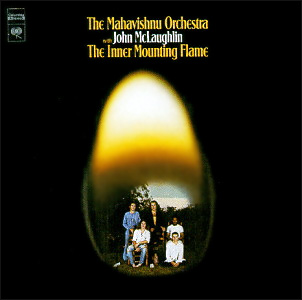
The debut album, 'The Inner Mounting Flame', was recorded in 1971 and released by Columbia later that year. It is still the clearest statement of the original band's shock value. The record opens with 'Meeting of the Spirits', a title that sounds mystical but a performance that feels almost aerodynamic: guitar, violin, and keyboard lines moving in hard-edged unison before the rhythm section opens the ground beneath them. 'The Noonward Race' is even more direct, a sprint in which Cobham's drumming turns the beat into a moving obstacle course. 'You Know You Know' reveals another side of the band, slower and more spacious, with a melody that later hip-hop producers would recognize for its stark atmosphere. What made the album different from much early fusion was not only speed. It was architecture. McLaughlin wrote themes with sharp intervals, sudden stops, unusual meters, and fast scalar passages, but the pieces still had dramatic shapes. The solos were wild, yet they usually exploded from tightly built frames.
The band's instrumentation was central to its identity. McLaughlin's guitar sound, often associated with his Gibson double-neck and loud amplifiers in the early years, had a fierce, singing sustain. Hammer's keyboards could shimmer, snarl, or bend like another guitar, especially as synthesizers became more important to the band's color. Goodman's violin gave the music an urgent human edge, sometimes lyrical, sometimes almost abrasive. Cobham did not simply keep time; he attacked the music with the force of a lead instrumentalist, using rolls, cymbal crashes, and kick patterns as structural events. Laird's role can be easy to underrate because the surrounding musicians were so spectacular, but his bass lines kept the band from flying apart. In a group full of virtuosos, he often supplied the essential discipline.
'Birds of Fire', released in 1973, sharpened and broadened the original formula. The title track is one of the band's defining pieces: a compact burst of electric dissonance, racing figures, and sudden rhythmic turns. 'Miles Beyond' openly acknowledged McLaughlin's debt to Miles Davis, but it did not imitate Davis' spacious electric music; it translated that debt into Mahavishnu's own faster, more angular language. 'Celestial Terrestrial Commuters' and 'One Word' showed how the group could move from tightly composed passages into extended improvisational pressure. The album also used studio texture more boldly than the debut, with synthesizer colors and production choices giving the music a more polished but still volatile surface. If 'The Inner Mounting Flame' sounded like a band arriving fully armed, 'Birds of Fire' sounded like a band realizing how much territory it could seize.
The intensity that made Mahavishnu Orchestra thrilling also made it unstable. The original quintet toured heavily, and the music demanded extreme concentration every night. Creative tensions grew around leadership, writing credits, spirituality, and the balance between McLaughlin's vision and the other members' strong musical personalities. This was not a band of sidemen. Cobham, Hammer, Goodman, and Laird were all powerful enough to shape the music, and that power made the group great while also making it difficult to contain. The live album 'Between Nothingness and Eternity', recorded at the Schaefer Music Festival in Central Park in August 1973 and released later that year, captures the original lineup near its breaking point. It is not as cleanly sculpted as the studio albums, but that is part of its force. The performances stretch, flare, and push the written material into a public test of stamina.
A studio album by the original lineup was recorded in 1973 but left unreleased at the time after the band fell apart. Those recordings eventually appeared decades later as 'The Lost Trident Sessions'. Their delayed release changed the way listeners could understand the group. Instead of seeing 'Between Nothingness and Eternity' as the only final statement of the first Mahavishnu Orchestra, fans could hear a studio document of where the quintet was heading: still intricate, still fiery, but with signs of each member's voice pulling against the frame. The fact that such strong music remained shelved for so long also underlines how quickly the original group burned through its possibilities. In barely two years, it created a vocabulary that other musicians spent decades studying.
After the first lineup ended, McLaughlin did not abandon the name. He rebuilt Mahavishnu Orchestra on a larger scale, bringing in drummer Narada Michael Walden, bassist Ralphe Armstrong, keyboardist and singer Gayle Moran, violinist Jean-Luc Ponty, and additional orchestral forces. The 1974 album 'Apocalypse' was a bold turn: produced by George Martin and recorded with the London Symphony Orchestra under Michael Tilson Thomas, it treated Mahavishnu not just as a fusion band but as a vehicle for symphonic drama. The result is grander, more arranged, and more theatrical than the first lineup's records. It does not have the same five-person knife-edge chemistry, but it shows McLaughlin trying to expand the spiritual and compositional scale of the project rather than repeat the debut formula.
'Visions of the Emerald Beyond', released in 1975, brought the second incarnation closer to a band sound while keeping the expanded colors. Narada Michael Walden was a different kind of drummer from Billy Cobham: more elastic in some grooves, more openly connected to funk and vocal music, and capable of explosive fills without sounding like a copy of his predecessor. Jean-Luc Ponty, whom McLaughlin had wanted to work with earlier, gave the violin role a more polished and classically fluent personality. Gayle Moran's voice and keyboards added a texture that would have been almost unimaginable on 'The Inner Mounting Flame'. This period was less stark and less terrifying than the original quintet, but it had its own ambition, moving toward a fusion of jazz-rock, orchestral color, funk, and devotional atmosphere.
By 'Inner Worlds' in 1976, the group had narrowed again, and the music reflected both changing tastes and a less unified identity. The mid-1970s fusion world was evolving quickly. Some players moved toward funk, some toward progressive rock, some toward smoother studio production, and McLaughlin himself would increasingly pursue other paths, most importantly the acoustic Indo-jazz group Shakti. Compared with Shakti's intimate dialogue with Indian classical traditions, the later Mahavishnu records can feel like the end of a storm. They still contain extraordinary playing, but the original question that had powered the first band had changed. The early Mahavishnu Orchestra asked how much speed, volume, spiritual aspiration, rhythmic complexity, and improvisational risk could be fused into one ensemble before it combusted. By the later 1970s, the combustion had already happened.
The band name returned in the 1980s, when McLaughlin recorded and performed with a new electric Mahavishnu lineup that included musicians such as Bill Evans, Jonas Hellborg, Mitchel Forman, Danny Gottlieb, and later Jim Beard. Albums like 'Mahavishnu' and 'Adventures in Radioland' reflected the sound of their era, with digital keyboards, tighter production, and a different relationship to jazz fusion than the raw 1971 group had embodied. These records are part of the story, but they did not redefine the name in the way the first two studio albums had. By then, Mahavishnu Orchestra was already a reference point, a challenge, and in some ways a myth that even McLaughlin could not simply recreate.
What made Mahavishnu Orchestra unique was the tension between spiritual language and almost violent musical execution. The titles suggested transcendence, devotion, and inner fire; the performances often arrived like controlled explosions. McLaughlin's compositions used odd meters, rapid unison lines, modal harmony, and abrupt dynamic shifts, but the band did not sound like musicians solving puzzles. At its best, it sounded like five people arguing in a shared language at impossible speed. That is why the music appealed beyond jazz audiences. Rock listeners could respond to the volume and drama. Jazz listeners could hear the improvisational sophistication. Progressive rock fans could admire the complexity. Drummers, guitarists, keyboardists, violinists, and bassists could each find a masterclass inside the same recording.
The group's influence is wide because it gave later musicians permission to be both technically extreme and emotionally intense. Its impact can be heard in jazz-rock fusion, progressive metal, instrumental rock, jam-band virtuosity, and any music that treats odd meters and high-level musicianship as vehicles for excitement rather than academic display. Billy Cobham and Jan Hammer went on to major careers of their own, and McLaughlin continued to move through electric fusion, acoustic Indian collaboration, guitar trio formats, and orchestral writing. But the original Mahavishnu Orchestra remains the moment when all those forces met in their most unstable form.
Mahavishnu Orchestra did not last long in its classic incarnation, and that brevity is part of its power. The first lineup's work from 1971 to 1973 feels less like a normal career phase than a flare: sudden, brilliant, and difficult to repeat. The later versions expanded the concept, sometimes impressively, but the core legend rests on the quintet that made 'The Inner Mounting Flame', 'Birds of Fire', and the live music around 'Between Nothingness and Eternity'. They turned fusion into something fierce, disciplined, and almost overwhelming. The band mattered because it proved that virtuosity could be more than display: in the right hands, it could become drama, pressure, release, and a search for something larger than genre.