
Metallica
Biography
Metallica began as a small Los Angeles collision of impatience, ambition, and record-collector obsession. Lars Ulrich, a Danish teenager who had moved to California with tennis in his family background and heavy metal in his head, placed an advertisement in the Los Angeles paper The Recycler in 1981 looking for musicians interested in the faster, harder end of British metal. James Hetfield answered. Hetfield had grown up in Downey, California, shaped by a strict Christian Science household, early family loss, and a deep attraction to the force of hard rock. He was not yet the commanding frontman he would become. He was a shy, heavy-handed rhythm guitarist with a tense, cutting voice and an unusually exact sense of attack. Ulrich was not a polished drummer either, but he had drive, contacts, records, and a hunger to build a band around the new sounds coming from groups like Diamond Head, Motorhead, Saxon, and Venom.
The first version of Metallica was messy, raw, and unstable, but the core idea was already clear: take the drama and riffs of the New Wave of British Heavy Metal and push them faster, tighter, and more aggressive. Dave Mustaine, a sharp and volatile lead guitarist, brought speed, danger, and a jagged melodic vocabulary. Ron McGovney played bass in the earliest lineup, but the band changed direction when Hetfield and Ulrich saw Cliff Burton performing with Trauma. Burton was not just a bassist in the usual supporting role. He played with distortion, wah-wah, classical influence, and a loose, almost psychedelic imagination. Metallica wanted him badly enough that they agreed to relocate to the San Francisco Bay Area, where Burton preferred to stay. That move mattered. The Bay Area thrash scene gave Metallica a tougher, more serious environment than the glam-dominated Los Angeles clubs, and the band quickly became part of a new underground built on tape trading, denim jackets, independent record shops, and fans who wanted metal to feel dangerous again.
In 1983, shortly before recording their debut album, Metallica dismissed Mustaine because of conflicts inside the band, including his drinking and violent behavior. He was sent back to California from New York by bus, a bitter episode that later became part of thrash metal history because Mustaine went on to form Megadeth. Kirk Hammett, then guitarist for Exodus, was brought in quickly. Hammett had studied with Joe Satriani and brought a more fluid, blues-informed lead style, less combative than Mustaine's but essential to Metallica's classic sound. The debut album, 'Kill 'Em All', was recorded on a modest budget and still sounds like a band racing ahead of its own technical limits. Its songs were fast, riff-packed, and direct, with Hetfield's bark sitting on top of Ulrich's restless drumming and Burton's distorted bass lines. Tracks like 'Hit the Lights', 'The Four Horsemen', 'Whiplash', and 'Seek & Destroy' helped define thrash metal not as a polished genre but as a physical experience: speed, precision, mosh-pit intensity, and youthful defiance turned into song structure.
Metallica's second album, 'Ride the Lightning', made clear that the band was not interested in remaining a one-dimensional speed act. Recorded in Copenhagen and released in 1984, it expanded the band's vocabulary with longer forms, acoustic passages, darker harmonies, and more ambitious themes. The album moved from the martial force of 'Fight Fire with Fire' into the doomed grandeur of 'For Whom the Bell Tolls', where Burton's bass introduction sounded almost like a distorted lead instrument. 'Fade to Black' was especially important because it introduced vulnerability into Metallica's music without softening its weight. Some early fans resisted the idea of an acoustic opening and a more emotional lyric, but the song became one of the band's defining pieces. 'Creeping Death' gave them a concert staple built on biblical imagery and a massive chant, while 'The Call of Ktulu' showed their interest in instrumental atmosphere and classical-style development. With this album, Metallica proved that extremity could coexist with composition.
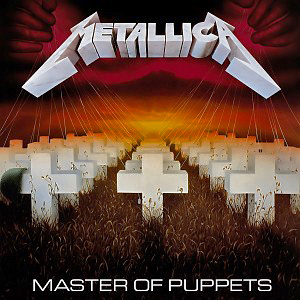
The band's breakthrough as a major creative force came with 'Master of Puppets' in 1986. By then Metallica had signed to Elektra, but the album did not compromise the band's underground identity. It refined everything they had been building: fast sections, precise rhythm changes, harmonized guitars, bleak subject matter, and long songs that moved like miniature dramas. The title track, built around addiction and control, became one of metal's most studied compositions, shifting from crushing down-picked riffs to a melodic middle section and back into violence with remarkable control. 'Battery' opened with delicate acoustic guitars before exploding into speed. 'Welcome Home (Sanitarium)' used dynamics and restraint to create tension rather than simply overwhelming the listener. 'Orion', Burton's great instrumental showcase, revealed how much musical color he gave the band. His bass was not decoration; it was part of the architecture.
The success of 'Master of Puppets' was followed almost immediately by tragedy. On September 27, 1986, while Metallica were touring in Sweden, the band's bus crashed. Cliff Burton was killed at age 24. His death left a permanent shadow over Metallica's story, not only because he was loved by the band and fans, but because he represented a particular version of Metallica: adventurous, musically curious, and unafraid of strange beauty inside heavy music. The band chose to continue and hired Jason Newsted, formerly of Flotsam and Jetsam. Newsted entered a group that was grieving, drinking heavily, and already bonded by years of struggle. He brought energy and commitment, but he also endured harsh treatment from the other members, something the band later acknowledged. His first full studio album with Metallica, '...And Justice for All', arrived in 1988 and sounded like grief turned into machinery.
'...And Justice for All' is one of Metallica's most severe records. Its production is famously dry, with Newsted's bass mixed so low that it is barely audible, a decision that has been debated for decades. Musically, the album is complex and unforgiving. Songs like 'Blackened', 'Harvester of Sorrow', and the title track move through long, angular arrangements, with riffs stacked in ways that can feel almost architectural. The centerpiece, 'One', adapted the antiwar horror of Dalton Trumbo's novel 'Johnny Got His Gun' into a slow-building nightmare. The band made its first music video for the song, using stark performance footage intercut with scenes from the film adaptation. For a band that had once rejected commercial presentation, the video became a major step into broader visibility without abandoning the seriousness of the music. Metallica were no longer only an underground phenomenon; they were becoming a major rock band on their own terms.
The decisive turn came with 1991's self-titled album, widely known as 'The Black Album'. Working with producer Bob Rock, Metallica stripped down the long structures and focused on groove, clarity, and impact. The process was difficult. Rock pushed the band toward tighter performances, stronger vocal takes, and a heavier recorded sound that would translate beyond the thrash audience. Hetfield's voice deepened into a more controlled instrument, and the guitars became enormous rather than merely fast. 'Enter Sandman' gave Metallica a sinister, simple riff that became a global rock anthem. 'Sad but True' slowed the band into a crushing stomp. 'The Unforgiven' and 'Nothing Else Matters' showed a new willingness to write openly melodic and personal material. The album made Metallica one of the biggest bands in the world, but it also changed the argument around them. To some fans, it was a betrayal of thrash complexity; to others, it was proof that heavy music could dominate the mainstream without losing its darkness.
Metallica spent much of the early 1990s becoming a stadium-level band, and that success changed their identity. The long tours behind 'The Black Album' made them more professional, more visible, and more separated from the underground that had raised them. When they returned with 'Load' in 1996 and 'Reload' in 1997, the shift was not only musical but visual. The band cut their hair, adopted a more styled image, and leaned into bluesy hard rock, Southern grooves, alternative rock textures, and looser song forms. 'Until It Sleeps', 'Hero of the Day', 'King Nothing', 'Fuel', and 'The Memory Remains' did not sound like the Metallica of 1986, but they reflected a band trying to avoid becoming a museum version of itself. The reaction was divided. Some listeners heard maturity and range; others heard a loss of danger. In hindsight, those records show Metallica wrestling with the problem faced by many extreme bands that become massive: how to keep changing when a large part of the audience wants the past preserved exactly.
The late 1990s and early 2000s exposed Metallica's internal tensions more publicly than ever. In 1999, 'S&M' paired the band with the San Francisco Symphony under conductor Michael Kamen. The project could have been a novelty, but it worked because Metallica's music had always contained dramatic structures and classical gestures, especially in the Burton-era material. Then came the Napster controversy in 2000, when the band sued the file-sharing service after discovering that unreleased and catalog material was being traded online. Many fans saw the lawsuit as rich rock stars attacking music listeners, while the band argued that artists should control their own work. The dispute made Metallica central to a much larger debate about digital music, ownership, and the future of the recording industry. It also damaged their public image at a moment when the internet was beginning to reshape fan culture.
Jason Newsted left Metallica in 2001, citing physical strain and frustration, including limits on his outside creative work. Around the same time, Hetfield entered rehab for alcohol and related issues. The making of 'St. Anger' was captured in the documentary 'Some Kind of Monster', which showed the band in therapy, arguing, breaking down, and trying to understand whether Metallica could still exist. The film is uncomfortable because it strips away the armor that had defined the band. These were not untouchable metal warriors but middle-aged musicians with resentment, money, addiction, ego, and history between them. 'St. Anger', released in 2003 with producer Bob Rock playing bass during recording, remains one of the most divisive albums in their catalog. It has no guitar solos, a raw rehearsal-room feel, and a snare drum sound that became infamous. Yet it also documents a real crisis. Its anger is not theatrical; it sounds like a band trying to function while its usual language has collapsed.
Robert Trujillo joined Metallica after the recording of 'St. Anger', bringing a powerful fingerstyle technique, deep groove, and experience from Suicidal Tendencies and Ozzy Osbourne's band. His arrival helped stabilize Metallica as a live unit. The next major studio step, 'Death Magnetic' in 2008, was widely heard as an attempt to reconnect with the band's 1980s architecture: long songs, fast riffs, solos, instrumental passages, and more intricate arrangements. Produced by Rick Rubin, the album did not simply recreate the past, but it clearly tried to restore elements that had been missing from 'Load', 'Reload', and 'St. Anger'. Songs like 'That Was Just Your Life', 'The Day That Never Comes', and 'All Nightmare Long' showed a band consciously re-engaging with its thrash vocabulary after years of experimentation and public turbulence.
Metallica's later career has been marked by a balance between legacy and ongoing work. They were inducted into the Rock and Roll Hall of Fame in 2009, a symbolic moment for a band that had once seemed too abrasive for traditional rock institutions. They played with Lou Reed on 'Lulu' in 2011, a collaboration that was widely criticized but also showed their willingness to risk embarrassment rather than only make safe brand decisions. 'Hardwired... to Self-Destruct' arrived in 2016 with a sharper, more direct sound, combining compact aggression with the longer instincts of their classic records. 'Moth Into Flame' addressed fame and self-destruction with a bright, cutting riff, while 'Spit Out the Bone' closed the album with the kind of velocity that reminded listeners how physical Metallica could still be.
In 2023, Metallica released '72 Seasons', an album centered on the idea that the first eighteen years of life shape much of a person's adult self. The record returned to themes that had followed Hetfield for decades: anger, identity, damage, control, and survival. It was not a reinvention, but it showed the band continuing to work through old subjects with the perspective of age. Songs such as 'Lux Aeterna', 'Screaming Suicide', 'If Darkness Had a Son', and 'Inamorata' connected the band's early love of speed and repetition with a later interest in endurance and self-examination. By this point, Metallica were no longer trying to prove they belonged in the mainstream or the underground. They occupied a rare position: a heavy band with stadium reach, a catalog full of arguments, and enough history that every new record was heard in conversation with several past versions of the group.
What makes Metallica unusual is not only their sales or their influence, but the way their contradictions became part of the music. They were underground purists who made one of the most commercially successful heavy albums ever. They were control-focused craftsmen whose career was repeatedly shaped by chaos, grief, addiction, and conflict. They wrote songs of enormous discipline, but their best work often feels like it is fighting against collapse. Hetfield's rhythm guitar remains the band's engine: percussive, exact, and instantly recognizable, with down-picked riffs that helped define the physical grammar of modern metal. Ulrich's drumming has often been debated, but his role as organizer, editor, and strategist was central to the band's rise. Hammett gave the music melody, flash, and a sense of release, while Burton, Newsted, and Trujillo each left a different mark on the band's low end and stage identity.
Metallica's influence runs through thrash metal, groove metal, alternative metal, hard rock, and even mainstream pop culture's idea of what heavy music can be. 'Master of Puppets' helped establish metal as a place for long-form composition and serious subject matter. 'The Black Album' opened doors for heavy bands on radio and television at a scale few could match. Their missteps also mattered, because they showed the cost of survival in public: lawsuits, backlash, therapy, uneven experiments, and the burden of carrying an audience that wanted different things from them at different times. Metallica's story is not a clean ascent from clubs to arenas. It is a story of speed becoming structure, grief becoming sound, rebellion becoming institution, and a band repeatedly forced to decide whether it was still alive creatively or merely protecting its name. That tension is why their music continues to feel important: it contains both the force of youth and the scars of everything that followed.