
Pantera
Biography
Pantera's story is one of the most dramatic transformations in heavy metal: a Texas band that began in the flashy hard-rock world of the 1980s and reinvented itself into one of the most punishing, influential metal groups of the 1990s. The band formed in Arlington, Texas, in 1981 around brothers Darrell Abbott and Vinnie Paul Abbott. Darrell, first known as Diamond Darrell and later as Dimebag Darrell, became one of metal's most recognizable guitarists. Vinnie Paul, his older brother, was a powerful drummer with a producer's ear and a deep sense of groove. Together they created the core of Pantera, a band built on family chemistry, Texas swagger, and a belief that heavy music should hit with physical force.
The early Pantera was very different from the band that later shook metal. With Terry Glaze as lead vocalist, the group played a style closer to glam metal and traditional heavy metal. Their first albums, 'Metal Magic', 'Projects in the Jungle', and 'I Am the Night', were self-released and filled with the bright guitars, high vocals, and party energy of the era. They were young, ambitious, and still searching for an identity. The Abbott brothers' father, Jerry Abbott, owned a recording studio and helped with production, which gave the band access to a recording environment unusual for a young regional act. That family connection helped Pantera document its growth, even before the music had found its true shape.
Those early records are important not because they represent Pantera at its best, but because they show how far the band traveled. Darrell was already a serious guitarist, blending Eddie Van Halen's flash with a heavier, sharper attack, and Vinnie was already a commanding drummer. But the group had not yet discovered the sound that would make it essential. By the mid-1980s, glam metal was still commercially powerful, but the underground was changing. Thrash metal, hardcore punk, and more extreme forms of heavy music were raising the stakes. Pantera heard that shift and chose not to remain frozen in spandex and high-register theatrics.
Rex Brown, then known as Rexx Rocker, had joined the band during the early 1980s and became an essential part of the classic lineup. His role was sometimes overshadowed by the huge personalities around him, but his playing became central to Pantera's weight. He locked tightly with Vinnie Paul's drums and thickened Darrell's riffs without cluttering them. Pantera's mature sound depended on that rhythm-section discipline. The guitars could roar, the vocals could attack, but the groove had to land hard. Brown and Vinnie gave the band that foundation.
The decisive change came when Phil Anselmo joined as vocalist in the second half of the 1980s. Anselmo, from New Orleans, brought a different kind of aggression. He had range and could sing in the high-metal style, but he also carried a harsher, more confrontational presence. On 'Power Metal', released in 1988, Pantera still had one foot in older metal, but the heavier future was beginning to show. The album had speed, sharper riffs, and a tougher vocal personality. It was a transition record, not the full reinvention, but it proved the band had found a frontman who could push them into harder territory.
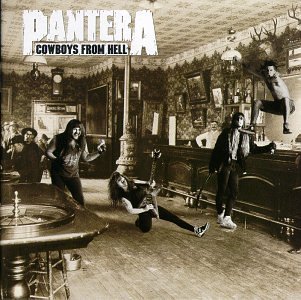
The breakthrough came with 'Cowboys from Hell' in 1990. Released by Atco, the album announced that Pantera had become a different animal. The hair-metal shine was gone. In its place was a sound that fused thrash precision, Southern attitude, heavy groove, and Darrell's razor-edged guitar tone. The title track opened like a declaration of arrival, with one of Darrell's most famous riffs and Anselmo delivering the words with full-chested menace. 'Cemetery Gates' showed that Pantera could still use melody and dynamics, moving from mournful passages to huge metallic release. 'Domination' became a live weapon, especially because of its crushing breakdown.
'Cowboys from Hell' mattered because it gave Pantera a new identity at exactly the moment metal was entering uncertainty. The 1980s metal marketplace was beginning to shift, and the glossy styles that had dominated MTV were losing force. Pantera did not soften itself for the new decade. It became heavier, leaner, and more rhythmically focused. The band sometimes called its approach 'power groove', a useful phrase because it captured what separated Pantera from many thrash bands. They were fast when they wanted to be, but their real power came from the way riffs sat in the body. The music did not just race. It stomped.
The album also introduced Darrell Abbott as a new kind of guitar hero. He had speed, harmonic squeals, dive bombs, and technical command, but he did not sound like a polite shredder. His playing was violent, expressive, and deeply rhythmic. His tone, often associated with Randall amplifiers and a sharp, biting attack, became a signature. He could play a fluid solo, then return to a riff that felt like machinery. That combination of flash and blunt-force groove made him one of the most imitated guitarists of the era.
If 'Cowboys from Hell' was the reinvention, 'Vulgar Display of Power' in 1992 was the full statement. The album cover, showing a man being punched in the face, matched the record's intent with almost blunt perfection. Produced by Terry Date, it stripped away remaining excess and sharpened the band's attack. The sound was dry, heavy, and immediate. Vinnie Paul's drums were massive but clear. Darrell's guitar tone was brutal and precise. Brown's bass gave the riffs a low, muscular push. Anselmo's vocals moved from barked command to full-throated rage.
'Vulgar Display of Power' became one of the defining metal albums of the 1990s. 'Mouth for War' opened the record with controlled anger. 'A New Level' turned personal defiance into pure riff architecture. 'Walk' became Pantera's most widely recognized anthem, built on a slow, simple, unforgettable groove and Anselmo's command to show respect. 'Fucking Hostile' gave the band a burst of hardcore-speed fury. 'This Love' balanced a brooding verse with explosive heaviness, while 'Hollow' showed the band's ability to move from ballad-like sadness into crushing weight. The album was not subtle, but it was not careless. Every stop, accent, and groove was placed for impact.
'Walk' deserves special attention because it explains Pantera's power in miniature. The riff is not complicated in a technical sense, but its timing is everything. It leaves space, snaps into place, and lets Anselmo's vocal phrasing become part of the rhythm. That was Pantera's genius: they made simplicity sound threatening. Many metal bands tried to impress through speed or complexity. Pantera understood the violence of space. A riff could be heavier if it breathed for half a second before landing again.
The band's live reputation grew into legend during this period. Pantera shows were physical, chaotic, and intensely communal. The audience did not simply watch; it collided with the music. The band encouraged a sense of unity through aggression, and while that atmosphere could be thrilling, it also carried real danger and volatility. Pantera's appeal depended partly on that tension. They offered release for anger, frustration, and alienation, but they did it with enough musicianship and control that the music never felt like random noise.
In 1994, Pantera released 'Far Beyond Driven', an album that became a remarkable commercial event. It debuted at number one on the Billboard 200 despite being one of the harshest major-label metal records ever to reach that position. That fact remains central to the band's legacy. At a time when alternative rock had reshaped the mainstream and many older metal acts were losing ground, Pantera became heavier and more successful. 'Far Beyond Driven' sounded uglier, more abrasive, and more inward than its predecessor. It was not designed to welcome casual listeners, yet it proved there was a huge audience for extreme heaviness.
The album contained some of the band's most important work. 'Strength Beyond Strength' opened with a sense of total escalation. 'Becoming' featured one of Vinnie Paul's most distinctive drum grooves and Darrell's strange, scraping guitar effects. '5 Minutes Alone' turned a real-life confrontation involving the band and an angry parent into a statement of defiance. 'I'm Broken' became one of Pantera's signature songs, full of stop-start riffing and Anselmo's raw delivery. The closing cover of Black Sabbath's 'Planet Caravan' was a surprise: a hazy, psychedelic moment of calm that showed the band's love for heavy music's roots.
'Far Beyond Driven' also marked the point where Pantera's inner darkness became more visible. Anselmo was dealing with severe back pain and drug addiction, and the band's internal life became increasingly strained. The music grew more hostile and claustrophobic. That pressure did not immediately break Pantera, but it changed the emotional temperature. The band that had once seemed like a united Texas gang now sounded like a machine with stress fractures forming inside it.
Those fractures were clear on 'The Great Southern Trendkill', released in 1996. The album was recorded under difficult circumstances, with Anselmo recording his vocals separately from the rest of the band. It is one of Pantera's most extreme and unsettled records, filled with bitterness, addiction imagery, and contempt for trends. The title itself was a challenge to a music industry that Pantera saw as fickle and shallow. Songs such as 'The Great Southern Trendkill', 'Suicide Note Pt. I', 'Suicide Note Pt. II', and 'Floods' showed a band pushing itself into darker territory.
'Floods' is one of the album's most important songs because it contains one of Darrell's most emotional solos. Known for aggression and wild stage personality, Darrell could also play with surprising lyricism. The solo in 'Floods' feels mournful and spacious, a reminder that Pantera's heaviness was not only anger. Darrell's guitar could express grief, grandeur, and strange beauty when the song allowed it. That depth is sometimes overlooked because Pantera's public image was so loud and confrontational.
The same period included one of the most serious moments in the band's history. In 1996, Anselmo suffered a near-fatal overdose after a show in Texas and was revived by emergency responders. The incident shocked the band and became part of the larger story of addiction and distance within Pantera. It is important not to sensationalize it. The point is not lurid detail, but impact: Anselmo's health and drug use affected trust, touring, communication, and the band's ability to function as a unit.
Pantera's final studio album, 'Reinventing the Steel', arrived in 2000. It was less revolutionary than the 1990s trilogy, but it carried a clear message: Pantera saw itself as a defender of real metal at a time when nu metal, industrial metal, and alternative styles had changed the landscape. The album's title was almost a mission statement. Songs such as 'Revolution Is My Name' and 'Goddamn Electric' celebrated heavy music itself, with references to Black Sabbath and Slayer woven into the band's sense of lineage. It was a proud record, but also one made by a group whose unity was weakening.
After the tours for 'Reinventing the Steel', Pantera drifted apart. Anselmo focused on Down, Superjoint Ritual, and other projects. The Abbott brothers formed Damageplan. Rex Brown also moved into other musical work. Public comments between camps became bitter, and the possibility of a reunion grew more complicated. The breakup was not a clean artistic ending; it was a collapse of trust after years of strain. Fans often hoped the classic lineup would repair itself, but events soon made that impossible.
On December 8, 2004, Dimebag Darrell was killed while performing onstage with Damageplan in Columbus, Ohio. The attack also killed others at the venue and left the metal community in shock. Darrell was 38. His death turned Pantera's breakup into something final and traumatic. For fans and musicians, it felt like the loss of one of metal's most joyful and generous figures. Darrell's public persona had been wild, funny, and loud, but he was widely remembered by peers as warm, encouraging, and deeply devoted to the guitar.
The aftermath was painful. Vinnie Paul, devastated by the death of his brother, had no interest in reuniting with Anselmo. He later continued making music with Hellyeah, but the wound around Pantera remained open. Vinnie died in 2018 at age 54 from heart-related disease, leaving Rex Brown and Phil Anselmo as the surviving members of the classic lineup. With both Abbott brothers gone, Pantera became not only a band from the past but a legacy surrounded by grief, loyalty, anger, and unresolved questions.
Pantera's influence, however, only grew. The band's groove-heavy approach reshaped modern metal. Metalcore, groove metal, nu metal, hardcore-influenced metal, and many later American heavy bands borrowed from Pantera's rhythms, guitar tone, breakdowns, and vocal aggression. Darrell's playing became a template for heavy guitarists who wanted technical skill without losing street-level force. Vinnie Paul's drum production and groove became just as influential. The snare sound, the tight kicks, the way the drums locked with guitar accents - all of it became part of the language of post-1990s metal.
The band's personality was also central to its appeal. Pantera presented itself as a brotherhood of outsiders who valued strength, loyalty, partying, and resistance to trends. That identity was powerful, but it also carried complications. Some lyrics and public moments reflected aggression and attitudes that have been criticized over time, and Anselmo in particular faced serious controversy for racist gestures and remarks at a 2016 event, for which he later apologized. A serious biography has to acknowledge this. Pantera's music shaped metal in profound ways, but the band's legacy also includes moments that remain painful and disputed.
In 2022, Pantera returned to the stage in a new form, with Phil Anselmo and Rex Brown joined by Zakk Wylde on guitar and Charlie Benante on drums. The lineup was presented as a tribute to the music and to the Abbott brothers rather than a reunion of the classic band. The decision divided fans. Some felt Pantera should not exist without Dimebag and Vinnie. Others saw the shows as a way for younger audiences to experience the songs live and for the surviving members to honor the catalog. Wylde, a close friend of Darrell's, did not try to become him, and Benante, best known for Anthrax, brought respect and power to Vinnie's parts. The shows confirmed that Pantera's music still had enormous force in front of crowds.
The key to Pantera's greatness lies in the way the classic lineup balanced four distinct roles. Anselmo was the voice of confrontation, pushing the songs toward rage, defiance, and physical intensity. Darrell was the sonic signature, combining Southern flash, harmonic squeals, monstrous riffs, and surprisingly emotional solos. Vinnie Paul was the architect of impact, a drummer who understood that heaviness comes from placement as much as volume. Rex Brown was the stabilizer, giving the band thickness and movement while rarely calling attention away from the main attack. Together they created a sound that was disciplined and brutal at once.
Pantera's best records form one of metal's most powerful creative runs. 'Cowboys from Hell' is the rebirth, where the band discovers its true identity. 'Vulgar Display of Power' is the peak of focus, the album that turns groove into a weapon. 'Far Beyond Driven' is the commercial shock, proving that extreme heaviness could reach number one without compromise. 'The Great Southern Trendkill' is the damaged, hostile document of internal pressure. 'Reinventing the Steel' is the final statement from a band trying to defend its idea of metal as the world changed around it.
What made Pantera different from many metal bands was their understanding of rhythm as violence and release. They did not simply write riffs; they wrote impacts. A Pantera song often feels like a series of body blows arranged with exact timing. The breaks, stops, pinch harmonics, bends, drum accents, and vocal entrances are part of one shared machine. This is why their songs remain so effective live and why so many later bands copied the surface but missed the deeper architecture. Pantera's heaviness was not only distortion. It was feel.
The band's Texas identity also mattered. Pantera did not come from Los Angeles glamour, New York cool, or Bay Area thrash orthodoxy. They sounded like a metal band raised on heat, space, bars, pride, and stubbornness. There was a Southern toughness in the way they carried themselves, even when the music drew from thrash, hardcore, classic metal, and groove. That regional character gave Pantera a different flavor from their peers. They were not elegant. They were not mysterious. They were direct, loud, and often deliberately abrasive.
Today, Pantera is remembered as one of the defining metal bands of the 1990s and one of the most influential heavy acts after the classic thrash era. Their catalog is not long, but its impact is massive. They kept metal dangerous during a decade when many assumed it had been pushed aside by alternative rock. They made groove as important as speed. They turned riffs into physical commands. They gave metal guitar a new hero in Dimebag Darrell and metal drumming a new standard of punch in Vinnie Paul.
The story is not simple. It includes reinvention, brotherhood, addiction, conflict, controversy, death, and revival as tribute. But the reason Pantera endures is musical. At their best, they sounded like no one else: Darrell's guitar screaming and grinding, Vinnie's drums landing like concrete, Rex's bass thickening the assault, and Anselmo's voice cutting through with rage and command. Pantera did not merely make heavy music heavier. They made it swing, stomp, and strike with a force that changed the shape of metal.