
Primus
Biography
Primus began in the East Bay of California as the kind of band that seemed almost designed to resist becoming normal. Its center was Les Claypool, a bassist and singer from El Sobrante whose musical imagination did not fit neatly into the usual rock-band hierarchy. In most bands, the bass holds the floor while the guitar carries the recognizable shape of the song. In Primus, Claypool made the bass the lead instrument, the rhythm engine, the comic narrator, and sometimes the strangest character in the room. His playing drew from funk, progressive rock, metal, and his own highly physical slap-and-pop technique, while his voice turned stories about odd men, unlucky workers, fishing, cars, animals, and suburban weirdness into miniature cartoons with sharp edges.
The earliest version of the band formed in 1984, when Claypool played with guitarist Todd Huth under the name Primate. The name was changed to Primus after another group objected to the similarity. Those first years were unstable, with several drummers passing through the lineup, but they were important because they established Claypool's taste for music that could be technically demanding and absurd at the same time. The early Primus did not sound like a band trying to chase a scene. They sounded like musicians who had absorbed Rush, Frank Zappa, funk, punk, metal, and Bay Area misfit culture, then decided that the most honest thing to do was make it all wobble.
The decisive lineup arrived when Claypool brought in guitarist Larry 'Ler' LaLonde and drummer Tim 'Herb' Alexander. LaLonde had played in the death metal band Possessed and had studied guitar with Joe Satriani, but in Primus he rarely behaved like a conventional metal guitarist. Instead of crowding Claypool's bass lines, he often played scratchy, sideways, oddly colored parts that gave the songs a nervous, surreal atmosphere. Alexander became the band's other essential force: a drummer with the precision to follow Claypool's twisting bass figures, but also the imagination to make the grooves feel slippery rather than mechanical. With Claypool's bass pushed forward, LaLonde's guitar acting like a strange electrical commentary, and Alexander's drums snapping around both of them, Primus had a sound that was instantly identifiable and difficult to imitate without sounding ridiculous.
One of the band's first important moves was practical, risky, and very Primus. Rather than wait for a label, they recorded a live album at Berkeley Square in 1989, when the classic lineup had only been together for a short time. The album, 'Suck on This', was funded with a loan of about 3000 dollars from Claypool's father and pressed in an initial run of 1000 copies. That detail matters because it shows how the band built its audience from the ground up. 'Suck on This' was not a polished introduction. It was a document of a local following already in motion, with crowd energy, oddball humor, and songs that would later become core pieces of the Primus catalog. The band sold copies, repaid the loan, and used the momentum to keep pressing the record. Before the major-label years, Primus was already proving that its weirdness could function as a business model.
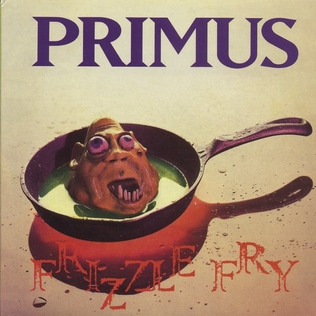
The first studio album, 'Frizzle Fry', released in 1990, captured Primus at the point where the live chaos became a durable studio identity. Recorded at Different Fur Studios in San Francisco and produced by the band with Matt Winegar, the album kept the rawness of the live material but sharpened the arrangements. Songs like 'John the Fisherman', 'Too Many Puppies', 'Groundhog's Day', and 'Harold of the Rocks' introduced the basic Primus universe: ordinary or marginal figures pushed into strange relief, riffs that sounded like machinery made of rubber, and rhythms that could be funky, heavy, and lopsided within the same phrase. 'Too Many Puppies', one of Claypool's early songs, also showed that beneath the cartoonish delivery there could be pointed social commentary. Primus were funny, but not empty.
A crucial part of the band's early identity was the phrase 'Primus sucks'. What began as a self-deprecating joke between the band and its audience became a ritual chant at concerts. In another group's hands, that might have seemed like a novelty gag. For Primus, it became a perfect statement of distance from rock-star polish. The audience was not insulting the band; it was joining the band in rejecting the normal language of admiration. This strange reversal helped Primus build a loyal culture around themselves. They were not selling glamour. They were inviting listeners into a private joke that also happened to require serious musicianship.
The breakthrough came with 'Sailing the Seas of Cheese' in 1991, Primus's major-label debut on Interscope. The timing was unusual. Alternative rock was moving toward the mainstream, but Primus did not resemble the grunge bands that would soon define the era, nor did they fit comfortably with funk metal, progressive rock, or the heavier underground. The album made that confusion work in their favor. 'Jerry Was a Race Car Driver' turned a hyperactive bass riff and a bizarre character sketch into something that could actually live on MTV. 'Tommy the Cat' gave Claypool room for theatrical vocal play and featured Tom Waits as the voice of Tommy, a guest appearance that made sense because Waits and Primus shared a taste for grotesque humor, junkyard rhythm, and characters who seemed to come from some cracked American underworld.
'Sailing the Seas of Cheese' is one of the clearest examples of why Primus mattered. The album did not simply put bass higher in the mix; it reorganized the band around it. Claypool's bass lines often carried the hooks, the percussive attack, and the melodic identity at once. LaLonde's guitar did not compete with that center. It added metallic flashes, dissonant squeals, and off-kilter texture. Alexander's drumming made the arrangements feel athletic without becoming sterile. The production still had the strangeness of an underground band, but the songs were concise enough to travel. Primus had found a way to be deeply eccentric and surprisingly accessible without sanding off the parts that made them strange.
The band's ascent in the early 1990s remains one of the more unlikely stories of that decade's rock mainstream. Primus appeared at a moment when audiences were more open to alternative sounds, but even then they were an odd fit for radio and television. Claypool described the idea behind 'Pork Soda' as something like an acquired taste, the opposite of what people expect from a soda. That was a neat description of Primus themselves. They could headline major shows, appear on MTV, and sell large numbers of records, yet they never looked or sounded like they were trying to become broadly palatable.
Released in 1993, 'Pork Soda' was the band's commercial peak and one of its darkest records. It debuted at number 7 on the Billboard 200, a surprising result for an album this abrasive and strange. The record followed a period of heavy touring, and its mood is more claustrophobic than 'Sailing the Seas of Cheese'. 'My Name Is Mud' became the signature song, built on one of Claypool's most recognizable bass figures and a narrator whose plainspoken menace is both comic and unsettling. 'Mr. Krinkle' pushed the theatrical side even further, with its bowed upright bass feel, creeping rhythm, and circus-like unease. 'DMV' turned everyday frustration into a warped funk-metal complaint. The album's success proved that Primus's audience had grown without requiring the band to become less peculiar.
'Pork Soda' also revealed how deceptive Primus's humor could be. The song titles and vocal characters could sound absurd on the surface, but the music often carried loneliness, irritation, social discomfort, and dark observation. Claypool's writing rarely worked like confessional rock. He did not usually present himself directly. Instead, he built figures and scenes: the fisherman, the race car driver, the man at the DMV, the mud-covered narrator, the carnival oddity. This gave Primus a kind of sideways emotional language. The songs did not ask for sympathy in obvious ways, but they often circled people who were alienated, obsessive, foolish, or trapped in private logic.
In 1993 Primus joined the Lollapalooza tour, placing them in front of a broad alternative audience alongside acts that were reshaping rock culture. Yet even in that context, they seemed like outsiders. They were too technically odd for punk purists, too funny for serious metal traditionalists, too heavy for jam-band comfort, and too rhythmically specialized to be ordinary alternative rock. That refusal to belong became their strength. Primus were not the center of a movement; they were a species of one.
'Tales from the Punchbowl', released in 1995, continued the band's commercial run and produced 'Wynona's Big Brown Beaver', their most widely recognized mid-1990s single. The song's title and bounce made it seem like a novelty at first glance, but the performance was tightly controlled, built around a country-fried rhythmic snap and one of the band's most memorable grooves. The video, directed by Claypool, became an important part of the song's identity: the band appeared in full-body plastic cowboy costumes, moving with an artificial stiffness that made them look like unsettling toys. The clip exaggerated the unnatural motion, adding another layer to the band's visual language. Primus understood that their music was already cartoon-like, so they leaned into imagery that was funny, handmade, and slightly disturbing.
The same period brought one of Primus's most durable pieces of pop-culture recognition: their connection to 'South Park'. Claypool wrote and performed the show's theme, and the pairing was almost too perfect. 'South Park' shared Primus's taste for crude humor, social satire, and characters who could be ridiculous without being simple. For many listeners who were too young to catch the band's early albums in real time, that theme became a doorway into Primus's world. It also confirmed how adaptable Claypool's musical personality was. A few seconds of his bass tone and nasal vocal delivery could identify him immediately.
After the mid-1990s peak, Primus changed shape. Tim Alexander left the band, and Bryan 'Brain' Mantia became the drummer for 'Brown Album' in 1997. The change mattered. Brain brought a different pocket, looser and more earthbound in certain ways, and the record had a murkier, dustier character than the sharp attack of the Alexander years. 'Shake Hands with Beef' and 'Over the Falls' kept the band's absurdity intact, but the album was not received with the same force as the previous run. Still, it showed that Primus was not simply a formula. The drummer's feel could alter the whole chemistry, because Primus's music depended so intensely on rhythmic personality.
The late 1990s also produced 'Antipop', an album that stands apart because of its outside collaborators and heavier production. Released in 1999, it included contributions from figures such as Tom Morello, Fred Durst, Matt Stone, Stewart Copeland, Tom Waits, James Hetfield, and Jim Martin. The result was uneven but fascinating: a Primus album that sounded more connected to the aggressive rock climate of the late 1990s, while still carrying Claypool's odd narrative voice and bass-centered writing. For some listeners, 'Antipop' felt like the band pushing against its own identity; for others, it was an example of how far the Primus concept could stretch. After the album and its touring cycle, Primus entered a hiatus, and Claypool poured more energy into side projects.
Those side projects are essential to understanding Primus, because Claypool has never seemed like a musician who could keep all of his ideas inside one band. He explored projects such as Les Claypool's Frog Brigade, Colonel Claypool's Bucket of Bernie Brains, Oysterhead with Trey Anastasio and Stewart Copeland, and other collaborations. These projects emphasized different parts of his personality: the jam-band explorer, the progressive-rock devotee, the comic storyteller, the bass eccentric, and the bandleader who enjoyed building strange ensembles. When Primus returned, it did so with the history of those experiments hovering around it.
In the 2000s, Primus became less a conventional album-cycle band and more a continuing organism with reunions, tours, special projects, and periodic recordings. The 2003 EP and DVD package 'Animals Should Not Try to Act Like People' brought the classic lineup back into view, while later tours revisited older material with the confidence of a band whose audience had become multigenerational. The group's reputation also shifted. What once seemed like a bizarre intrusion into the mainstream began to look, in retrospect, like one of the boldest examples of 1990s rock weirdness making it through the commercial machinery intact.
'Green Naugahyde', released in 2011, was the first full-length Primus album of new material in more than a decade. It featured Jay Lane, one of the band's early drummers, returning to the fold. The album reconnected Primus to its funkier, spring-loaded side, with Claypool's bass again acting as both rhythm and lead voice. It did not attempt to recreate the exact sound of the early 1990s, but it reminded listeners that Primus's identity was not nostalgia alone. The band could still write grooves that seemed to bend at the joints.
In 2014 Primus took a turn that was strange even by Primus standards with 'Primus & the Chocolate Factory with the Fungi Ensemble'. Rather than make a standard tribute album, they reimagined music associated with the 1971 film 'Willy Wonka & the Chocolate Factory' through their own warped lens. The project made sense because Wonka's world of candy, punishment, temptation, and grotesque fantasy fit Claypool's sensibility. The arrangements were eerie and theatrical rather than merely playful, turning familiar material into something closer to a psychedelic carnival. It was also a reminder that Primus had always contained a visual, almost cinematic imagination.
'The Desaturating Seven', released in 2017, pushed the band toward concept-album territory. Inspired by Ul de Rico's children's book 'The Rainbow Goblins', it gave Primus a storybook framework full of color, appetite, and menace. Musically, the album leaned into the progressive side of the band, with extended passages and a more unified mood. By this point, Primus were no longer competing with contemporary rock trends. They were operating inside their own mythology, drawing from childhood images, absurdist humor, and technical musicianship in ways that only made sense because they had spent decades building that language.
Another revealing chapter came with the band's Rush tribute tour, built around performing 'A Farewell to Kings' in full. Rush had long been one of Primus's clearest influences, especially in the way technical playing could coexist with eccentric vocals and unusual structures. For Claypool, covering Rush was not a random classic-rock exercise; it was a public acknowledgment of musical ancestry. Primus did not become Rush, of course. Their version of virtuosity was earthier, stranger, and more comic. But the tribute showed how deeply progressive rock had shaped their rhythmic ambition and their willingness to let instrumental personality define a song.
The band faced another major transition when Tim Alexander left again in 2024. His departure was significant because his drumming had been central to the classic Primus sound. Rather than quietly hire a replacement, the band turned the search into a public event, receiving more than 6000 audition submissions and documenting the process as the 'Interstellar Drum Derby'. John Hoffman was eventually selected as the new drummer in 2025. It was a very Primus way to handle a personnel crisis: part serious musicianship, part spectacle, part community event, and part absurd challenge.
Primus's influence is difficult to measure by direct imitation, because very few bands can copy them without sounding like a joke. Their deeper impact lies in how they expanded the idea of what a rock trio could be. They made bass virtuosity central without turning the music into sterile demonstration. They brought funk technique into heavy rock without smoothing away the awkwardness. They wrote songs that were funny without being disposable, technical without being cold, and bizarre without losing physical groove. Their career also helped make room in mainstream rock for bands that did not fit the expected emotional or visual language of the era.
Les Claypool remains the obvious focal point, but Primus has never been only a solo vehicle. LaLonde's guitar is crucial because it refuses the obvious role. He can shred, but he often chooses texture, interruption, and sour color over heroic display. Alexander's best work gave the classic records their tense elasticity, while later drummers changed the band's weight and swing in meaningful ways. Primus works because the musicians understand the negative space around Claypool's bass. They do not simply support the weirdness; they frame it.
What makes Primus endure is not just that they are strange. Plenty of bands are strange for a moment. Primus built a complete musical world out of strangeness: a place where virtuoso bass lines, slapstick imagery, dark little stories, progressive structures, funk rhythms, metal edges, and self-mocking humor all belong together. Their famous chant says they suck, but the joke has lasted because the opposite is obvious. Primus created one of the most distinctive bodies of work in alternative rock by trusting the parts of themselves that the music industry usually tries to correct.