
Slayer
Biography
Slayer formed in Southern California in 1981 and quickly became one of the most severe forces in American thrash metal. The classic lineup brought together two guitarists with different but complementary instincts: Kerry King, direct, confrontational, and obsessed with attack, and Jeff Hanneman, a punk-influenced writer with a gift for riffs that sounded both simple and unforgettable. Tom Araya, a Chilean-born bassist and vocalist who had worked as a respiratory therapist before the band became his life, gave Slayer a voice that was less theatrical than many metal singers of the time. He did not sing like a fantasy narrator. He barked, shouted, and pushed words forward with a grim, almost documentary force. Dave Lombardo, the Cuban-born drummer whose speed, control, and explosive double-kick work helped define thrash drumming, gave the band its engine.
The early version of Slayer grew out of the same Los Angeles-area metal underground that helped launch Metallica and Megadeth, but they were never simply another fast metal band. They absorbed Judas Priest, Black Sabbath, Iron Maiden, Venom, hardcore punk, and the darker side of European metal, then stripped away almost everything that felt decorative. Their image used pentagrams, spikes, leather, and occult provocation, but behind the shock was a surprisingly disciplined band. Slayer's power came from repetition, precision, and refusal. They did not chase radio choruses. They built songs around speed, tension, ugly chromatic riffs, sudden stops, and solos that often sounded less like melodic statements than controlled panic.
Before the major-label years, Slayer paid their dues in clubs and on small stages where their extremity became their calling card. Their 1983 debut, 'Show No Mercy', was released by Metal Blade Records after the band self-financed much of the recording. Compared with what came later, it still carried traces of traditional metal: high-speed riffing, demonic imagery, and a young band's hunger to sound dangerous. Songs such as 'Die by the Sword', 'The Antichrist', and 'Black Magic' announced the basic vocabulary: fast tempos, dark themes, and King's and Hanneman's serrated guitar interplay. The record was raw, but it traveled through tape-trading circles and helped Slayer build an audience before mainstream media had much interest in them.
The EP 'Haunting the Chapel' in 1984 was a major leap. Its sound was harsher, its playing tighter, and 'Chemical Warfare' became one of the early songs that separated Slayer from the metal pack. The live album 'Live Undead' and the touring that followed reinforced their reputation as a band that could turn underground devotion into something almost tribal. Their fans did not just like Slayer; they treated the band as a test of intensity. That relationship would follow the group for decades. For people outside metal, Slayer often seemed excessive or hostile. For many inside the scene, they represented commitment: no glamour, no softening, no apology.
In 1985, Slayer released 'Hell Awaits', an album that pushed their early style into darker, more complex territory. The songs were longer, the arrangements more labyrinthine, and the production created a cavernous atmosphere. The title track opened with reversed chanting and a sense of ritual menace, while songs such as 'At Dawn They Sleep' and 'Necrophiliac' leaned into horror imagery that helped make the band controversial. The album did not have the focused impact of the masterpiece that followed, but it showed Slayer becoming more ambitious. They were learning how to make speed feel oppressive rather than merely exciting.
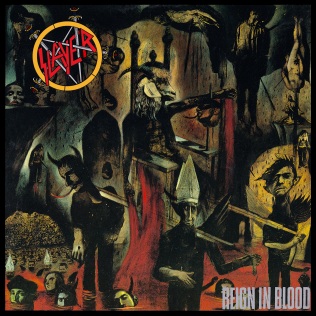
The decisive turning point came when Slayer began working with producer Rick Rubin and released 'Reign in Blood' in 1986 through Def Jam. Rubin, known more for hip-hop and stripped-down rock production than for metal, helped remove the murk from Slayer's sound. The result was a record that lasted under half an hour but felt like an assault with no wasted motion. The guitars were dry and cutting, Lombardo's drumming was astonishingly fast and clear, Araya's vocals were pushed to the front, and every song seemed engineered for maximum impact. Where many metal albums of the period were padded with long intros or theatrical excess, 'Reign in Blood' was brutally efficient.
'Reign in Blood' was also the album that made Slayer permanently controversial. 'Angel of Death', written by Hanneman, dealt with Nazi doctor Josef Mengele and drew criticism for the way it used historical horror as metal subject matter. The band repeatedly denied Nazi sympathies, and Hanneman's fascination with military history became part of the debate around the song. The controversy mattered because it exposed the central tension in Slayer's art: they often wrote from the perspective of evil, violence, power, or corruption without offering easy moral framing. That ambiguity made their music frightening to some listeners and compelling to others. The album ended with 'Raining Blood', whose slow opening, sudden acceleration, and collapsing final storm became one of metal's most recognizable sequences.
What set 'Reign in Blood' apart was not only its speed. Many bands were fast by 1986. Slayer sounded merciless because they understood compression. The songs gave the listener almost no room to recover. Lombardo's drums moved with both athletic force and musical intelligence, shifting between blast-like bursts, galloping patterns, and violent accents. King and Hanneman's solos ignored blues-rock elegance and often became streams of noise, dive-bombs, and dissonant fragments. Araya delivered the lyrics with a clipped urgency that made the most extreme lines feel less sung than reported from inside a disaster. The album became a pillar of thrash and an influence on death metal, black metal, grindcore, and many forms of extreme metal that followed.
After making one of the fastest and most influential metal albums of the decade, Slayer did something unexpected. On 'South of Heaven' in 1988, they slowed down. This was not a retreat. It was a different kind of threat. The title track opened with a cold, descending riff that proved the band could be just as disturbing at mid-tempo as at full speed. Some fans initially resisted the change, but over time the album became one of Slayer's most respected works. It showed a more deliberate sense of atmosphere and dynamics, with songs such as 'Mandatory Suicide', 'Ghosts of War', and 'Silent Scream' expanding the band's emotional and rhythmic range.
'South of Heaven' also revealed how important Hanneman and King were as contrasting writers. Hanneman often brought a punk-rooted directness and a sense of narrative darkness, while King leaned toward blunt force, aggression, and provocation. The partnership worked because Slayer did not need polish in the conventional sense. Their songs needed impact, momentum, and identity. 'South of Heaven' proved they could use space as a weapon. The slower tempos made Araya's vocals sound more commanding, and the riffs had room to sink in. It was the sound of a band refusing to repeat its most famous trick.
In 1990, Slayer released 'Seasons in the Abyss', often seen as the most complete expression of their classic era. Produced again with Rubin involved, the album balanced the speed of 'Reign in Blood' with the heavier pacing of 'South of Heaven'. 'War Ensemble' opened the record with military precision, while 'Dead Skin Mask' used a slower, more sinister structure to explore horror from a psychological angle. The title track closed the album with one of Slayer's most memorable grooves, and its video was filmed in Egypt, giving the song an unusually cinematic presence for a band that rarely relied on glamour.
'Seasons in the Abyss' mattered because it showed Slayer's range without softening their identity. The production was clear but not slick, the songwriting was varied but still hostile, and the band sounded fully in command of its language. Lombardo's playing on the album was a masterclass in controlled violence. Araya's vocals were more measured than on the earliest records, but that restraint made the words land harder. By this point, Slayer had become one of the 'Big Four' of thrash metal alongside Metallica, Megadeth, and Anthrax, but they occupied the most uncompromising corner of that group. Metallica moved toward wider accessibility, Anthrax brought humor and crossover energy, and Megadeth emphasized technical sharpness and political paranoia. Slayer stayed closest to the abyss.
The early 1990s brought change. Dave Lombardo left the band after the 'Seasons in the Abyss' cycle, and Paul Bostaph became Slayer's drummer. Bostaph was an accomplished player with enormous stamina, but replacing Lombardo was one of the hardest jobs in metal. The 1994 album 'Divine Intervention' introduced the new lineup at a time when heavy music had changed dramatically. Grunge had disrupted the commercial rock world, alternative metal was rising, and thrash was no longer the dominant underground language it had been in the late 1980s. Slayer responded by sounding harsh, dry, and stubborn. The album was not as universally celebrated as the Rubin-era trilogy, but it kept the band moving with songs such as 'Dittohead' and 'Serenity in Murder'.
Slayer's mid and late 1990s work showed both consistency and restlessness. 'Undisputed Attitude' in 1996 was a covers album focused largely on punk and hardcore, making explicit a part of Hanneman's musical DNA that had always been present. Rather than treating punk as a side influence, Slayer honored bands such as Minor Threat, D.R.I., and others by translating that aggression through their own metallic force. 'Diabolus in Musica' in 1998 arrived during the nu metal era and included lower tunings and some groove-oriented elements. It remains one of the band's more divisive albums, partly because it sounded like Slayer acknowledging the moment around them without fully belonging to it.
The band's first album of the 2000s, 'God Hates Us All', arrived in 2001 with a title that captured Slayer's gift for confrontation. Released on September 11, 2001, by coincidence, the album felt raw, bitter, and modernized, with a more abrasive production style and direct lyrical anger. It did not have the compositional elegance of 'Reign in Blood' or 'Seasons in the Abyss', but it reasserted Slayer's relevance in a heavier landscape shaped by younger bands who had grown up on them. Their influence had become impossible to miss. Death metal, groove metal, metalcore, and extreme hardcore all carried traces of Slayer's speed, riffing, and emotional severity.
Dave Lombardo returned to the band in the early 2000s, first for live work and then in the studio for 'Christ Illusion', released in 2006. His return gave the album a sense of restored classic chemistry, even though the band was older and the metal world around them had changed. 'Christ Illusion' was aggressive, compact, and politically charged, and it earned Slayer Grammy recognition for 'Eyes of the Insane' and later 'Final Six'. The awards were almost ironic given Slayer's long distance from mainstream approval, but they confirmed what metal listeners already knew: the band had shaped the vocabulary of heavy music for a generation.
'World Painted Blood' followed in 2009 and became the final Slayer studio album with Jeff Hanneman. It was not a reinvention, but it contained flashes of the old ferocity and a sense of a band still committed to its own grammar. Then came the event that changed Slayer permanently. In 2011, Hanneman contracted necrotizing fasciitis, which was widely reported in connection with a suspected spider bite, and was forced away from touring. Gary Holt of Exodus stepped in as a live guitarist, a fitting choice because Exodus had been part of thrash metal's original foundation. In 2013, Hanneman died at age 49. His official cause of death was reported as alcohol-related cirrhosis. His death removed one of Slayer's central creative forces and one of the key riff writers in extreme metal history.
The loss of Hanneman was not simply a personnel change. It altered the meaning of the band. Hanneman had written or co-written many of Slayer's defining songs, and his punk instinct helped keep the band's music from becoming technical for its own sake. Soon after, Lombardo was out of the band again, and Paul Bostaph returned. With King, Araya, Bostaph, and Holt, Slayer recorded 'Repentless', released in 2015. It was the first Slayer album without Hanneman as an active creative presence, though one Hanneman song, 'Piano Wire', was included. The album could not escape the shadow of what had been lost, but it showed the band determined to continue rather than turn itself into a museum piece.
Tom Araya's role in Slayer became more fascinating with time. Offstage, he often appeared warmer and more reflective than the band's image suggested. He was raised Catholic and has spoken about faith, a fact that sat uneasily and interestingly beside decades of songs filled with anti-religious imagery, horror, war, and blasphemous provocation. Araya did not write all of the band's most extreme lyrics, and his job was often to deliver material with conviction even when it did not represent a simple personal statement. That tension became part of Slayer's identity. They were not a band of cartoon villains. They were working musicians who built an extreme aesthetic and kept refining it until it became a recognizable art form.
Kerry King, by contrast, often embodied Slayer's public defiance. Bald, tattooed, blunt in interviews, and visually inseparable from his chains and aggressive stage presence, King became the band's most visible guardian of the Slayer idea. His playing favored attack over refinement, and his solos were often chaotic by design. Critics who wanted traditional guitar beauty could miss the point. King's style worked because Slayer's music was about impact and abrasion. Hanneman's riffs, King's violence, Araya's voice, and Lombardo's or Bostaph's drumming formed a machine that did not ask to be liked in a conventional way.
Slayer announced a farewell tour in 2018 and played what was billed as their final show at the Forum in Inglewood, California, on November 30, 2019. For a band that had built its reputation on refusal, the ending felt unusually controlled. They did not fade away through endless half-returns. They took a long final lap, honored the audience that had stayed with them, and closed the main chapter of the band. Yet Slayer's retirement did not remain absolute. Beginning in 2024, they returned for selected festival appearances with Araya, King, Holt, and Bostaph, framing the shows as special events rather than the start of a full new album cycle.
The cultural impact of Slayer is difficult to separate from the fear and fascination they generated. They were accused of being dangerous, immoral, juvenile, brilliant, monotonous, and revolutionary, sometimes by the same kinds of observers at different times. Their lyrics explored war, religious corruption, serial violence, authoritarianism, death, and human cruelty, but their importance lies as much in form as in subject. They changed the physical expectations of metal: how fast it could move, how sharply it could be recorded, how little it needed to compromise, and how extreme music could still be memorable.
Slayer's best albums remain central documents in heavy music. 'Reign in Blood' is the compressed manifesto, the album that made speed and brutality feel almost mathematical. 'South of Heaven' is the proof that they could slow down and become more ominous. 'Seasons in the Abyss' is the balanced statement, where every side of the classic band meets: speed, groove, horror, discipline, and atmosphere. Around those records sits a larger catalog that shows persistence, stubbornness, and a refusal to become respectable in the usual rock-star way.
What made Slayer unique was not just that they were heavy. Many bands are heavy. Slayer were exact in their extremity. Their riffs were direct enough to be remembered after one listen, but strange enough to unsettle. Their rhythm section could feel like machinery without losing human force. Their vocals avoided operatic drama and chose command instead. They took the darker obsessions of metal and hardcore and organized them into a sound that was severe, fast, and instantly identifiable.
Today, Slayer stand as one of the essential bands in metal history. Their music is not comfortable, and it was never meant to be. It can be punishing, repetitive, confrontational, and deliberately ugly. But inside that ugliness is craft: the placement of a stop, the timing of a drum fill, the shape of a riff, the way a chorus lands like a command rather than a hook. Slayer mattered because they took the most extreme possibilities of thrash metal and made them durable. They did not merely play faster or darker than most of their peers. They made extremity sound disciplined, and that discipline became their legacy.