
The Beatles
Biography
The Beatles began as four young men from Liverpool and became the most influential band in popular music not because they stayed the same, but because they changed faster than the world around them could react. John Lennon, Paul McCartney, George Harrison, and Ringo Starr compressed an extraordinary creative evolution into less than a decade of recording. They started as a sharp, hungry club band built on rock and roll, rhythm and blues, skiffle, Motown, girl-group pop, and American country music. By the end of the 1960s, they had expanded the possibilities of the studio, the album, the pop song, the rock group, and the relationship between youth culture and mass media.
The story begins in Liverpool, a port city where American records arrived with unusual force. John Lennon, born in 1940, formed the Quarrymen in the late 1950s, first drawing from skiffle and early rock and roll. Paul McCartney, born in 1942, met Lennon in 1957 and soon joined the group. McCartney brought melodic discipline, musical curiosity, and a gift for harmony that matched Lennon's sharper, more instinctive edge. George Harrison, born in 1943, was younger, but his guitar ability and quiet determination earned him a place. Before they were polished pop stars, they were teenagers absorbing Chuck Berry, Little Richard, Buddy Holly, Carl Perkins, the Everly Brothers, and the raw excitement of American rock.
The group went through names and lineups before becoming the Beatles. Stuart Sutcliffe, Lennon's art-school friend, played bass in an early version of the band, and Pete Best became their drummer during the period when they were playing in Hamburg, Germany. Hamburg was crucial. The Beatles played long, exhausting sets in rough clubs, often for audiences that demanded volume, stamina, and showmanship. Those nights hardened them. They learned how to hold a room, stretch songs, sing harmonies under pressure, and survive as a working band. The Beatles who returned from Hamburg were not delicate pop hopefuls. They were loud, funny, fast, and experienced beyond their years.
Brian Epstein, a Liverpool record shop manager, saw them at the Cavern Club and became their manager in 1961. Epstein helped sharpen their presentation, steering them away from leather-jacket chaos toward suits, bows, and a cleaner stage image. This did not remove their personality; it made it legible to a wider public. In 1962, producer George Martin brought them to EMI's Parlophone label. Around the same time, Pete Best was replaced by Ringo Starr, born Richard Starkey, an experienced Liverpool drummer with a steady groove, dry humor, and an instinctive feel for song structure. Starr was not a flashy technical drummer, but his parts became essential to the band's balance. He knew how to serve a song without draining its character.
The Beatles' early recordings show a band discovering how to turn live energy into pop architecture. 'Love Me Do' introduced them modestly in 1962, but 'Please Please Me' in 1963 made the breakthrough clear. The debut album of the same name was recorded quickly and captured the force of their stage act. Lennon's vocal on 'Twist and Shout', recorded when his voice was already strained, became one of the great examples of controlled recklessness in early rock. The album mixed originals with covers, showing what the Beatles had learned from American music while also proving that Lennon and McCartney could write songs that stood beside their influences.
Beatlemania arrived with astonishing speed. In Britain, the band's singles, television appearances, wit, and visual unity turned them into a phenomenon. In America, after early delays, their 1964 appearance on 'The Ed Sullivan Show' introduced them to a massive television audience and became a landmark in postwar pop culture. The timing mattered. The United States was still grieving the assassination of President John F. Kennedy, and the Beatles seemed to arrive with color, humor, and release. But the excitement was not only social. The records were unusually strong. 'I Want to Hold Your Hand', 'She Loves You', and 'A Hard Day's Night' had directness, harmonic freshness, and rhythmic lift that made them feel both simple and new.
'A Hard Day's Night', released in 1964, was a major step because it was made entirely of Lennon-McCartney originals. The film presented the Beatles as quick, irreverent, and self-aware, while the album showed their songwriting becoming more confident. The opening chord of the title track became famous for a reason: it sounded like a door being thrown open. Lennon dominated much of the album's emotional tone with songs that balanced excitement and anxiety, while McCartney's melodic ease gave the record warmth. Harrison's twelve-string guitar, especially his use of a Rickenbacker, added brightness and jangle to the band's texture and helped influence the sound of folk rock.
The pace was brutal. The Beatles recorded, toured, filmed, gave interviews, and faced crowds whose screams often made it impossible for them to hear themselves onstage. Their public charm hid the pressure of constant performance. The 1964 album 'Beatles for Sale' already sounded more tired and reflective, even while it contained strong songs such as 'No Reply', 'I'm a Loser', and 'Eight Days a Week'. Lennon's lyrics were beginning to reveal self-doubt and emotional complication beneath the cheerful surface. The Beatles were still pop idols, but the writing was becoming more personal.
'Help!' in 1965 continued that transition. The title song, later acknowledged by Lennon as more emotionally sincere than its upbeat arrangement might suggest, placed vulnerability inside a hit single. 'You've Got to Hide Your Love Away' showed the influence of Bob Dylan and folk songwriting, while McCartney's 'Yesterday' changed the scale of what a Beatles song could be. Recorded with acoustic guitar and a string quartet, without the full band playing, 'Yesterday' pointed toward a future where the Beatles were no longer bound by the idea that every record had to reproduce a live group sound.
The decisive artistic turn came with 'Rubber Soul' in late 1965. It was not a complete break from pop, but it felt more unified, more adult, and more inward than their earlier albums. The songs drew from folk rock, soul, and introspective lyric writing. 'Norwegian Wood' featured Harrison playing sitar, one of the most prominent early uses of an Indian instrument on a Western pop record, and it opened a door that Harrison would explore more deeply. 'In My Life' combined memory, restraint, and emotional clarity in a way that showed Lennon reaching beyond teenage romance. McCartney's bass playing became more melodic and active, while Starr's drumming remained economical and deeply musical.
'Rubber Soul' also showed how the Lennon-McCartney partnership worked as both collaboration and competition. Sometimes they wrote closely together; often they brought in songs largely shaped by one writer and finished with help from the other. Lennon's writing tended toward irony, confession, wordplay, and emotional abrasion. McCartney often favored melodic construction, formal variety, and musical elegance. The difference was not absolute, and each could surprise the other, but the tension between their instincts gave the band enormous range. Harrison, meanwhile, was developing as a songwriter in the shadow of two unusually dominant writers.
'Revolver', released in 1966, was the album where the Beatles became a fully modern studio band. They were still officially a touring group, but the music was already moving beyond what could easily be performed onstage. The album used tape loops, backwards guitar, close-miked strings, distorted bass, Indian instrumentation, brass, and new approaches to recording. George Martin and engineer Geoff Emerick were essential partners in this transformation, helping the band turn unusual ideas into finished records. The studio became not merely a place to capture performance but an instrument in itself.
'Revolver' is remarkable because of its range. McCartney's 'Eleanor Rigby' used a string octet and told a compact story of loneliness with almost no conventional rock instrumentation. Lennon's 'Tomorrow Never Knows' drew from psychedelic experience, tape manipulation, and a single-chord drone to create a track that still feels startling. Harrison's 'Taxman' opened the album with political bite and one of his strongest early compositions. 'Here, There and Everywhere' showed McCartney's gift for pure melodic beauty, while 'She Said She Said' captured Lennon's fractured, acid-tinged tension. Few albums had moved so far from familiar pop-band language while remaining so concise.
By 1966, touring had become unsustainable. The Beatles faced security risks, political backlash, and the practical impossibility of performing increasingly complex music through poor live sound systems while audiences screamed over them. Lennon's remark that the Beatles were more popular than Jesus, made in a British interview and later inflamed in the United States, caused protests and record burnings. The band's tour of the Philippines also became dangerous after a misunderstanding involving the Marcos family. After their final commercial concert in San Francisco in August 1966, they stopped touring. This decision changed everything. Freed from the stage, they could become a studio-centered band without compromise.
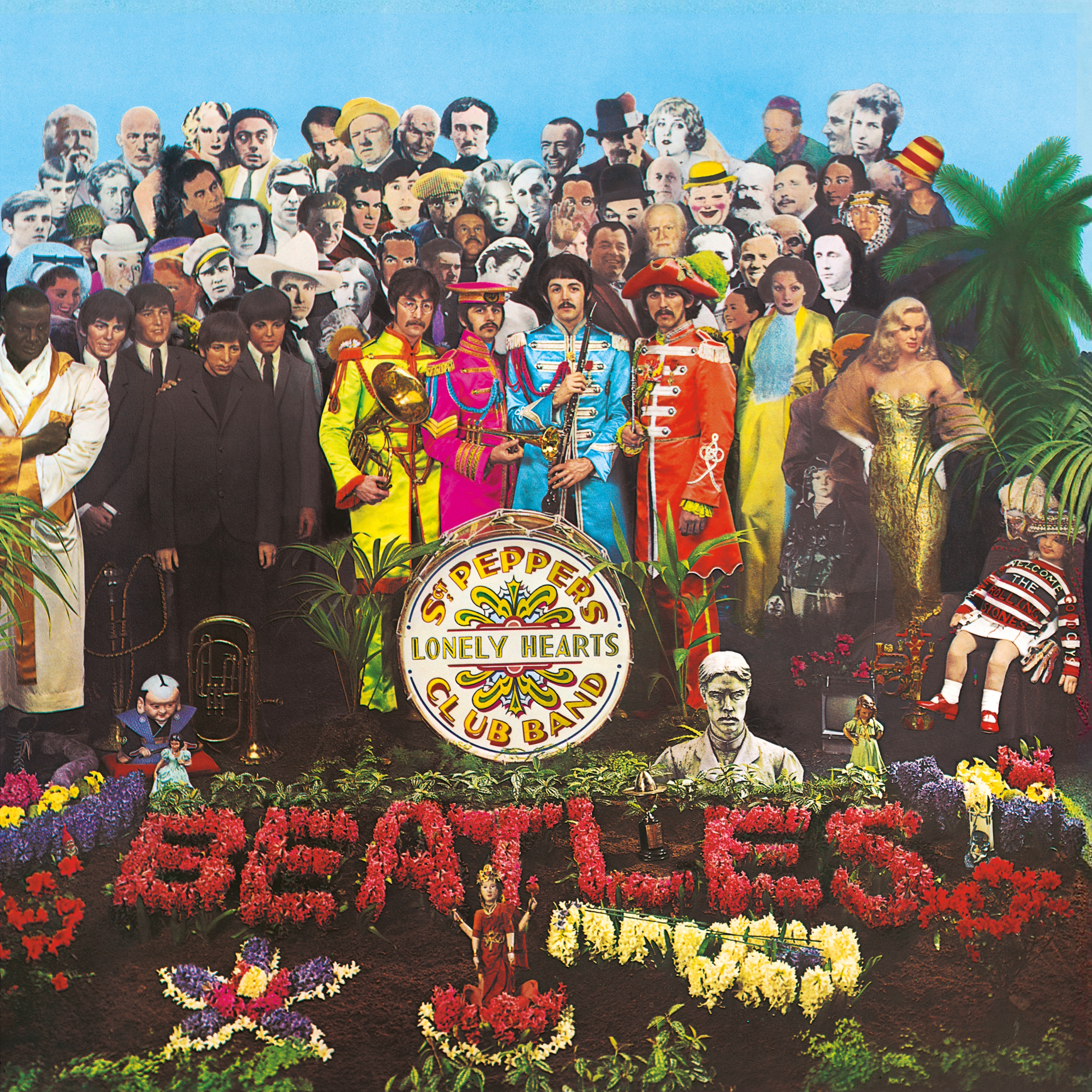
The first major result was 'Sgt. Pepper's Lonely Hearts Club Band' in 1967. The album is often discussed in inflated terms, but its real importance is concrete. It treated the album as a designed experience, with packaging, sequencing, studio experimentation, and a loose fictional band concept creating a sense of occasion. The Beatles used orchestration, tape effects, varispeed recording, crowd noise, Indian influence, music-hall colors, rock, and psychedelic textures. 'Lucy in the Sky with Diamonds', 'Being for the Benefit of Mr. Kite!', 'Within You Without You', and 'A Day in the Life' each expanded the band's vocabulary in different directions.
'A Day in the Life' became one of the Beatles' greatest studio achievements. Lennon brought a dreamlike, detached narrative inspired partly by newspaper fragments, while McCartney contributed a contrasting middle section grounded in ordinary routine. The orchestral glissandos, the final piano chord, and the careful editing turned the song into something larger than either writer's individual part. It captured what made the Beatles extraordinary at their peak: collaboration, contrast, risk, and control. They could make experimental choices feel emotionally direct.
The same year brought both triumph and disorientation. Their satellite broadcast performance of 'All You Need Is Love' placed them at the center of the global counterculture moment, but Brian Epstein died in August 1967. Epstein's death left a managerial and emotional vacuum. He had protected the band's business life and helped shape their public path. Without him, the Beatles were increasingly forced to make decisions as businessmen, filmmakers, label owners, and adults with diverging lives. The music remained powerful, but the internal structure around the band began to weaken.
'Magical Mystery Tour', first released as a television film and accompanying music, showed both their imagination and their lack of outside discipline after Epstein. The film was poorly received in Britain, but the music contained extraordinary work, including 'I Am the Walrus' and 'The Fool on the Hill'. In the United States, the later album version also gathered major 1967 singles including 'Strawberry Fields Forever' and 'Penny Lane'. Those two songs are among the band's greatest achievements. Lennon's 'Strawberry Fields Forever' transformed childhood memory into psychedelic uncertainty, while McCartney's 'Penny Lane' turned Liverpool detail into bright, almost surreal pop. Together they showed the Beatles looking back at home through the altered lens of fame and experimentation.
Harrison's role also changed during this period. His interest in Indian music and spirituality deepened after his exposure to Ravi Shankar and the sitar. This was not a passing studio trick for him. It affected his writing, his worldview, and his sense of purpose inside the band. Songs such as 'Love You To' and 'Within You Without You' brought Indian classical influence into Beatles records in ways that were serious and structurally meaningful. Harrison was still limited by the dominance of Lennon and McCartney, but his identity was becoming increasingly distinct.
In early 1968, the Beatles traveled to Rishikesh, India, to study Transcendental Meditation with Maharishi Mahesh Yogi. The retreat became one of their most productive songwriting periods, even though the visit ended with disillusionment and tension. Many songs that would appear on 'The Beatles', widely known as 'The White Album', were written there. The album, released in 1968, was sprawling, fragmented, brilliant, uneven, and deeply revealing. Instead of the unified color of 'Sgt. Pepper', it sounded like four individuals pulling in different directions while still using the Beatles name as a shared frame.
'The White Album' contains some of the band's most striking contrasts. McCartney moved from the roaring proto-metal force of 'Helter Skelter' to the tender simplicity of 'Blackbird' and the music-hall charm of 'Honey Pie'. Lennon gave the album 'Dear Prudence', 'Happiness Is a Warm Gun', 'Julia', and the raw self-exposure of 'Yer Blues'. Harrison contributed 'While My Guitar Gently Weeps', strengthened by Eric Clapton's guest guitar part, and 'Long, Long, Long', one of his most delicate spiritual songs. Starr received his first solo songwriting credit on a Beatles album with 'Don't Pass Me By'. The album's greatness lies partly in its lack of neatness. It is the sound of a group still capable of miracles while beginning to come apart.
The sessions were difficult. The band members increasingly worked separately, and tensions rose over creative control, personal relationships, business decisions, and simple exhaustion. Ringo briefly left the group during the recording, feeling undervalued, before returning to find his drum kit decorated with flowers. The story is small but revealing: affection still existed, but it now had to fight through resentment and pressure. The Beatles were no longer four young men locked together against the world. They were adults with different needs, ambitions, partners, and visions of the future.
In 1969, the troubled 'Get Back' project tried to return the band to live performance and simpler recording. The idea was to strip away studio artifice, rehearse new material, and perform publicly again. Instead, the filmed sessions exposed tension, boredom, jokes, flashes of brilliance, and the awkwardness of a band trying to rediscover an old unity. The famous rooftop concert on top of Apple Corps headquarters in London became their final public performance. For a brief stretch, playing in the cold air above the city, they sounded like a real band again: rough, alive, amused, and powerful.
Much of the 'Get Back' material was later shaped by producer Phil Spector and released in 1970 as 'Let It Be', after the group had effectively ended. The album contains moments of beauty and strain: 'Across the Universe', 'Two of Us', 'I've Got a Feeling', 'Let It Be', and 'The Long and Winding Road'. Its history has always been complicated because it was both a document of dissolution and a set of songs that fans came to love. Later versions of the material, especially 'Let It Be... Naked', presented a less orchestrated view of the sessions, showing how much debate remained over what the Beatles had intended.
Before 'Let It Be' came out, the Beatles made 'Abbey Road', released in 1969. Though not the final album released, it was the last one they recorded together in a sustained way, and it gave their story a more graceful ending than the business reality around them. Side one contained some of their most polished late work, including Lennon's 'Come Together', Harrison's 'Something', McCartney's 'Oh! Darling', and Starr's 'Octopus's Garden'. Harrison's 'Something' was especially important because it confirmed him as a songwriter fully equal to the moment. It became one of the most admired Beatles ballads and showed how far he had traveled since his early role as the quiet lead guitarist.
The second side of 'Abbey Road' used a medley structure that turned fragments into a flowing suite. McCartney was central to this architecture, but the whole band contributed to its emotional effect. 'You Never Give Me Your Money' reflected business frustration and personal exhaustion, while the later sequence moved through humor, beauty, and release. 'The End' gave each member a moment, including rare drum soloing from Starr and traded guitar solos from McCartney, Harrison, and Lennon. The line about the love one takes and makes could have been sentimental, but in context it felt earned. A band built on partnership was saying goodbye in musical form.
The breakup became public in 1970, though the separation had been unfolding for some time. Business conflicts around Apple Corps, disagreements over management, especially the divide between Allen Klein and McCartney's preference for the Eastman family, and accumulated personal tensions all contributed. Each member moved into a solo career. Lennon pursued raw confession, political work, and domestic reinvention. McCartney built Wings and continued his melodic and commercial instincts. Harrison released the massive 'All Things Must Pass', drawing on songs that had accumulated while he was limited within the Beatles. Starr became a beloved solo figure with his own hits and a steady public warmth.
The Beatles' creative process was built on unusual chemistry. Lennon and McCartney's partnership was the engine, but it was not a simple friendship myth. It included rivalry, irritation, admiration, humor, and deep musical understanding. Harrison pushed from the margins until he became indispensable. Starr gave the group feel, humility, and a rhythmic personality that held the music together. George Martin translated ambition into arrangement and studio technique without overwhelming the band's identity. Engineers such as Geoff Emerick helped invent sounds that became part of the records' emotional meaning.
Their innovation was not only technical. It was structural. They helped make the self-contained rock band a model: performers who wrote their own material, developed album-length statements, and evolved in public. They expanded what a single could do, what an album could be, and how quickly an artist could move from one style to another. They treated pop as a place where jokes, grief, childhood memories, Indian philosophy, tape experiments, string quartets, heavy guitars, love songs, nonsense, and social observation could coexist.
The cultural impact is almost impossible to measure cleanly because it spread in so many directions. The Beatles influenced rock, pop, folk rock, progressive music, psychedelic music, power pop, singer-songwriters, studio production, music video, youth fashion, album art, and the business of popular music. Their hair, clothes, humor, and public behavior shaped the 1960s as surely as their records did. But their deepest legacy remains musical. The songs have survived because they are built with unusual strength: memorable melodies, inventive harmony, rhythmic clarity, emotional variety, and arrangements that reward close listening.
The deaths of John Lennon in 1980 and George Harrison in 2001 changed the way the Beatles were remembered. Lennon's murder turned him into a symbol as well as a musician, sometimes obscuring his complexity: tenderness and cruelty, wit and insecurity, idealism and contradiction. Harrison's death after cancer deepened appreciation for his spiritual seriousness, guitar voice, and songwriting. McCartney and Starr carried the living connection forward, performing, giving interviews, and protecting the band's legacy while also continuing their own work.
Decades after their breakup, the Beatles remain central not because of nostalgia alone, but because the recordings still sound alive with discovery. 'Please Please Me' captures the young live band. 'A Hard Day's Night' captures the first flush of total pop confidence. 'Rubber Soul' and 'Revolver' show songwriting and studio language expanding together. 'Sgt. Pepper' reflects the psychedelic album as event. 'The White Album' exposes the beauty and fracture of individual voices inside one name. 'Abbey Road' offers the elegant final bow. Few catalogs show such rapid movement without losing identity.
The Beatles matter because they made change itself part of pop music's promise. They were not the first rock and roll band, the first writers of their own songs, the first studio experimenters, or the first youth-culture phenomenon. Their achievement was to combine those forces at the highest level, in real time, while millions listened. They turned friendship, competition, curiosity, humor, discipline, and pressure into records that altered the expectations of popular music. From Liverpool clubs to global mythology, their story remains the clearest example of how a band can become both a product of its time and a force that changes time around it.