
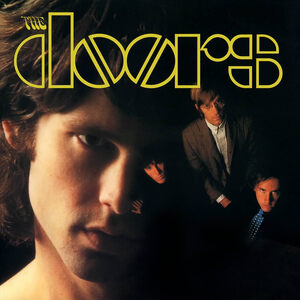
The Doors
Biography
The Doors were one of the most unusual major rock bands of the 1960s: literary, theatrical, blues-rooted, psychedelic, and dangerous in a way that was not only musical but psychological. They came out of Los Angeles, but they did not sound like the sunshine version of California. Their music suggested night streets, desert visions, old blues clubs, European poetry, film noir, and the unstable edge between performance and breakdown. At the center stood Jim Morrison, a singer and writer whose voice could move from velvet croon to shouted incantation, but The Doors were never just Morrison with a backing band. Ray Manzarek, Robby Krieger, and John Densmore built the strange architecture that made his words and presence possible.
The band began in 1965 after Morrison and Manzarek, who had both studied film at UCLA, met again on Venice Beach. Morrison had been writing poems and lyrics, and Manzarek was struck by the song ideas he heard, including the early form of 'Moonlight Drive'. The name The Doors came from Aldous Huxley's book 'The Doors of Perception', which itself drew its title from William Blake's idea that if the doors of perception were cleansed, everything would appear infinite. That name was not random decoration. It captured the band's ambition to make rock music feel like an opening into dream, fear, desire, and altered consciousness.
Ray Manzarek was essential from the beginning. Trained enough to understand harmony and structure, but open enough to experiment, he gave The Doors one of their defining sounds by playing keyboard bass lines with his left hand while handling organ and electric piano parts with his right. Because the band had no regular bass guitarist in its classic live configuration, Manzarek's keyboard work filled an unusual amount of space. His Vox Continental organ could sound carnival-like, icy, sacred, or sinister. It gave The Doors a texture unlike guitar-centered rock bands of the period.
Robby Krieger joined with a background that included flamenco, folk, blues, and jazz influences. He did not play like a typical blues-rock guitarist trying to dominate every song with volume. His lines were often lyrical, precise, and slightly exotic in color. He could be delicate, as on 'The Crystal Ship', sharp and rhythmic, as on 'Love Me Two Times', or hypnotic, as on 'Light My Fire', a song he wrote that became the band's breakthrough. John Densmore, influenced by jazz as much as rock, completed the lineup. His drumming was sensitive to mood and language. He could swing, whisper, explode, or follow Morrison's phrasing like a theater musician responding to an actor.
Before they became famous, The Doors developed in Los Angeles clubs, most importantly the London Fog and later the Whisky a Go Go. Those residencies mattered because they allowed the band to stretch songs, test Morrison's stage persona, and become stranger in public. Morrison was not a conventional frontman at first. He could be shy, even singing with his back to the audience in the early days, but he gradually learned to use stillness, silence, stare, and eruption as tools. He was influenced by poetry, theater, cinema, blues singers, and the idea of the performer as a kind of shamanic figure. That idea could be powerful, but it could also become self-destructive.
The Whisky a Go Go period ended dramatically after the band performed 'The End' with Morrison adding Oedipal spoken-word imagery that shocked the club. Whether later retellings have polished the moment into legend, the basic event became part of The Doors' origin story: this was a band willing to push a rock performance into territory closer to ritual theater and taboo. That willingness attracted attention. Elektra Records signed them, and producer Paul A. Rothchild became a crucial studio partner, helping them shape their long, moody arrangements into records that could still work as popular music.
The Doors' self-titled debut album, released in 1967, remains one of the strongest first albums in rock history. It introduced nearly every major part of their identity at once. 'Break On Through (To the Other Side)' opened the record with Latin-tinged rhythm, clipped guitar, and Morrison's command to cross a boundary. 'Soul Kitchen' brought a bluesy, urban atmosphere. 'The Crystal Ship' showed their gift for eerie beauty. 'Alabama Song (Whisky Bar)', adapted from Brecht and Weill, revealed their theatrical and European cabaret instincts. Then came 'Light My Fire', the song that made them stars.
'Light My Fire' was unusual for a hit single. The album version stretched past seven minutes, with long organ and guitar solos over a circular structure that gave the song both sensuality and tension. Krieger wrote the core song, but the arrangement was collective: Manzarek's famous opening figure, Densmore's buoyant rhythm, Morrison's cool vocal, and the extended instrumental middle turned it into something larger than a pop tune. Edited for radio, it became a number one single in the United States. Suddenly The Doors were not just a strange club band. They were a major act inside the exploding psychedelic era.
The debut album closed with 'The End', one of The Doors' defining recordings. The song moved slowly, almost like a procession, building from quiet guitar and organ textures into a long psychological drama. Morrison's words mixed farewell, myth, desire, violence, and Freudian provocation, while the band created a dark, suspended atmosphere around him. It was not rock and roll in the usual sense. It was closer to a staged descent, and it showed what made The Doors different from many of their peers. Their songs could be sensual and accessible, but they also wanted to confront the listener with fear, mortality, and inner disorder.
Their second album, 'Strange Days', also released in 1967, deepened the mood. It was recorded after the band had become famous but still drew from material developed in their earlier club period. The title track used early synthesizer textures to create an atmosphere of alienation. 'People Are Strange' became one of Morrison's clearest statements of outsider identity, concise and almost cabaret-like in its melody. 'Love Me Two Times' gave the band a blues-rock hit with Krieger's sharp riffing, while 'When the Music's Over' stretched into another long, dramatic performance piece. The album did not have the same commercial shock as the debut, but it may be the purest expression of The Doors' early darkness.
What made The Doors' sound distinctive was the way each musician left space for the others. Manzarek's keyboards provided bass, harmony, and atmosphere. Krieger's guitar often slipped through the arrangement rather than sitting on top of it. Densmore's drums responded to the lyric and mood instead of simply keeping time. Morrison's voice became the central character, but the band around him was unusually flexible. They could sound like a blues band, a jazz trio, a chamber group, a garage-rock act, or a psychedelic theater ensemble, sometimes within the same song.
Morrison's writing drew from many sources: French symbolist poetry, the Beat writers, Native American imagery filtered through his own myth-making, Greek tragedy, film, blues, and the counterculture's fascination with altered states. He could write sharply memorable rock lyrics, but he was also prone to grand gestures and symbolic overload. At his best, this gave The Doors a language of dream and danger that few rock bands could match. At his worst, it could become theatrical excess. The tension between power and pretension was always part of him, and part of the band's fascination.
In 1968, The Doors released 'Waiting for the Sun'. The album showed the pressures of success and the difficulty of turning their most ambitious ideas into finished work. They attempted a long theatrical piece, 'Celebration of the Lizard', but it did not become the full album-side statement originally imagined. Only the section 'Not to Touch the Earth' appeared on the album. Even so, 'Waiting for the Sun' produced one of their biggest singles, 'Hello, I Love You', a direct, driving pop song that reached number one. The album also included 'The Unknown Soldier', a bold antiwar song with a staged execution sequence, and 'Five to One', a heavy, confrontational track that became a live favorite.
By this point, Morrison's public behavior was becoming harder to separate from the music. He drank heavily, challenged audiences, and sometimes treated concerts as confrontations rather than performances. For fans, this unpredictability could feel thrilling, as if anything might happen. For the band, promoters, and authorities, it could be exhausting and risky. Morrison's charisma was real, but it came with instability. The Doors were becoming famous not only for their records but for the possibility of collapse onstage.
The most notorious incident came in Miami on March 1, 1969. During a chaotic concert at the Dinner Key Auditorium, Morrison was accused of exposing himself and charged with several offenses. The case became a national scandal, leading to canceled concerts and damaging the band's reputation with promoters. Morrison denied the most serious allegation, and the event has remained debated in details, but its consequences were undeniable. The Miami incident marked a turning point. The Doors were no longer simply provocative rock stars. They were under legal and cultural scrutiny at a moment when America was already tense over youth culture, drugs, war, and public morality.
The album released in 1969, 'The Soft Parade', reflected both ambition and strain. Paul Rothchild encouraged elaborate arrangements with horns and strings, and the band moved into a more produced, ornate direction. Some songs, such as 'Touch Me', worked brilliantly in that setting, with Curtis Amy's saxophone solo and Morrison's strong vocal making it one of their major hits. But the album divided listeners. The title suite was ambitious but uneven, and the orchestration sometimes softened the eerie economy that had made the earlier records so powerful. Still, 'The Soft Parade' is important because it shows The Doors refusing to remain fixed, even when the experiment did not fully cohere.
One major development during this period was the clearer separation of songwriting credits. Earlier Doors songs had often been credited to the group, but by 'The Soft Parade' the members wanted more precise attribution, partly because of discomfort with some lyrics. This matters because it highlights the band's internal dynamics. Morrison was the public focus, but Krieger wrote several of the band's most successful songs, including 'Light My Fire', 'Love Me Two Times', 'Touch Me', and later 'Love Her Madly'. Manzarek and Densmore were not passive accompanists. The Doors' identity was collective, even when Morrison's myth threatened to swallow everything.
In 1970, The Doors returned to a harder, more stripped-down sound with 'Morrison Hotel'. The album felt like a corrective after the orchestral experiments of 'The Soft Parade'. Its first side, titled 'Hard Rock Cafe', opened with 'Roadhouse Blues', one of the band's most durable songs. The track featured a bar-band swagger, harmonica from John Sebastian under an alias, and Morrison sounding less like a doomed poet than a blues shouter enjoying the grit of the room. The album also included 'Waiting for the Sun', 'Peace Frog', 'Blue Sunday', and 'Indian Summer', balancing blues-rock toughness with atmospheric reflection.
'Morrison Hotel' matters because it reconnected The Doors to American roots music without erasing their strangeness. 'Peace Frog' turned political violence and Morrison's recurring blood imagery into a tight, funky rock track, while 'Roadhouse Blues' became a statement of earthy survival. The band sounded more relaxed and more physical than on the previous album. After the Miami scandal and the mixed response to 'The Soft Parade', 'Morrison Hotel' helped restore their credibility.
Their final album with Morrison, 'L.A. Woman', released in 1971, is often seen as one of their greatest achievements. Recorded without Paul Rothchild, who left the project after disliking the direction, the album was produced by the band with engineer Bruce Botnick. They recorded much of it in their own rehearsal space, the Doors Workshop, with bassist Jerry Scheff and rhythm guitarist Marc Benno helping give the sessions a looser, bluesier feel. The result was rawer, more relaxed, and more rooted than their most elaborate records.
'L.A. Woman' turned Los Angeles into a mythic landscape of highways, desire, exhaustion, and decay. 'Love Her Madly', written by Krieger, gave the album a radio-friendly doorway. 'Riders on the Storm' became one of The Doors' most haunting recordings, built around rain sounds, electric piano, and a cool, drifting groove. Morrison's voice on the album was deeper and rougher, shaped by years of heavy drinking and performance, but that wear suited the material. The title track, with its driving rhythm and the repeated phrase 'Mr. Mojo Risin'', an anagram of Jim Morrison, became a final self-mythologizing burst of energy.
'L.A. Woman' is crucial because it showed a path The Doors might have followed: less psychedelic theater, more blues, groove, and nocturnal American realism. The band sounded alive, not finished. But Morrison was already pulling away. He moved to Paris in 1971 with Pamela Courson, hoping to write and step back from the machinery of rock stardom. On July 3, 1971, he died in Paris at age 27. No autopsy was performed, and the official account was heart failure, though the circumstances have remained the subject of speculation. His death froze him permanently as one of rock's most famous doomed figures.
The impact on The Doors was immense. Morrison had been difficult, unpredictable, and sometimes destructive, but he was also the band's central voice and symbolic presence. Manzarek, Krieger, and Densmore continued for a time, releasing 'Other Voices' in 1971 and 'Full Circle' in 1972. Those albums have moments of musical interest, but they could not escape Morrison's absence. The Doors without him were a capable band missing the dangerous theatrical center around which their identity had formed. They disbanded in the early 1970s.
The Doors' afterlife was unusually strong. In 1978, the surviving members created music around Morrison's recorded poetry for 'An American Prayer'. The project divided critics, but it reinforced the idea of Morrison as poet-performer rather than only rock singer. In the late 1970s and 1980s, new generations discovered the band through radio, reissues, books, posters, and the growing mythology around Morrison. The 1991 Oliver Stone film 'The Doors' further shaped public perception, though it also emphasized the most extreme parts of Morrison's persona in ways the surviving members sometimes criticized.
One challenge in understanding The Doors is separating the music from the Morrison legend without pretending the legend is irrelevant. Morrison's charisma, intelligence, recklessness, drinking, legal troubles, and early death all became part of rock mythology. But focusing only on that misses the band's craft. Manzarek's keyboard bass allowed the group to operate without a normal low-end structure. Krieger's songwriting and guitar tone gave the music sensuality and color. Densmore's jazz-informed drumming kept the songs fluid and dramatic. The Doors were not a simple hard rock band. They were an ensemble with a rare sense of theatrical space.
Their creative process often began with poetry, riffs, moods, or fragments brought into the room and shaped collectively. 'Light My Fire' came from Krieger but became a Doors classic because of the arrangement. 'The End' grew through performance. 'Riders on the Storm' emerged from a jam connected to the country song 'Ghost Riders in the Sky' and became something entirely different through mood, keyboard color, and Morrison's lyric. This was one of The Doors' great strengths: they could transform source material until it sounded like it had come from a private symbolic world.
The band's relationship with the blues is also essential. Morrison admired blues singers, and The Doors frequently drew from blues forms, but they rarely played blues in a straightforward traditional way. They filtered it through jazz, flamenco, theater, and psychedelia. 'Roadhouse Blues' is direct, but 'The End' and 'When the Music's Over' are something stranger: blues feeling stretched into ritual. This helped make The Doors accessible to rock audiences while keeping them separate from both British blues-rock and San Francisco psychedelia.
The Doors' cultural impact lies partly in how they expanded the idea of what a rock band could perform. They brought darkness, erotic tension, literary ambition, and theatrical confrontation into mainstream rock without losing hit-making power. They showed that a band could have number one singles and still release long, unsettling pieces that challenged the form. They influenced gothic rock, punk, post-punk, alternative rock, dark cabaret, and countless artists drawn to the combination of minimal instrumentation and maximum atmosphere.
Their key albums mark distinct phases. 'The Doors' is the explosive arrival, where the band's club material becomes a fully formed debut. 'Strange Days' is the deepening of their psychedelic night-world. 'Waiting for the Sun' captures success, pressure, and partial fragmentation. 'The Soft Parade' is the orchestral experiment, flawed but revealing. 'Morrison Hotel' is the return to rock and blues toughness. 'L.A. Woman' is the final, mature statement, loose, shadowed, and rooted in the city that made them.
Morrison's death inevitably shaped the band's legacy, but The Doors' music endures because it was built from more than tragedy. It had groove, melody, risk, humor, menace, and a sense of space that still feels distinctive. Morrison could be pretentious, but he could also be concise and devastating. Manzarek could make an organ sound like a carnival, a church, or a nightmare. Krieger could write a pop hook or a serpentine guitar line. Densmore could make a rock song breathe like jazz. Together they created a sound that was immediately identifiable and difficult to imitate without slipping into parody.
Today, The Doors remain one of the essential bands of the 1960s because they captured the decade's promise and danger in unusually concentrated form. They were psychedelic but not gentle, blues-based but not traditional, literary but not academic, popular but never fully safe. Their best music feels like Los Angeles after midnight: headlights, heat, temptation, fear, and the sense that something hidden is about to step into view. The Doors opened a passage in rock music that many later artists walked through, but few entered with the same strange combination of discipline, danger, and dream.