
The Prodigy
Biography
The Prodigy began in Braintree, Essex, at a moment when British rave culture was still raw, often semi-legal, and only partly understood by the mainstream. Their founder, Liam Howlett, was not a conventional bandleader. He had classical piano training, but he had also been shaped by hip-hop, electro, punk attitude, and the physical pressure of sound systems. Before The Prodigy became a group, Howlett had been a DJ and a member of the hip-hop crew Cut 2 Kill. He was interested in beats as impact, not decoration: chopped breaks, distorted synth stabs, and samples that felt as if they had been pulled from somewhere unstable. Around 1990, after meeting Keith Flint and Leeroy Thornhill on the Essex rave scene, he gave Flint a cassette of tracks he had made. Flint liked it enough to encourage Howlett to perform the music live. That small exchange became one of the important turning points in British electronic music.
The earliest version of The Prodigy was less like a traditional band and more like a live rave unit. Howlett made the music, while Flint, Thornhill, and later Maxim Reality brought the stage to life. Sharky was also part of the earliest live lineup, though she left before the band became internationally known. Maxim, born Keith Palmer, became the group's MC and later one of its defining voices. Flint and Thornhill were originally dancers, but that description does not fully capture what they added. In clubs and on festival stages, they translated Howlett's tracks into movement, confrontation, and theatre. The Prodigy were electronic, but from the beginning they did not behave like faceless dance producers. They looked like a gang, moved like a punk band, and hit like a sound system.
Their first releases came through XL Recordings, a label deeply connected to the early 1990s rave explosion. The 1991 single 'Charly' became their first major hit, built around a sample from a British public information film. It was catchy, mischievous, and instantly recognizable, but it also created a problem for Howlett. The song was grouped with a wave of novelty rave records, and for an artist with serious musical ambition, that association was frustrating. The Prodigy had broken into the charts, but the success risked making them look disposable. Howlett's response was not to soften the group. It was to sharpen them.
Their debut album, 'Experience', released in 1992, captured the speed and euphoria of the early rave years. Tracks such as 'Out of Space', 'Everybody in the Place', and 'Fire' were built for bodies in motion: fast breakbeats, cartoonish vocal snippets, reggae and hip-hop traces, and synth lines that seemed to jump out of the speakers. The album now sounds like a document of a particular moment in British youth culture, when warehouse parties, pirate radio, and the new language of breakbeat hardcore were still close to the underground. But it was not just a scene record. Howlett already had a gift for arrangement. Even at their most frantic, the tracks had hooks, tension, drops, and a sense of character. 'Experience' made The Prodigy stars of rave, but it also gave Howlett a target to escape from.
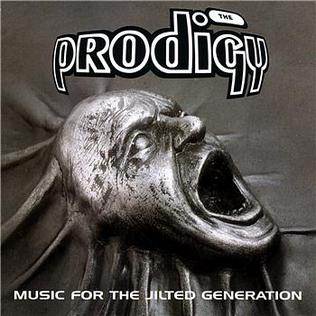
By the time he started making 'Music for the Jilted Generation', Howlett had grown hostile toward the formula that early rave had become. The British government and police were cracking down on free parties, and dance music itself was becoming more commercial and predictable. The 1994 album carried that tension in its title and artwork. It was not simply a collection of dance tracks; it was a statement of resistance from inside rave culture. The record pushed beyond the bright rush of 'Experience' into darker, more aggressive territory. 'Voodoo People' fused breakbeats with a guitar sample from Nirvana, while 'Their Law', made with Pop Will Eat Itself, turned anti-authoritarian frustration into a snarling hybrid of techno, rock, and industrial pressure. The album's inner artwork, showing a young rebel cutting through the earth away from the police and toward a rave, captured the mood: escape, defiance, and noise as a form of identity.
'No Good (Start the Dance)' showed another side of Howlett's craft. It was built around a vocal sample from Kelly Charles, but instead of simply looping it, he framed it with rushing drums and synths that made the track feel both euphoric and threatening. The long closing sequence, 'The Narcotic Suite', also proved that Howlett was not only a singles producer. He could build atmosphere, structure, and tension across extended pieces. 'Music for the Jilted Generation' reached a much wider audience than most underground electronic records of its kind, and it helped move The Prodigy away from the category of rave act and toward something stranger: a band whose sound could live in clubs, rock festivals, bedrooms, and car stereos without fully belonging to any one of them.
The next transformation came through Keith Flint. For the first half of The Prodigy's career, Flint had been known mainly as a dancer and visual presence, but 'Firestarter' changed everything. Released in 1996, it presented him as a frontman: spiked hair, intense stare, piercings, and a performance that felt closer to punk provocation than dance-pop showmanship. The video, filmed in a disused London Underground tunnel, became one of the decade's defining music television images. Flint did not sing in a polished way; he spat the words with a cartoon menace that was thrilling because it felt both theatrical and real. It gave The Prodigy a face that matched the violence of Howlett's production.
'The Fat of the Land', released in 1997, made The Prodigy a global force. It entered at number one in both the UK and the US and arrived when electronic music was being pushed as the next major commercial wave in America. But The Prodigy did not sound like polite ambassadors for club culture. 'Breathe' paired Flint and Maxim in a claustrophobic call-and-response over a beat that seemed to lurch rather than flow. 'Smack My Bitch Up' became one of the band's most controversial tracks because of its title, lyric, and video, drawing criticism and broadcast restrictions while also becoming one of their most discussed recordings. 'Diesel Power' brought in Kool Keith, showing how deep Howlett's hip-hop instincts still ran. The album's power was in its collisions: breakbeats, metal textures, punk sneer, rave programming, reggae bass pressure, and rap phrasing all forced into one compressed attack.
The making of that period also exposed what made The Prodigy unusual. Howlett was the studio architect, but the group worked because the other members gave the music bodies and voices. Maxim's deep, commanding presence grounded the chaos. Flint turned danger into performance. Thornhill, tall and fluid on stage, helped preserve the connection to rave's physical culture even as the band crossed into rock arenas. Their concerts were not DJ sets and not conventional rock shows. They were built on impact: strobes, volume, movement, and the feeling that the stage might spill into the crowd. This is one reason The Prodigy could play to dance audiences and metal audiences without seeming like tourists in either world.
The success of 'The Fat of the Land' also created pressure. The Prodigy had become enormous by refusing to fit, but global fame can freeze a band into the image that made it famous. After the late 1990s peak, the group slowed down. Leeroy Thornhill left in 2000, a major change because he had been part of the original live chemistry. In 2002, the single 'Baby's Got a Temper' appeared, but Howlett later distanced himself from it, and it did not lead to a full album. The Prodigy were still a major name, but the next real chapter had to prove that they were more than a 1990s explosion.
'Always Outnumbered, Never Outgunned', released in 2004, was essentially a Liam Howlett studio album under The Prodigy name. Flint and Maxim were largely absent from the record, and the guest list included figures such as Juliette Lewis, Liam Gallagher, Kool Keith, Princess Superstar, and Twista. The album was abrasive, compressed, and restless. It had strong moments, especially 'Girls' and 'Spitfire', but it also revealed how important the full group's chemistry had been. Without Flint and Maxim as central presences, the music could feel more like a producer fighting with machines than a band turning that fight into collective identity. Still, the record matters because it kept The Prodigy from becoming a nostalgia act. Howlett was testing whether the name could survive reinvention.
The answer came with 'Invaders Must Die' in 2009. Released on the band's own Take Me to the Hospital label, it brought Howlett, Flint, and Maxim back into a more unified shape. The album did not try to repeat 'The Fat of the Land' exactly; instead, it reconnected with the group's core ingredients: rave riffs, punk energy, big hooks, and live force. 'Omen' became one of their strongest late-period singles, while 'Warrior's Dance' reached back toward old-school rave without sounding like a museum piece. Dave Grohl played drums on 'Run with the Wolves', a detail that made sense because The Prodigy had long since built a bridge between electronic programming and rock physicality. The album's success in the UK confirmed that their audience had not disappeared. It had grown up, and younger listeners had joined it.
Part of The Prodigy's power has always come from Howlett's refusal to treat electronic music as smooth or polite. His productions often work through friction. The drums are not just beats; they are cut, stacked, and shoved forward. The basslines do not simply support the tracks; they prowl. Samples appear like stolen fragments from radio, film, reggae, hip-hop, rock, or public memory, then get twisted until they become part of The Prodigy's own language. His best tracks have the shape of pop songs but the attitude of sabotage. They are direct enough to shout along to, but detailed enough that the production keeps revealing small edits, breaks, and turns.
Flint's role in the group's identity deserves special attention because it was so unusual. He was not the original songwriter or producer, and he was not a conventional vocalist, yet he became one of the most recognizable frontmen of his era. He understood performance as transformation. On stage and in videos, he used his body, hair, face, and voice to become a kind of living alarm signal. Away from that image, people who knew him often described a more gentle and humorous person, which made the contrast sharper. The public saw the wild-eyed figure from 'Firestarter'; the band knew the friend and collaborator who had helped turn Howlett's music into a living, breathing force.
Maxim's contribution was different but just as important. His voice gave The Prodigy weight and authority. Where Flint brought twitchy danger, Maxim brought command. On tracks like 'Breathe' and in the live show, he functioned as MC, vocalist, and crowd controller, tying The Prodigy back to sound-system culture and hip-hop as much as to rave. This balance helped the group avoid becoming a one-image band. The Prodigy were never only Keith Flint's sneer or Liam Howlett's machines. They were a collision of personalities, each one intensifying the others.
After 'Invaders Must Die', The Prodigy continued to work in a hard, confrontational mode. 'The Day Is My Enemy', released in 2015, was darker and more relentless, with tracks such as 'Nasty', 'Wild Frontier', and the title track emphasizing pressure over crossover polish. The album sounded like a band suspicious of comfort. It arrived in an era when electronic music had become globally commercial through EDM festivals and pop collaborations, but The Prodigy positioned themselves against that gloss. Their sound remained dirty, aggressive, and stubbornly physical.
'No Tourists', released in 2018, became the last Prodigy album issued during Keith Flint's lifetime. It included tracks such as 'Need Some1', 'Light Up the Sky', and 'We Live Forever', and it continued the group's late-career pattern: short, sharp records built around impact rather than reinvention for its own sake. By this point, The Prodigy had nothing left to prove commercially, but they still had a clear identity. They were not chasing modern dance trends. They were maintaining a world they had built: rave as riot, electronics as attack, performance as confrontation.
Keith Flint died in March 2019 at the age of 49. His death shook The Prodigy's audience because he had seemed, on stage, almost indestructible. The band cancelled planned shows, and for a time the future of The Prodigy was uncertain. The loss was not only symbolic. Flint had been central to how millions of people understood the group: the face of 'Firestarter', the voice on 'Breathe', and the figure who made electronic music look dangerous to people who thought dance acts were anonymous. A later inquest left the exact circumstances unresolved, and the most respectful way to understand the event is through its impact: it left a deep absence in the band and in British music culture.
Howlett and Maxim eventually returned to the stage as The Prodigy, treating the live shows partly as continuation and partly as tribute. The absence of Flint changed the emotional charge of the performances, but it did not erase the force of the music. In a strange way, the songs had always been built for survival. They were made from fragments, breaks, alarms, chants, and impact. They could carry memory without becoming quiet.
The Prodigy's influence is difficult to reduce to one genre because their importance lies in the way they broke genre borders. They helped bring rave culture into the album era without sanding off its edges. They made electronic music feel like a band experience for rock listeners, while keeping enough breakbeat, bass, and sound-system DNA to remain connected to the dance underground. They opened doors for big beat and alternative dance, but they were always more feral than most of the acts grouped around those labels. Their music influenced electronic producers, rock bands, festival culture, video-game soundtracks, extreme sports media, and the broader idea that a sampler, sequencer, or laptop could hit with the force of guitars and drums.
What makes The Prodigy endure is not only their volume or aggression. It is the precision behind the chaos. Howlett's records are built with the instincts of a producer who understands hooks, tension, rhythm, and shock. Flint and Maxim gave that architecture human electricity. Thornhill helped root the early group in rave's communal body language. Together, they created a sound that felt illegal even when it was selling millions. The Prodigy came from a specific British moment, but their best music still works because it captures a universal sensation: the thrill of pressure building until control breaks. They were never simply a dance act, never simply a rock act, and never simply a product of the 1990s. They were a rare case of underground energy becoming mass culture without losing its threat.