
Jimi Hendrix
Biography
Jimi Hendrix was born Johnny Allen Hendrix in Seattle, Washington, on November 27, 1942, and was later renamed James Marshall Hendrix by his father, Al Hendrix. His childhood was unstable, marked by poverty, family tension, and frequent moves, but music became a constant early obsession. Before he owned a proper instrument, he carried a broom around as if it were a guitar, imitating the sounds and gestures of the blues and rock and roll records that had entered his imagination. His first real guitar was a cheap acoustic, followed by an electric Supro Ozark. He was left-handed, but because left-handed guitars were rare and expensive, he learned to play right-handed guitars flipped upside down and restrung. That practical workaround became part of his visual identity and helped shape the physical language of his playing.
Hendrix came of age in a city where rhythm and blues, gospel, jazz, and rock and roll mixed through radio, local clubs, and neighborhood parties. He absorbed the raw blues feeling of Muddy Waters and Howlin' Wolf, the stagecraft of Little Richard, the guitar bite of B.B. King and Albert King, and the excitement of early rock and roll. He was not a formal student in the academic sense, but he was a serious listener. He studied records intensely and learned how to make a guitar speak in several voices at once: lead line, rhythm stab, bass movement, and pure noise. That ability would become one of his great gifts. Hendrix did not simply play solos over songs. He seemed to build whole weather systems around them.
After a difficult period as a teenager, Hendrix joined the United States Army in 1961 and served in the 101st Airborne Division. His military career was brief, and after leaving the Army in 1962, he moved deeper into music. He met bassist Billy Cox while stationed in Kentucky, and the two formed a musical bond that would resurface at key points in Hendrix's career. In the early 1960s Hendrix worked the so-called chitlin' circuit, playing behind singers and showmen in hard-working rhythm and blues bands. He worked with artists and groups including the Isley Brothers, Little Richard, Don Covay, King Curtis, and Curtis Knight. These years were not glamorous, but they were crucial. He learned discipline, timing, dynamics, how to support a frontman, how to read an audience, and how to survive as a working musician.
The sideman years also revealed a problem: Hendrix was too restless to stay in the background. With Little Richard, whose own showmanship left little room for another flamboyant performer, Hendrix's stage moves and musical freedom created tension. He was still known as Jimmy James during much of this period, moving through Harlem and Greenwich Village clubs, trying to find a setting where his guitar could be the center rather than a decoration. In New York he formed Jimmy James and the Blue Flames and began to stretch blues, soul, and rock into something stranger and more personal. One of the people who saw him there was Linda Keith, then connected socially to the Rolling Stones circle. She became an important early believer in Hendrix and helped bring him to the attention of Chas Chandler, the Animals bassist who was looking to move into management and production.
Chandler saw Hendrix perform in 1966 and understood that the guitarist needed a different stage. He brought him to London, where Hendrix quickly became one of the most talked-about musicians in the city. The move changed everything. London in 1966 was full of ambitious guitar players, but Hendrix seemed to arrive from another planet. Eric Clapton, Jeff Beck, Pete Townshend, and members of the Beatles and Rolling Stones were already shaping British rock, yet Hendrix's combination of blues authority, volume, feedback control, sensual phrasing, and theatrical confidence was startling even to them. At an early London appearance, Hendrix joined Cream onstage and played 'Killing Floor' at a furious speed. Clapton, already considered one of the great guitarists of the moment, was reportedly shaken by what he heard. Whether every retelling has grown in drama or not, the event captures the effect Hendrix had on his peers: he made the electric guitar feel newly possible.
Chandler helped build the Jimi Hendrix Experience around him, pairing Hendrix with bassist Noel Redding and drummer Mitch Mitchell. Redding had played guitar before switching to bass, while Mitchell brought a jazz-influenced looseness and quickness that suited Hendrix's expanding ideas. The trio did not behave like a standard blues-rock backing band. Mitchell's drumming was explosive and conversational, Redding's bass often held the center while Hendrix moved between rhythm and lead, and the whole group could sound larger than three people. Their first singles, including 'Hey Joe', 'Purple Haze', and 'The Wind Cries Mary', announced Hendrix as a songwriter as well as a guitarist. 'Hey Joe' was a dramatic reinvention of an existing song, dark and controlled. 'Purple Haze' was more alien, with its tritone opening, distorted tone, and lyrics that blurred desire, confusion, and dream logic. 'The Wind Cries Mary' showed a gentler side, written after an argument with his girlfriend Kathy Etchingham and shaped into one of his most graceful early ballads.
The debut album, 'Are You Experienced', released in 1967, remains one of the most concentrated arrivals in rock history. It was recorded in London studios under tight budgets and time pressure, yet it sounded spacious, futuristic, and dangerous. Chandler's production kept the songs focused, but Hendrix used the studio as a laboratory. He stacked guitar parts, explored feedback as a musical device, and treated distortion not as dirt but as color. The album moved from the swagger of 'Foxy Lady' to the dreamlike drift of 'May This Be Love', from the manic drive of 'Manic Depression' to the psychedelic landscape of 'Third Stone from the Sun'. On that track, Hendrix mixed surf-rock guitar, jazz phrasing, science-fiction atmosphere, and studio manipulation into a miniature cosmic drama. He was not abandoning the blues; he was expanding it until it could hold outer space, sexuality, humor, loneliness, and noise.
Hendrix's breakthrough in the United States came with the Monterey Pop Festival in June 1967. Though he had already become famous in Britain, many American listeners were encountering him for the first time. His performance was carefully placed for impact, and he delivered a set that balanced musical force with unforgettable theater. At the end of 'Wild Thing', he knelt over his Stratocaster, doused it with lighter fluid, set it on fire, and smashed it. The act could be misunderstood as a gimmick, but in context it felt like a ritual sacrifice: showmanship, destruction, humor, sexuality, and rebellion fused into one image. It also risked overshadowing the musicianship of the set, which was fierce and controlled. Monterey made Hendrix a star in America and fixed his image in public memory as a performer who seemed to push rock beyond ordinary rules.
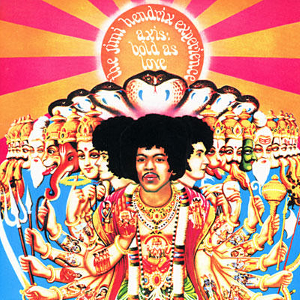
The second Experience album, 'Axis: Bold as Love', released later in 1967, showed a more refined and melodic Hendrix. Its opening, 'EXP', played with radio interference and mock science-fiction dialogue, but much of the record was intimate and richly colored. Songs such as 'Little Wing' and 'Castles Made of Sand' revealed his gift for compressed storytelling and chordal invention. 'Little Wing' in particular showed how unusual his rhythm playing was. The guitar does not simply strum chords; it decorates them with hammer-ons, melodic fragments, and passing tones, creating a floating structure that many later guitarists would study obsessively. 'If 6 Was 9' expressed Hendrix's outsider confidence without turning it into a slogan. The album's title track, 'Bold as Love', used color imagery and emotional abstraction, ending with a swirling fade that suggested his growing interest in the studio as an instrument.
One famous story from the 'Axis' period shows both the pressures around Hendrix and the fragile nature of record-making in the 1960s. Hendrix reportedly left tapes connected to the album in a London taxi shortly before the record had to be completed, forcing urgent reconstruction work from available mixes. The episode has often been told as a near-disaster, and it fits Hendrix's life at the time: brilliant work happening amid exhaustion, speed, and chaos. He was producing music at an extraordinary pace, touring constantly, dealing with management pressure, and becoming a public symbol faster than he could privately process.
By 1968 Hendrix wanted more control. 'Electric Ladyland', his third studio album with the Experience, became the fullest statement of his imagination. The sessions were long, crowded, and sometimes difficult. Chandler, who preferred concise songs and disciplined sessions, grew frustrated with Hendrix's perfectionism and the number of guests and hangers-on in the studio. Hendrix, meanwhile, was hearing music on a larger scale. He wanted extended forms, layered guitars, unusual textures, and a freer blend of blues, funk, rock, soul, and studio psychedelia. The album included the burning blues of 'Voodoo Chile', the tight and supernatural 'Voodoo Child (Slight Return)', the restless urban groove of 'Crosstown Traffic', and the expansive suite-like flow of '1983... (A Merman I Should Turn to Be)'.
'Electric Ladyland' also contained Hendrix's version of Bob Dylan's 'All Along the Watchtower', one of the rare covers that redefines the song without erasing the writer. Hendrix tightened the arrangement, intensified the drama, and used layered guitar parts to create a sense of approaching storm. Dylan later acknowledged the power of Hendrix's interpretation by performing the song in a way influenced by it. The track became Hendrix's only Top 40 hit in the United States, but its importance goes beyond chart placement. It showed how he could take a song built on folk imagery and transform it into electric prophecy through arrangement, tone, and momentum.
Hendrix's relationship with the guitar was physical, technical, and imaginative all at once. He used a Fender Stratocaster through loud Marshall amplifiers, often with effects such as the wah-wah pedal, Octavia, Uni-Vibe, and fuzz. But the equipment alone does not explain the sound. Hendrix manipulated volume, pickup position, feedback, string bends, thumbed bass notes, double-stops, and percussive muting with unusual command. Because he played a right-handed Stratocaster upside down, the reversed string length and pickup angle subtly affected tension and tone. He could make the guitar scream, laugh, whisper, imitate sirens, or dissolve into feedback, yet his playing was rooted in rhythm. Even his wildest passages often had a deep groove underneath them.
As fame increased, the original Experience began to fray. Redding was frustrated by Hendrix's expanding studio methods and by his own limited role. The band broke apart in 1969, and Hendrix began searching for new musical settings. That summer he appeared at Woodstock with a larger group sometimes called Gypsy Sun and Rainbows, including Billy Cox on bass and Larry Lee on rhythm guitar, with additional percussionists. The performance took place on the morning of August 18, after delays had thinned the festival crowd. Hendrix's version of 'The Star-Spangled Banner' became one of the defining musical moments of the era. It was not a simple protest song and not a patriotic singalong. Through feedback, dive bombs, distortion, and fragments of melody, he turned the national anthem into a soundscape that seemed to contain celebration, violence, mourning, and irony at once. Coming during the Vietnam War, it was heard by many as a statement about America tearing itself apart, though Hendrix himself resisted easy explanations.
At the end of 1969 Hendrix formed Band of Gypsys with Billy Cox and drummer Buddy Miles. This group moved him toward a heavier funk and soul foundation. Their live album, 'Band of Gypsys', recorded at the Fillmore East on New Year's Eve 1969 and New Year's Day 1970, was released in 1970 and stands apart from the Experience records. The centerpiece, 'Machine Gun', is one of Hendrix's most powerful performances. Built on a slow, ominous groove, the song used guitar sounds to evoke the terror and machinery of war without becoming a literal sound-effects exercise. It stretched blues improvisation into political lament and psychological pressure. Buddy Miles's drumming and Cox's steady bass gave Hendrix a different kind of floor: less jazz-like than Mitchell, more grounded in funk and R&B. The group did not last long, but it revealed a direction Hendrix might have explored further.
Hendrix was not only a spectacular performer; he was also increasingly serious about recording infrastructure. In 1970 he opened Electric Lady Studios in New York, designed as a place where he could work without the punishing cost and restrictions of rented studio time. The studio was built with his creative habits in mind: late-night work, experimentation, layering, and careful attention to sound. He spent significant time there recording material intended for a new studio album, often discussed under titles such as 'First Rays of the New Rising Sun'. Songs from this period, including 'Freedom', 'Angel', 'Dolly Dagger', 'Ezy Ryder', and 'Night Bird Flying', suggest a musician moving toward a leaner, funkier, more rhythmically intricate sound while still retaining his psychedelic imagination. The work was unfinished at his death, leaving one of rock's great unanswered questions: not whether Hendrix had more to say, but how far he might have gone once he controlled his own studio environment.
Hendrix's personality in public could seem paradoxical. Onstage he was magnetic, sensual, funny, and explosive, capable of playing behind his back or with his teeth while still maintaining musical control. Offstage, many accounts describe him as soft-spoken, polite, and sometimes shy. He disliked being reduced to tricks, even though he understood the power of spectacle. He was also under heavy pressure from audiences, managers, legal disputes, racial expectations, and the demands of constant touring. As a Black artist leading a rock band in a largely white rock marketplace, he occupied a complicated position. Some Black audiences saw him as distant from soul and R&B traditions, while many white rock fans misunderstood how deeply his music came from those traditions. In truth, Hendrix's work drew from blues, gospel, soul, funk, jazz, science fiction, and rock at the same time. He did not fit neatly into the racial or genre categories the industry wanted to impose on him.
His career was also marked by conflict and vulnerability. A 1969 arrest in Toronto for drug possession threatened him with serious legal consequences, though he was acquitted after testifying that the substances had been placed in his bag without his knowledge. The case hung over him during an already exhausting period. He faced disputes over contracts signed before his fame, including obligations connected to earlier manager Ed Chalpin. The 'Band of Gypsys' live album was partly tied to resolving those legal complications. These business pressures did not create the music, but they shaped the conditions under which it was made. Hendrix often had to fight for time, control, and space while being treated as both a commercial asset and a cultural phenomenon.
On September 18, 1970, Jimi Hendrix died in London at the age of 27. The widely accepted cause was barbiturate intoxication. His death came while he was still developing, still recording, and still searching for the next form his music would take. Because his public career lasted only about four years, from his London breakthrough in 1966 to his death in 1970, the density of his achievement is almost difficult to measure. He released three studio albums with the Experience during his lifetime, one major live album with Band of Gypsys, and left behind a large body of recordings that continued to be studied, released, debated, and reorganized for decades.
Hendrix's influence is not limited to guitar technique, although that alone would be enormous. He changed how musicians thought about electric sound. Before him, distortion and feedback were often treated as accidents or aggressive effects. Hendrix made them expressive, controllable, and emotionally precise. He expanded the role of the rock guitarist from soloist to arranger, sonic architect, and bandleader. His chord vocabulary influenced soul, funk, R&B, and rock players. His stagecraft influenced hard rock and heavy metal. His studio imagination helped open paths for psychedelic rock, progressive rock, funk-rock, and later experimental music. Artists as different as Prince, Eddie Van Halen, Stevie Ray Vaughan, Funkadelic, Miles Davis's electric bands, and countless hip-hop producers have drawn something from him: tone, freedom, rhythm, color, attitude, or the idea that sound itself can carry meaning.
What makes Hendrix endure is not just that he played fast or loud. Many guitarists have done both. His greatness lies in the way he fused technique with feeling and imagination. A Hendrix performance can feel loose and dangerous, yet beneath the fire there is deep musical intelligence: chord movement, rhythmic placement, dynamic control, and an instinct for drama. He could turn a blues phrase into a personal confession, a national anthem into a battlefield, or a studio track into a dream sequence. His music still feels alive because it does not sit comfortably inside one category. It is blues and rock, body and mind, earth and outer space, discipline and chaos. Jimi Hendrix did not simply raise the standard for electric guitar. He changed the instrument's vocabulary, and in doing so changed the sound of modern music.