
Queens Of The Stone Age
Biography
Queens of the Stone Age began as Josh Homme's attempt to move beyond the desert rock scene he had helped define. Before QOTSA, Homme was the teenage guitarist in Kyuss, the Palm Desert band whose slow, low-tuned, sun-blasted riffs became one of the foundations of stoner rock. Kyuss were powerful but never fully mainstream, and after they broke up in 1995 Homme did not immediately rush to become a frontman. He briefly moved to Seattle, played rhythm guitar with Screaming Trees on tour, and began thinking about a new kind of rock band: heavy but not macho, repetitive but not dull, dark but also sly, robotic and sensual at the same time.
The first version of the project was called Gamma Ray, but after a name conflict with the German power metal band, Homme changed it to Queens of the Stone Age. The name itself mattered. It was partly a joke, partly a mission statement. Homme has often pushed back against the idea that heavy music had to be aggressively masculine. He wanted something tough and seductive, something that could swing instead of simply crush. That instinct became the band's core identity: riffs built like machinery, but with a strange elegance running through them.
The 1998 debut album 'Queens of the Stone Age' was almost a solo reconstruction of Homme's musical imagination. With former Kyuss drummer Alfredo Hernandez, Homme recorded a stripped-down, hypnotic record where he handled much of the instrumentation and, crucially, became the singer almost by necessity. His voice was not the expected heavy rock roar. It was smooth, nasal, controlled, sometimes almost detached, and that contrast changed the character of the music. Instead of shouting over the guitars, he floated above them. Songs such as 'Regular John' and 'Mexicola' kept some of the desert weight of Kyuss but reshaped it into something more aerodynamic. The riffs repeated like engines, the drums locked into blunt grooves, and the vocals gave the songs an eerie coolness.
Queens of the Stone Age soon became less a fixed lineup than a moving gang around Homme. This would remain one of the band's defining features. Musicians entered, left, returned, and reappeared in different roles, creating a catalog that feels unified by Homme's taste rather than by a stable membership. Nick Oliveri, another former Kyuss member, joined on bass and brought a rawer, more chaotic presence. Mark Lanegan, the deep-voiced Screaming Trees singer and a close Homme collaborator, became a recurring presence whose weathered baritone added shadow and gravity. Dave Catching, Gene Trautmann, Troy Van Leeuwen, Joey Castillo, Dean Fertita, Michael Shuman, Jon Theodore, and others would all shape different eras of the band.
The first major leap came with 'Rated R' in 2000. If the debut was a desert machine, 'Rated R' was a wider, weirder, more dangerous ride. The album expanded the band's palette with keyboards, horns, handclaps, backing vocals, and sudden changes in mood. It could be heavy, funny, bleak, loose, and polished within the same stretch of music. 'The Lost Art of Keeping a Secret' gave the band one of its first major alternative radio breakthroughs, but the album's personality was bigger than any single. 'Better Living Through Chemistry' drifted into psychedelic space, 'Auto Pilot' showed Oliveri's softer melodic side, and 'In the Fade' used Lanegan's voice to bring a haunted calm to the record. The album also showed Homme's gift for making danger sound controlled. Even when the songs seemed reckless, the arrangements were precise.
One of the clearest early anecdotes around the band is the deliberate provocation of 'Feel Good Hit of the Summer'. Built around a blunt, repetitive chorus that listed party substances, the song was less a simple celebration than a sarcastic dare, a way of turning the band's wild reputation into a minimalist rock joke. It also showed Homme's taste for confrontation through form: the song barely changes, because the joke is the repetition itself. That kind of dry humor would become part of QOTSA's DNA. They were heavy, but rarely humorless.
The band's commercial and creative explosion arrived with 'Songs for the Deaf' in 2002. The album was built around a loose concept: the experience of driving through the California desert from Los Angeles toward Joshua Tree, switching between strange fictional radio stations, hearing music as if it were being picked up through heat, boredom, distance, and static. The idea came directly from the geography that shaped Homme. Unlike many concept albums, 'Songs for the Deaf' does not tell a linear story. It creates an environment. Between the songs, radio skits interrupt the flow, making the record feel like a long night drive through a place where the road, the dial, and the mind start to blur.
Dave Grohl's drumming was central to the album's force. After Gene Trautmann's time with the band ended, Homme brought in Grohl, and his arrival gave the record a physical snap that separated it from the sludgier end of desert rock. His parts on 'No One Knows' are not just powerful; they are architectural, pushing and lifting the song's stop-start riff until it becomes danceable and crushing at once. 'Go with the Flow' turned a pounding piano and guitar pattern into one of the band's most direct anthems, while 'Song for the Dead' let Grohl and Lanegan drag the band into something darker and more monumental. Nick Oliveri's screams on several tracks gave the album a wild edge, while Homme's cleaner voice kept the whole thing from collapsing into pure aggression.
'Songs for the Deaf' made Queens of the Stone Age one of the defining rock bands of the early 2000s. The album connected with mainstream listeners without softening the band's oddness. It was heavy enough for metal fans, catchy enough for alternative radio, and strange enough to avoid feeling like a simple hard rock revival. It also showed why QOTSA were different from many bands around them. They did not sound like they were trying to return rock to the past. They sounded like they had taken older ingredients - Black Sabbath weight, punk economy, garage rock attitude, glam sleaze, krautrock repetition - and rebuilt them into a sleek desert vehicle.
The success of 'Songs for the Deaf' also intensified the instability around the band. In 2004, Homme dismissed Nick Oliveri. The split ended the most volatile version of QOTSA and changed the band's chemistry. Oliveri had brought danger, speed, and a confrontational stage presence; without him, Homme had more space to steer the group toward mood, texture, and arrangement. The next album, 'Lullabies to Paralyze' in 2005, reflected that shift. It was darker, more nocturnal, and more fairy-tale-like than its predecessor. Troy Van Leeuwen, who had joined during the 'Songs for the Deaf' era, became increasingly important as a guitarist and arranger, helping give the band a more layered sound.
'Lullabies to Paralyze' opened with 'This Lullaby', a brief Mark Lanegan performance that sounded like a cursed folk song, then moved into the hard swing of 'Medication' and the creeping menace of 'Burn the Witch'. The album had roots in horror imagery and warped blues, but it was also carefully produced. The guitars were less about sheer mass and more about tone: dry, sharp, buzzing, sometimes insect-like. Billy Gibbons of ZZ Top appeared on 'Burn the Witch', a fitting guest because Homme has always understood the erotic snap and rhythmic economy of older blues-based rock. The album did not have the same explosive cultural moment as 'Songs for the Deaf', but it deepened the band's world.
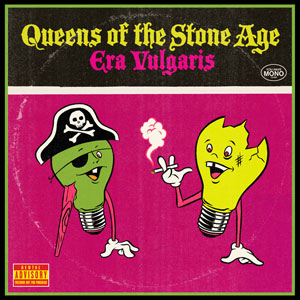
'Era Vulgaris' in 2007 pushed that world into harsher, more synthetic territory. Homme described the record's sound around that period in terms that suggested something ugly and modern, and the album lived up to that idea. The guitars were clipped and acidic, the grooves were stiff and twitchy, and the songs often felt like they were grinning through bad wiring. 'Sick, Sick, Sick' had a mechanical grind, 'Make It wit Chu' reused a smoother song from Homme's 'Desert Sessions' project, and '3's & 7's' showed the band's ability to make odd turns feel like hooks. The record divided some listeners, but it was an important refusal to become predictable. QOTSA could have made another desert road album. Instead, they made something more urban, dirty, and metallic in texture.
Homme's work outside QOTSA also fed back into the band. His long-running 'Desert Sessions' project, started in the late 1990s, gathered musicians in the California desert to write and record quickly, often with a playful, experimental spirit. Eagles of Death Metal, his project with Jesse Hughes, showed his love of stripped-down, danceable rock and absurd humor. In 2009 he formed Them Crooked Vultures with Dave Grohl and Led Zeppelin bassist John Paul Jones, a supergroup that emphasized complex riffs, muscular grooves, and Homme's ability to sound relaxed even in technically demanding music. These projects reinforced the sense that QOTSA was not just a band but the main artery of a wider creative ecosystem.
After several turbulent years, Queens of the Stone Age returned in 2013 with '...Like Clockwork', one of the most important albums in their catalog. The record followed a difficult period for Homme that included complications after knee surgery, a long recovery, depression, and major changes inside the band. Drummer Joey Castillo left during the making of the album, and Dave Grohl returned to play drums on several tracks. The guest list was unusually rich: Mark Lanegan, Trent Reznor, Alex Turner, Jake Shears, Brody Dalle, and Elton John all contributed in different ways. Elton John's appearance became one of the album's most memorable real-life stories: he ended up playing piano and singing on 'Fairweather Friends', a meeting that sounded bizarre on paper but made sense in the band's glam-damaged universe.
'...Like Clockwork' mattered because it let vulnerability enter QOTSA without weakening the music. The band had always had darkness, but this album made the wounds more visible. 'I Sat by the Ocean' dressed heartbreak in bright, bitter guitar pop. 'My God Is the Sun' reconnected with desert heat and ritual force. 'Kalopsia' moved between dreamlike softness and violent interruption. The closing title track was unusually exposed, with piano and vocal carrying a sadness that earlier versions of the band might have hidden behind volume. The album debuted at number one on the Billboard 200, a major commercial achievement for a band that had never sounded fully designed for the mainstream.
The lineup that settled around this period - Homme, Troy Van Leeuwen, Michael Shuman, Dean Fertita, and Jon Theodore - became one of the band's most durable. Theodore, formerly of The Mars Volta, brought a different kind of drumming from Grohl or Castillo: fluid, explosive, and technically elastic, but able to sit inside QOTSA's tight grooves. Shuman's bass and backing vocals added both weight and melodic support. Fertita's keyboards and guitar textures helped the band move between garage rock, art rock, and gothic atmosphere. Van Leeuwen remained Homme's most important guitar foil, often adding elegance, tension, and color around Homme's central riffs.
In 2017, 'Villains' surprised many listeners by pairing QOTSA with producer Mark Ronson, best known for pop, funk, and dance-oriented production. On paper, it seemed like a strange match. In practice, it emphasized something that had always been inside the band: Queens of the Stone Age often groove like a dance band disguised as a hard rock band. 'The Way You Used to Do' made that explicit, with a handclap swing and a sharp, almost cartoonish strut. 'Feet Don't Fail Me' built from a slow, cinematic opening into a sleek rock stomp. The album was cleaner and brighter than '...Like Clockwork', but it was not simple. Ronson did not turn QOTSA into pop; he pulled their rhythmic confidence forward.
The 'Villains' era also came with public controversy. In 2017, during a performance, Homme kicked photographer Chelsea Lauren's camera, striking and injuring her. He publicly apologized afterward, and the incident damaged his public image because it clashed with the charm and humor that often surrounded him in interviews. It is part of the band's story because Queens of the Stone Age have never existed as a clean corporate rock product. Their history includes brilliance, volatility, bad judgment, recovery, and attempts to keep moving. Homme's public persona has often appeared as a mix of swagger, wit, stubbornness, and deep commitment to risk. At his best, that tension fuels the music. At his worst, it has caused real harm.
The band returned again in 2023 with 'In Times New Roman...', released after another difficult stretch in Homme's life. The album arrived six years after 'Villains' and carried a rougher, more bitter, more serrated sound. It has often been heard as a loose emotional companion to '...Like Clockwork' and 'Villains': three records concerned with collapse, survival, desire, shame, and endurance. 'Emotion Sickness' used a curled, sarcastic groove to turn personal wreckage into something almost playful. 'Paper Machete' was one of the band's sharpest rock songs in years, direct and cutting. 'Carnavoyeur' floated with a strange fatalistic beauty. The production was less polished than 'Villains', more scarred and physical, as if the band wanted the seams to show.
One of the most unusual later chapters came with 'Alive in the Catacombs', recorded in July 2024 in the Catacombs of Paris and released in 2025 as a concert film and live EP. Rather than simply performing a normal set in an exotic location, the band reimagined material from across its catalog for the setting. That choice says a lot about QOTSA's seriousness as arrangers. Their songs are often remembered for riffs, but many of them are flexible compositions, able to survive when stripped down, slowed, or reshaped. In a space associated with death, echo, and underground history, the band leaned into atmosphere rather than volume, showing another side of music that is too often reduced to desert rock heaviness.
Queens of the Stone Age's sound is distinctive because it depends on contradiction. The guitars are heavy but often dry rather than muddy. The rhythms are repetitive but rarely lazy. The vocals can be seductive, sarcastic, or wounded, but almost never conventionally heroic. Homme's writing often avoids direct confession while still feeling personal; he hides feeling inside wordplay, menace, and crooked humor. The band also understands space. Many hard rock groups fill every gap, but QOTSA often leave enough room for a riff to breathe, for a drum pattern to swing, or for a backing vocal to turn the song sideways.
Their creative process has often reflected Homme's belief in pressure, accidents, and trusted collaborators. The 'Desert Sessions' method - musicians gathering, trying ideas quickly, refusing to overthink everything - hovers over QOTSA even when the albums are carefully constructed. Homme is known for being exacting about tone and arrangement, but he also values the spark that comes from putting strong personalities in a room. This is why the guest appearances rarely feel ornamental. Lanegan did not simply add vocals; he changed the emotional temperature. Grohl did not simply play drums; he changed the engine. Elton John did not simply provide celebrity; he added theatrical piano color to a song that already leaned toward damaged grandeur.
The band's influence is broad but sometimes hard to measure because few artists can imitate them without sounding obvious. They helped move heavy rock away from both grunge's aftermath and nu metal's commercial dominance, offering a model that was intelligent, physical, stylish, and strange. They made it possible for a modern rock band to be riff-based without being retro, dark without being humorless, and ambitious without becoming pompous. Their fingerprints can be heard in later alternative, garage, stoner, and hard rock bands that chase groove, dryness, and menace rather than simple distortion.
Queens of the Stone Age also matter because they made the desert into more than a backdrop. In their music, the desert is not just sand and amplifiers. It is distance, heat, repetition, isolation, bad reception, long drives, cheap motels, strange humor, and the feeling of being both free and trapped. Homme took the environment that formed him and turned it into a musical architecture. Even when the band moved into slicker, darker, or more urban sounds, that desert logic remained: reduce the riff to its essential shape, repeat it until it becomes hypnotic, then let something human and unstable leak through.
Today, Queens of the Stone Age are viewed as one of the most important rock bands to emerge from the post-grunge era, but their story is not a simple rise from underground to mainstream. It is a story of reinvention around one stubborn center. Members changed, scenes changed, rock's commercial power rose and fell, but QOTSA kept finding new ways to make heavy music feel dangerous, elegant, and alive. Their best records - especially 'Rated R', 'Songs for the Deaf', and '...Like Clockwork' - do not merely document stages in a career. They show a band repeatedly rebuilding its own rules. That is why Queens of the Stone Age remain compelling: not because they preserved a style, but because they turned instability into a sound.